How long shadow stays in the body differs from how long its effect lasts. The effect usually wears off within hours, while its breakdown products may remain in the urine for roughly one to three days after occasional use, possibly extending to a week or more with heavy daily use, and its traces remain in hair for months. But the most important question with shadow specifically isn’t “how long does it stay?” but “can the test see it at all?”. The usual hashish strips mostly don’t recognize it, and detecting it needs specialist laboratory tests. This article explains the approximate figures for each type of test, what changes them, and how to read the result.
Why is detecting shadow different from detecting hashish?
The traditional hashish test looks for a specific product formed in the body from the active substance in the cannabis plant. Shadow, however, doesn’t contain this substance at all, but synthetic compounds that differ in chemical structure, which break down in the body into other products the hashish strip doesn’t recognize. That is why a person may be a regular user and their hashish strip result comes back negative. And the matter is further complicated by the fact that the compounds sprayed under the name shadow change from time to time, so laboratories need to keep updating the lists of substances they look for.
What happens to shadow inside the body?
After smoking, the substance passes quickly from the lungs into the blood and then to the brain, so the effect begins within minutes. Then the liver breaks it down into multiple products, some still active, and the body gets rid of most of them through the urine. And because many of these compounds dissolve in fat, part of them may be stored in body tissues with repeated use, then seep slowly into the blood, which is one reason the detection period is longer in a daily user than in someone who tried it once.
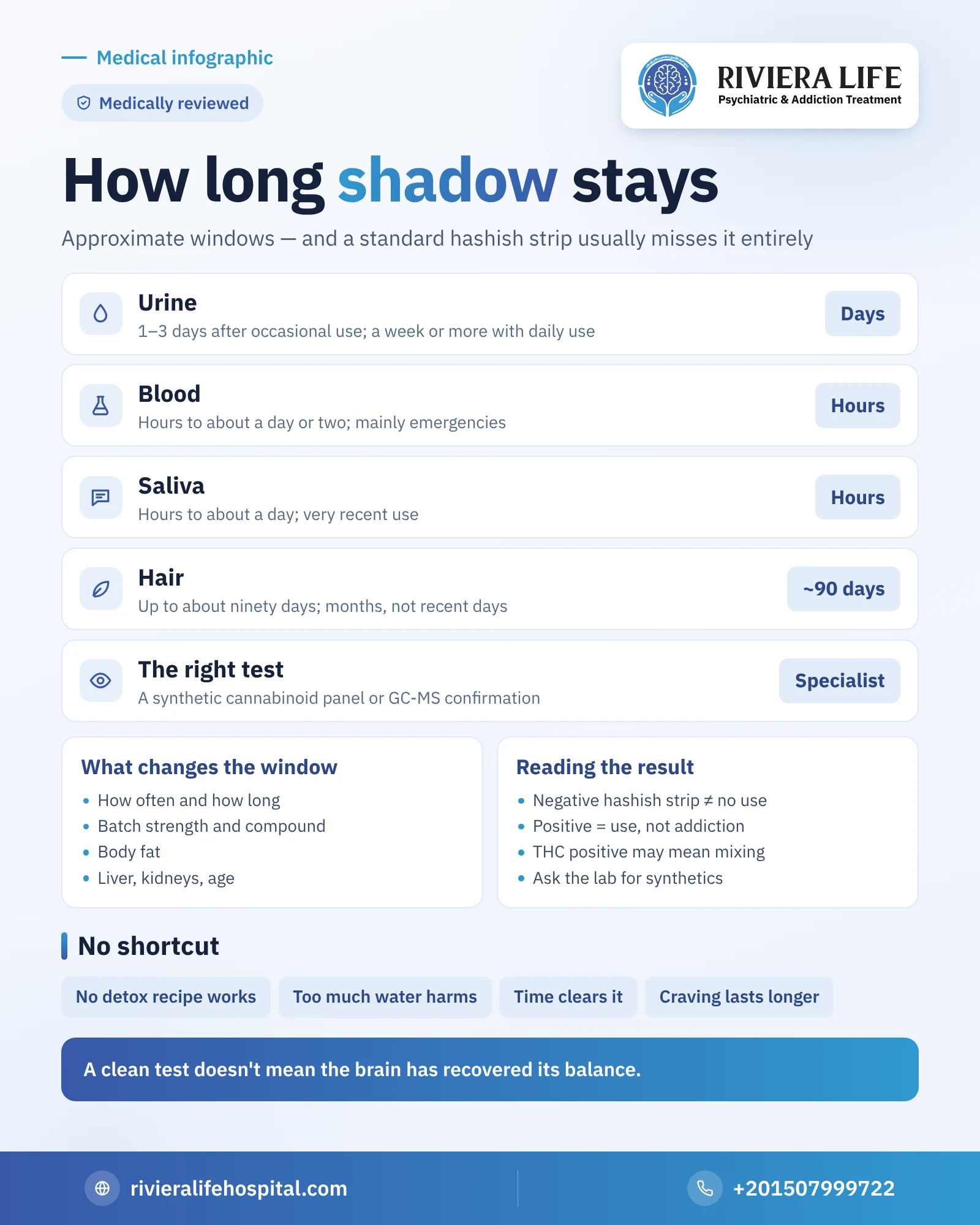
How long shadow shows in each type of test
The following figures are estimates, and vary with the compound itself, the way it is used and the sensitivity of the test:
| Sample type | Approximate detection period | Notes |
|---|---|---|
| Urine | One to three days after occasional use, possibly a week or more with daily use | The most used, and needs a test specific to synthetic cannabis |
| Blood | Hours to about a day or two | Usually requested in emergencies to confirm recent poisoning |
| Saliva | Hours to about a day | Reflects very recent use, and its sensitivity varies |
| Hair | Up to about ninety days | Reveals the pattern of use over months, not the last few days |
Urine test
This is the most requested in periodic screening and treatment follow-up, because the sample is easy and its detection window is longer than blood and saliva. But we are talking here about a test designed for synthetic cannabis products, not the ordinary hashish strip.
Blood test
Its window is short, but it is useful in hospital when a patient arrives with seizures or confusion and no one knows what they took. It isn’t usually used in periodic screening because it requires drawing a sample and covers a very short period.
Hair test
It isn’t suitable for knowing what happened yesterday, because hair needs days to grow above the surface of the skin, but it gives a picture of continued use over the past months. Its analysis is relatively expensive and not available in every laboratory, and it is usually turned to when the long-term picture is what is needed.
Why does the duration differ from person to person?
There is no single figure that suits everyone, and several factors control the duration:
- How often and for how long the person has used: a daily user for months is different from someone who tried it once.
- The strength of the batch and the compound itself, which change without announcement.
- Body fat percentage, because the compounds are stored in it.
- Liver and kidney efficiency, age and the amount of fluids.
- The sensitivity of the device used and the list of compounds the laboratory looks for.
Rapid tests and specialist laboratory tests
A rapid test gives a result within minutes, but it relies on a reaction with a specific group of substances, so if it isn’t designed for synthetic cannabis it won’t see shadow. There are rapid strips for some synthetic cannabinoids, but their coverage is limited. A confirmatory laboratory test, however, using chromatographic separation devices with mass spectrometry, can identify the compound precisely, and it is the reference when the result matters medically or legally.
How do you read the test result?
A negative result on a hashish strip doesn’t mean the person isn’t using shadow, nor even that the specialist test will be negative. A positive result on a synthetic cannabis test means there was use during the period the sample type covers, but it doesn’t determine the amount or say whether the person is addicted. And if a hashish strip comes back positive in a shadow user, this may mean they mixed it with bango or hashish, or that the product itself was mixed with them. For details on detecting hashish, see how long hashish stays in the body.
Shadow leaving the test doesn’t mean its effect is over
The substance may disappear from the urine after days, while insomnia, irritability, mood disturbance and intense craving continue for weeks. These aren’t remnants of the substance in the blood, but the adaptation of the brain, which needs time to return to balance. That is why a patient may say “the test is clean and I’m still tired”, which is entirely expected and doesn’t mean they have gone back to using, nor that the fatigue will last. Our article on shadow withdrawal symptoms explains what happens in this period day by day.
What happens in the emergency department when shadow poisoning is suspected?
Many families think the doctor will need the test result first in order to start treatment, but the reality is the opposite. The results of specialist tests for synthetic cannabis may take time, while the emergency team deals immediately with what it sees: monitoring the heart, blood pressure, temperature and breathing, stopping seizures, calming agitation, replacing fluids, and checking kidney and muscle function. So the most important thing the family provides on arrival is honest information: what the person took, when, and whether they mixed it with something else. This information saves precious time and isn’t used against them.
Is there a way to speed up shadow leaving the body?
Many recipes circulate promising to cleanse the body quickly, from drinking large amounts of water to drinks and herbs sold for this purpose. There is no medical evidence that any of them speeds up the breakdown of shadow meaningfully, and some may be harmful; drinking too much water, for example, may upset the body’s salts. The body gets rid of the substance at the speed the liver and kidneys work, and what the person really needs in these days is regular sleep, balanced food and follow-up of the symptoms of stopping, not chasing the result.
Advice for the family before requesting a test
A test is a tool, not a final verdict or a means of punishment. Before you request it, ask yourself: what will I do with the result? If the answer is only “confrontation”, it is better to start with conversation and a medical assessment, because a surprise test increases stubbornness and teaches concealment. And if you decide to do it, choose a reliable laboratory, and tell it explicitly that you want a synthetic cannabis test, not just hashish. The behavioral signs you see at home may be clearer than any strip, and you will find them detailed in shadow addiction symptoms.
How are tests used during treatment?
In treatment programs, periodic tests are used by agreement with the patient, not by surprise, and their aim is to support their commitment, follow their progress and detect relapse early so treatment can be adjusted. At Riviera Life this follow-up is carried out within a complete plan explained in our article on shadow addiction treatment, in complete confidentiality, with results going only to the patient and those they authorize.
More from our shadow guide
- Shadow: the complete guide
- The harms of shadow
- The causes of shadow addiction
- Shadow withdrawal symptoms
Questions many people ask
Usually not, because the hashish strip looks for a product of the cannabis plant, and shadow is made of different synthetic compounds. Detecting it needs a test designed for synthetic cannabis.
Roughly one to three days after occasional use, and the period may extend to a week or more with heavy daily use. The figure varies with the compound and the sensitivity of the test.
Yes, some specialist laboratories can detect synthetic cannabis products in hair for up to about ninety days, but it doesn't detect use in the last few days.
The test used may not be designed for the compound the person took, or the detection period may have passed. Behavioral signs and medical assessment matter as much as the test.
There is no evidence for this, and excessive water may harm the body's salts. The body clears the substance at its natural speed through the liver and kidneys.