No one becomes addicted to shadow because they decided to, and most causes of shadow addiction begin with a familiar story: a cigarette in a gathering of friends, curiosity about a name that keeps coming up, or an attempt to escape a distress the young person doesn’t know how to name. Then the characteristics of the substance itself, its short effect, and the person’s psychological and family circumstances intervene to turn the experiment into a habit and then into dependence. This article explains why some people fall into shadow addiction faster than others, what factors raise the risk, and what protects against it.
Why does shadow attract some young people in particular?
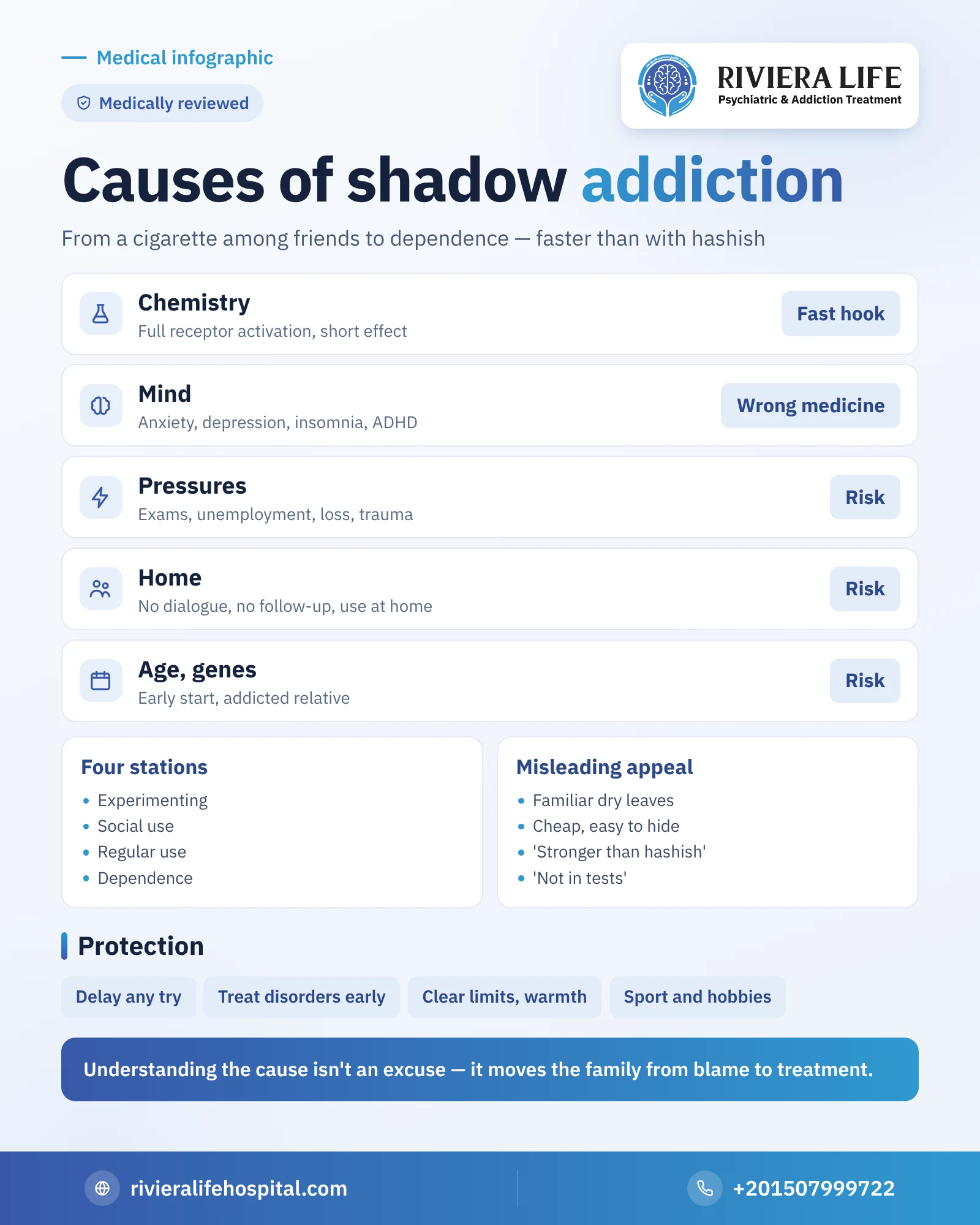
Shadow has a special appeal that isn’t only about its effect, but about the way it is presented on the street:
- A familiar look: dry leaves rolled in a cigarette, so the user doesn’t feel they are approaching a “drug” in the sense that frightens them.
- An affordable price and a small amount easy to hide in a pocket or a cigarette pack.
- A reputation of being “stronger than hashish”, a reputation that tempts those seeking a different experience.
- A widespread belief that it doesn’t show up in tests, a belief that pushes some towards it instead of hashish during periods of routine testing at work or before licenses.
- The idea that it is “herbs” and therefore less harmful.
Each of these points is deceptive. The extra strength itself is the source of danger, specialized tests detect it as the article on how long shadow stays in the body explains, and the herbs are just paper carrying a synthetic substance.
What does shadow do in the brain to make repetition easy?
The substances sprayed on shadow activate the brain’s cannabinoid receptors fully, much more strongly than hashish does. This intense activation quickly changes the person’s sense of pleasure and comfort, so it becomes linked in their memory that the cigarette “switches them off” from any pressure. And because the effect is relatively short and wears off within hours, distress returns quickly, so the search for another cigarette returns. With repetition the brain reduces the sensitivity of its receptors to protect itself, so the effect weakens and the person needs a larger amount, then feels tension and insomnia when shadow is absent. At this point use is no longer a search for euphoria, but an attempt to stop a bad feeling.
From experimenting to addiction: how does it develop?
The path isn’t the same for everyone, but it often goes through four stations:
- Experimenting: a cigarette or two out of curiosity or to go along with friends.
- Social use: use linked to particular gatherings and occasions, with a feeling that it is “under control”.
- Regular use: it turns into a means of sleeping or enduring a hard day, and solitary use begins.
- Dependence: a larger amount, physical and psychological distress on stopping, and a clear decline in study or work.
The distance between the first station and the last may be shorter with shadow than with hashish, because of its strength and short effect.
Psychological disorders: when shadow becomes the wrong medicine
A large proportion of those addicted to shadow were suffering before it from anxiety, depression, chronic insomnia, attention deficit or the effects of psychological trauma, without diagnosis or treatment. The person finds temporary calm in the cigarette, so they use it as a patient uses medicine. The problem is that shadow brings these symptoms back more severely than they were when its effect wears off, and may add panic attacks, suspicion or psychotic symptoms to them. That is why the combination of a psychological disorder with addiction is called “dual diagnosis”, and its treatment requires dealing with both together, not with the addiction alone.
Pressures and difficult experiences
Academic pressure in the secondary and university years, unemployment or working long hours, marital disputes, and losing someone close are all situations that make a person look for a quick way out. Early trauma, such as violence within the family or neglect in childhood, increases susceptibility to addiction in general. Not everyone who goes through pressure uses, but someone who has no healthy ways to deal with pressure is more likely to find in shadow an easy solution.
Friends and the surrounding environment
Rarely does anyone buy shadow themselves the first time; it is usually offered to them at a party or at a café. The risk increases when use is a normal part of the circle of friends, when the substance is available near home or the place of study, or when shadow is linked in the young person’s mind with an image of “daring” or belonging to the group. Long idle time and the absence of a sporting activity or hobby also play a role that shouldn’t be underestimated.
Factors inside the home
The family can be the strongest protection, and it can, unintentionally, be one of the risk factors. Susceptibility rises when dialogue is absent and replaced by punishment or neglect, when calm follow-up of the son’s friends and times is absent, when there is a history of addiction in a family member, or when smoking and use are implicitly accepted at home. On the other hand, regular dialogue, clear limits and emotional warmth protect even in difficult circumstances.
Age and genetic predisposition
The younger the age at which use begins, the higher the likelihood of it developing into addiction, because the brain in adolescence is still maturing, especially the areas responsible for impulse control and decision-making. Research also indicates that part of the susceptibility to addiction is inherited, so someone with a first-degree relative who suffered from addiction is more vulnerable. Genetics here means predisposition, not inevitability; it raises the risk but doesn’t impose fate.
Moving between substances
Many of those who reach shadow went through hashish or bango before it, then switched to it in search of a stronger effect or because it is cheaper or easier to obtain. Some combine it with tramadol, pregabalin or sedatives, and this mixing doesn’t only make addiction more complicated, but raises the risk of poisoning, as the article on the harms of shadow explains. Movement in the opposite direction also happens, as someone addicted to shadow may turn to other substances when it becomes hard to obtain.
Risk factors and protective factors
| Factors that raise the risk | Factors that protect against it |
|---|---|
| Starting use at an early age | Delaying any experiment and honest early awareness |
| Untreated anxiety, depression or attention deficit | Diagnosing and treating the psychological disorder early |
| Friends who use and easy availability | A circle of friends and activities away from use |
| Family disputes and lack of follow-up | Regular dialogue, clear limits and emotional warmth |
| A history of addiction in the family | The family’s awareness of susceptibility and seeking advice early |
| Long idleness and pressures with no outlet | Sport, hobbies and skills for dealing with stress |
Is shadow addiction a personal choice?
The first experience is a decision, that is true. But what happens after it isn’t subject to will alone. Repeated use changes the way the brain’s reward and impulse-control circuits work, so stopping becomes much harder than someone looking from outside imagines. That is why medical bodies deal with addiction as a treatable disorder, not a moral flaw. This understanding isn’t a justification for use, but it is what makes the family turn to treatment instead of blame, which increases hiding and stubbornness.
How do you protect yourself and your children?
Talk to your children about shadow by name, with accurate information and not exaggerated scare tactics, as a teenager stops listening if they sense exaggeration. Know their friends and where they go out without the follow-up turning into constant interrogation. Watch for anxiety, sadness and insomnia in them and seek psychological help for them early, as treating these symptoms is among the strongest means of prevention. And if you notice signs that raise suspicion, review the symptoms of shadow addiction before confronting.
How does Riviera Life help you?
Understanding the cause is an essential part of treatment, not just a prelude to it. That is why the psychiatry consultants at Riviera Life begin by assessing what lies behind the use, whether anxiety, depression or family pressures, then the plan is built on this understanding in complete confidentiality. The first consultation is free.
More from the shadow guide
- Shadow: the complete guide
- Shadow addiction treatment
- Symptoms of shadow addiction
- Shadow withdrawal symptoms
Questions many people ask
Usually in search of a stronger effect, or because it is cheaper and easier to obtain, or because of a false belief that it isn't detected in tests. This move raises the risk of both poisoning and addiction.
They are among the strongest risk factors, because the person uses shadow to calm themselves and comes to depend on it. Treatment usually succeeds only by treating the psychological disorder along with the addiction.
Addiction itself isn't inherited, but part of the susceptibility to it may be genetic. Having an addicted relative raises the risk without making it inevitable.
Because its effect is relatively short, so tension returns after hours and pushes towards another cigarette. This closely spaced repetition speeds up tolerance and dependence.
Honest dialogue based on accurate information, knowing their friends without constant interrogation, treating anxiety and sadness early, and setting clear limits with warmth.