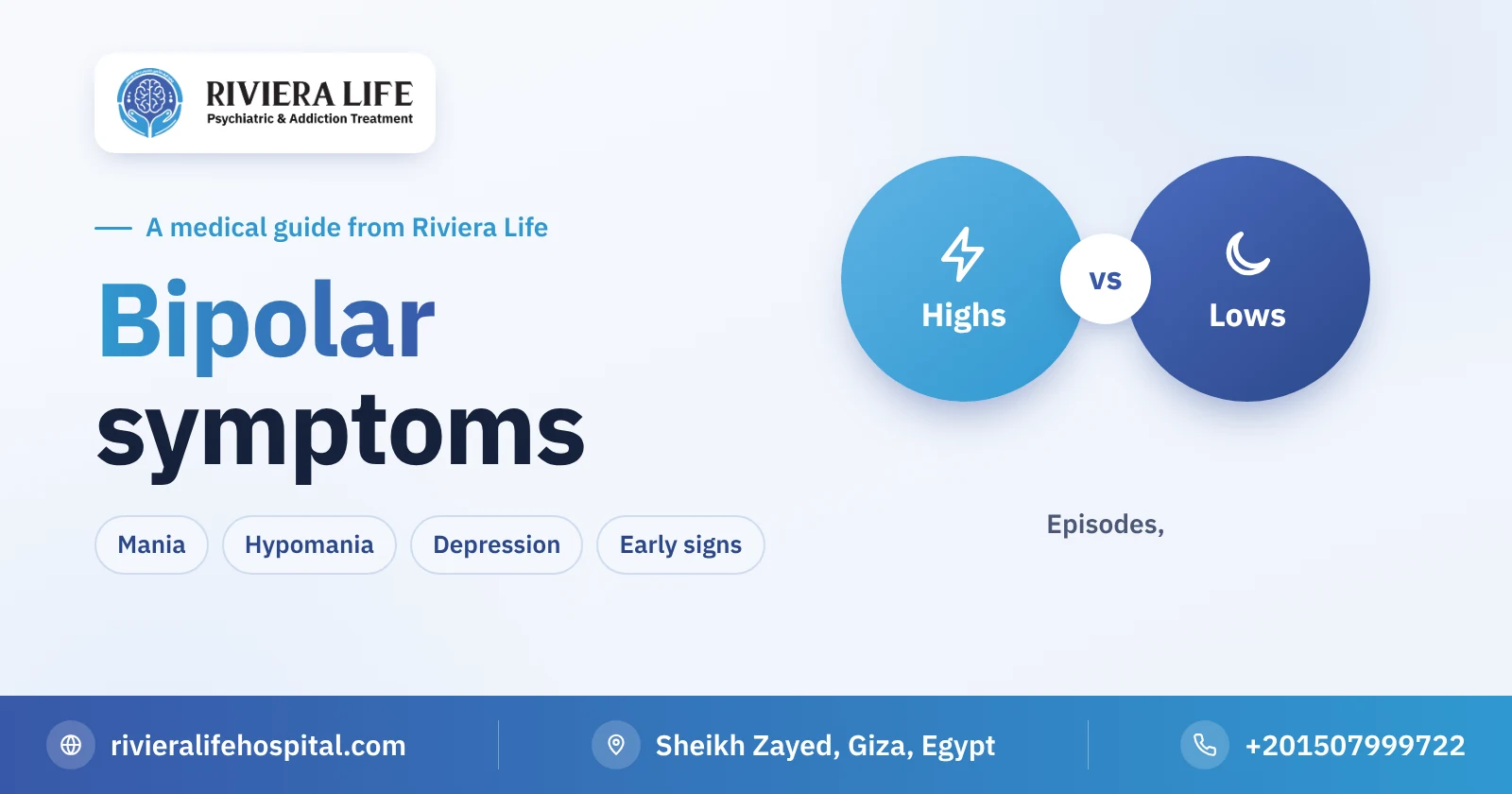
The symptoms of bipolar disorder come in the form of episodes, not as a mood that swings all day. In a high episode sleep decreases, energy increases, speech speeds up and decisions become reckless, and in a low episode sadness, exhaustion and loss of pleasure dominate. Between the two episodes the person may seem completely normal, which is what confuses families and delays diagnosis. This article helps you recognize the signs and when they deserve an assessment, but it doesn’t replace the doctor, as the diagnosis is only made by a psychiatrist or psychologist after a full interview.
What does a manic episode look like?
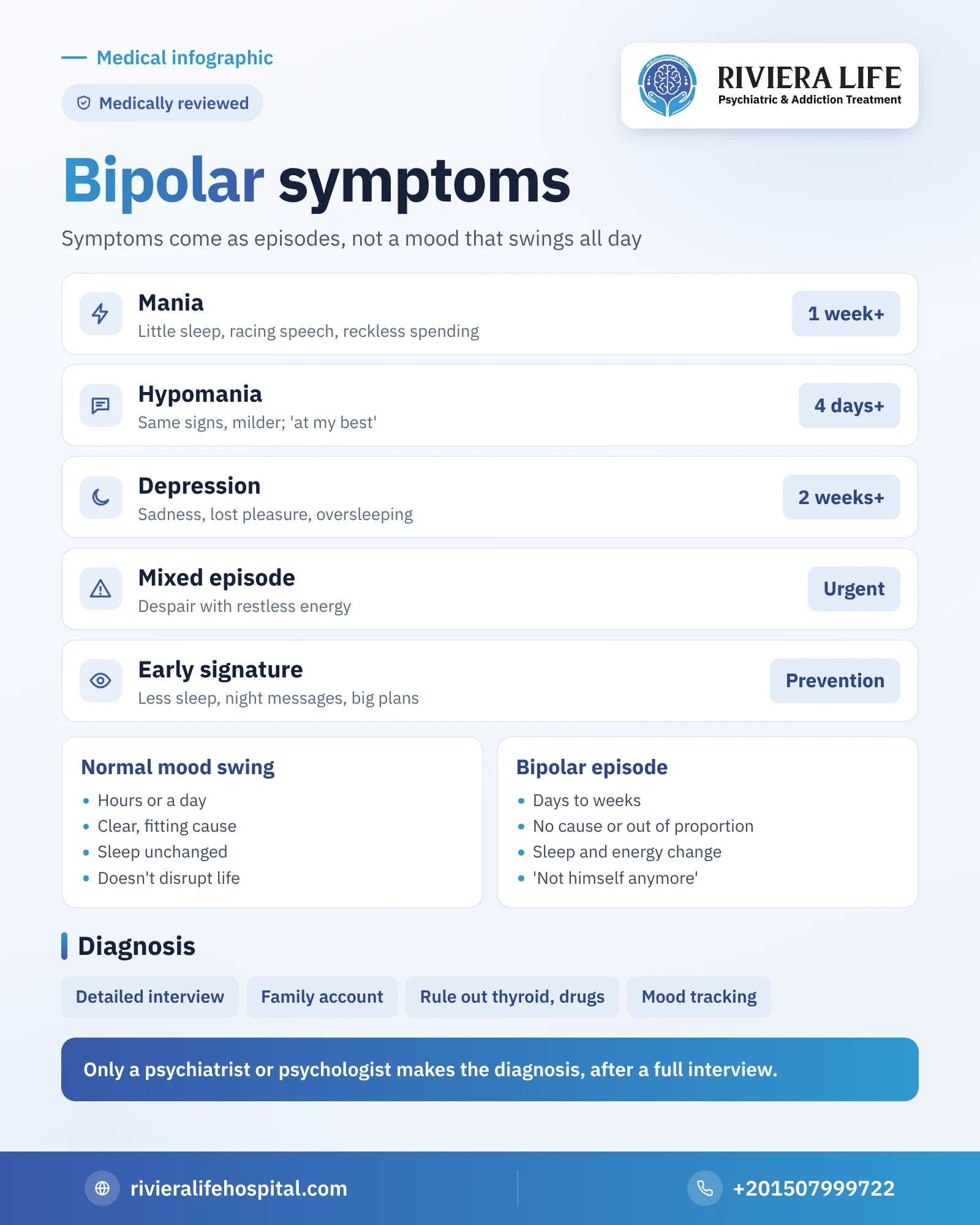
Imagine a young man who used to sleep seven hours, now sleeping three and waking full of enthusiasm. He calls friends he hasn’t spoken to for years, starts three projects in a week, buys things he doesn’t need on installments, and gets very angry if anyone suggests he calm down. This is a typical picture of a manic episode, and its symptoms fall into three areas:
Mood and energy
- Exaggerated elation or sharp irritability out of proportion to the situation, and sometimes both together.
- Excess activity and little need for sleep without feeling tired.
- Inflated self-confidence that may reach a feeling of grandeur or exceptional distinction.
Thinking and speech
- Fast and abundant speech that others find hard to interrupt or keep up with.
- Racing thoughts and jumping from one subject to another.
- Severe distraction that makes finishing any task difficult.
Behavior
- Heavy spending or uncalculated investments and financial decisions.
- Reckless driving, sexual behavior unusual for the person, or dangerous adventures.
- Many projects and plans without completing any of them.
For the doctor to consider it a manic episode, this state lasts at least a week for most hours of the day, or becomes severe enough to require hospital admission. In some severe episodes psychotic symptoms appear, such as the patient believing they have been charged with a mission or hearing voices others don’t hear.
Hypomania: a calmer picture that is hard to notice
Hypomania carries the same symptoms to a lesser degree, and usually lasts four days or more. It isn’t accompanied by psychosis, and doesn’t greatly disrupt life; the person may even seem more productive and cheerful than usual during it. That is why the patient rarely complains of it, and often describes it afterwards as “I was at my best”. The family here is the most important eye: did you notice he became a different person for several days, talking more, sleeping less and angering faster? This observation may be the key that distinguishes ordinary depression from bipolar II disorder.
Symptoms of a depressive episode in bipolar disorder
A depressive episode lasts at least two weeks, and its symptoms resemble usual depression:
- Sadness, emptiness or distress most of the day.
- Loss of interest in things that used to be enjoyable.
- Excess sleep or insomnia, and a change in appetite and weight.
- Slowness in movement and thinking, or on the contrary tension and restlessness.
- A feeling of guilt and worthlessness, and difficulty concentrating and making decisions.
- Repeated thoughts of death or suicide.
Doctors note that depression in bipolar disorder tends to start at a younger age, towards oversleeping and severe lethargy, and to recur. For a detailed comparison with unipolar depression you can refer to the article on depression symptoms.
The mixed episode: when the two poles meet
Episodes aren’t always pure. The patient may go through a period in which they feel despair and sadness, and at the same time restless energy, racing thoughts and severe insomnia. Doctors call this an episode with mixed features, and it is among the hardest states for the patient, because the energy of mania meets the pain of depression, so the risk of impulsivity and self-harm rises. That is why a mixed episode deserves an urgent assessment, not waiting for the next appointment.
Early signs before the episode
Each patient has a special “signature” with which their episodes start, and knowing it is among the most important tools of prevention. Among the common early signs before a high: less sleep night after night without tiredness, a lot of phone talk and night messages, sudden talk of huge projects, and quick agitation. And before a low: withdrawal from gatherings, postponing simple tasks, sleeping longer hours, and losing the wish to reply to people. Recording these signals in a mood diary helps the patient and doctor intervene before the episode is complete.
What happens between episodes?
Many patients return between episodes to a level close to their normal selves, so they work, study and live their lives. But some keep some symptoms, such as poor concentration, a slight tendency to depression or disturbed sleep. Calm between episodes doesn’t mean the disorder is over; rather it is the best time to build a plan that prevents the next episode.
How do symptoms differ in teenagers and women?
In teenagers a high episode may appear as irritability, outbursts of anger and long late nights more than elation, so it is confused with adolescent stubbornness or attention-deficit/hyperactivity disorder. The important difference is that the episode represents a clear change from the teenager’s usual nature, and lasts for days.
For women, the weeks after childbirth represent a sensitive period, in which a depressive or high episode or psychotic symptoms may appear in those with a predisposition. Any sharp change in the mother’s behavior, sleep or thoughts after childbirth deserves a quick assessment.
Bipolar disorder in children: how does the picture differ?
In a child, episodes usually don’t come in the form adults know. Instead of clear elation you may see severe anger outbursts that repeat and last hours, energy that doesn’t run out with little sleep the child doesn’t complain of, and fast speech and big ideas about their abilities beyond normal play. The state also changes faster than we see in adults, so it is hard to judge from a single situation.
That is why diagnosis at this age is cautious and deliberate, because many causes produce similar symptoms: attention-deficit/hyperactivity disorder, anxiety, trauma, oppositional disorder and lack of sleep itself. The signs that deserve an assessment with a child psychiatrist:
- A clear change from the child’s nature lasting days, not just hours.
- Little sleep with high activity in the morning without any tiredness.
- Anger out of proportion to its cause that repeats severely.
- Long periods of sadness or withdrawal between periods of excess activity.
- A first-degree relative with the disorder.
The doctor uses a sleep and mood log written by the family and school observations. The child isn’t given any psychiatric medicine without supervision by the specialist doctor, and the parents take part in every decision. For general signs by age, see the article on mental illness in children.
Bipolar disorder in women: hormones, pregnancy and childbirth
The disorder affects both sexes in roughly similar proportions, but its course in women is linked to hormonal stations. Depressive episodes tend to appear more in women, the state may change around the menstrual period, and the weeks after childbirth are among the periods in which a new episode most often appears. The symptoms may also be hard to distinguish from the swings of pregnancy and the menstrual cycle, so diagnosis is delayed in some women, and depression is treated alone without asking about previous high periods.
A woman thinking of pregnancy needs an advance plan with the doctor, because some mood-stabilizing medicines require adjustment before pregnancy, and stopping them by individual decision raises the risk of relapse. After childbirth, any severe insomnia, strange thoughts or unusual elation calls for a quick assessment without delay, because postpartum psychosis is an emergency.
You will find the discussion of pregnancy within the marital relationship in the article on bipolar disorder and marriage, and the picture of depression in women in depression symptoms in women.
A normal mood swing or a disorder?
| A normal mood swing | An episode of bipolar disorder |
|---|---|
| Lasts hours or a day | Lasts days to weeks |
| Has a clear cause and fits it | May come without a cause or far exceed the cause |
| Doesn’t greatly change sleep and energy | A clear change in sleep, energy and activity |
| Others don’t notice it as a change in personality | Those close say: he’s not himself anymore |
| Doesn’t disrupt work and relationships | Decisions and losses whose effects extend beyond the episode |
Questions that help you observe
These questions aren’t a diagnostic test, but help you organize what you notice before visiting the doctor:
- Have you had a period lasting several days in which you slept much less without feeling tired?
- Have those close to you said you were talking more than usual or that you weren’t yourself?
- During such a period, did you make financial or personal decisions you later regretted?
- Have you been treated for depression before, then felt unfamiliar energy and impulsivity after starting the medicine?
- Is there anyone in your family diagnosed with bipolar disorder or treated for repeated mood episodes?
If your answer is yes to more than one question, mention it clearly to the psychiatrist.
How does the doctor confirm the diagnosis?
The doctor relies on the detailed interview, the history of previous episodes and the family’s accounts, and may ask for mood tracking for several weeks. They rule out causes that may mimic the symptoms, such as an overactive thyroid, stimulant use or some medicines. They also distinguish bipolar disorder from conditions that resemble it in some respects, such as borderline personality disorder and attention-deficit/hyperactivity disorder. The factors that raise the likelihood of the illness in the first place are in the article on the causes of bipolar disorder. And for a comparison with borderline personality specifically see the difference between bipolar disorder and borderline personality.
Diagnosing bipolar disorder: how is the picture put together?
There is no blood test or scan that proves the diagnosis. The doctor builds it from the patient’s story over time, and the core of the assessment is one question: has he gone through an unusual high period that lasted days? Many people come the first time only because of depression, and don’t mention those periods because they count them as “good days”, and here comes the importance of a family member attending the session with them.
The diagnostic process rests on the following steps:
- A long interview about sleep, energy, spending and decisions in the high periods.
- The account of someone close, as the patient may not notice the change in themselves.
- Tests that rule out organic causes such as the thyroid and the effect of some medicines and substances.
- Tracking mood and sleep for weeks to document the pattern.
Screening questionnaires widespread on the internet may alert to a possibility, but they don’t diagnose. In many cases diagnosis is delayed for years because depression is treated alone first, then the illness reveals itself later. After confirmation, the plan moves to what the article on bipolar disorder treatment explains.
When do symptoms become an emergency?
Ask for urgent help immediately if you see
Call an ambulance on 123 or go to the nearest emergency department, and don't leave the person alone.
- Talk of suicide or that life isn’t worth continuing
- An attempt at self-harm or looking for a means to do so
- Consecutive days with almost no sleep with escalating agitation
- Reckless behavior that puts their life or others’ lives in danger
- Delusions or voices pushing them to do something dangerous
- Threatening or attacking others
In these moments, don’t get into an argument with the person about their thoughts; speak in a calm voice and short sentences, and move away from them anything they might harm themselves with.
How does Riviera Life help you?
If you recognize some of these signs in yourself or someone you love, the next step is a calm assessment, not a prior judgment. The consultant psychiatrists at Riviera Life receive the case in complete confidentiality, and the first consultation is free, then the available options explained in the article on bipolar disorder treatment are discussed.
More from the bipolar disorder guide
- Bipolar disorder: the complete guide and types
- Bipolar disorder treatment and the recovery plan
- The causes of bipolar disorder and risk factors
- Depression: the complete guide
- Types of bipolar disorder: type I, type II and cyclothymia
- Cyclothymic disorder: symptoms, the difference from bipolar disorder and treatment
- The difference between schizophrenia and bipolar disorder: a comparison table and how the doctor tells them apart
- Bipolar test: instant result
Questions many people ask
It differs from person to person, but a depressive episode is the most common start, which is why diagnosis is sometimes delayed. Among the clearest signs later are periods in which sleep drops a lot without tiredness.
A manic episode lasts at least a week, and may go on for weeks if not treated. Hypomania usually lasts four days or more.
Often not, as the patient feels they are at their best and sees others' concern as exaggeration. That is why the family's observations are very important at assessment.
It may be part of a manic or mixed episode, especially in teenagers. But irritability alone has many causes, and what counts is its appearance within an episode in which energy and sleep change.
Yes, the period after childbirth is sensitive for a woman with a predisposition, and a depressive or high episode may appear in it. Any sharp change in the mother's sleep or behavior calls for a quick assessment.