How long strox stays in the body is one of the questions we hear most, as families often come to the hospital holding a negative test strip, with a single question on their faces: “If the test is clean, why is my son behaving like this?”. The answer is that the common drug test, specifically the bango strip, doesn’t detect strox in most cases.
With specialized tests, how long strox stays in the body differs by sample: its breakdown products are usually detected in urine for about one to three days after intermittent use, which may extend to a week or more with heavy daily smoking depending on the compound; in blood for a few hours up to a day or two; and in hair for a period that may reach about three months. This article explains the reason for this difference, what test is suitable, and what no test can tell you.
What happens to strox inside the body?
After smoking, the substance reaches the blood and then the brain within minutes. The liver then starts breaking it down into multiple metabolites, some of which are still active and prolong the effect, and these products then leave mainly in the urine. The original compound itself almost disappears from urine, so tests usually look for the breakdown products, not the substance the person smoked. Because many of these compounds dissolve in fat, part of them can be stored in body tissues and released slowly in someone who uses heavily, so their detection window is longer than in someone who tried it once.
Does strox show up in an ordinary drug test?
In most cases, no. Bango strips and the usual screening tests are designed to detect a breakdown product of natural cannabis, and strox compounds differ from it chemically even though they act on the same receptors. Added to this, manufacturers constantly change the composition, so new compounds appear that haven’t yet been added to detection lists. The practical result: a negative bango strip doesn’t rule out strox use, as international health bodies confirm, describing these substances as mostly undetectable by routine tests.
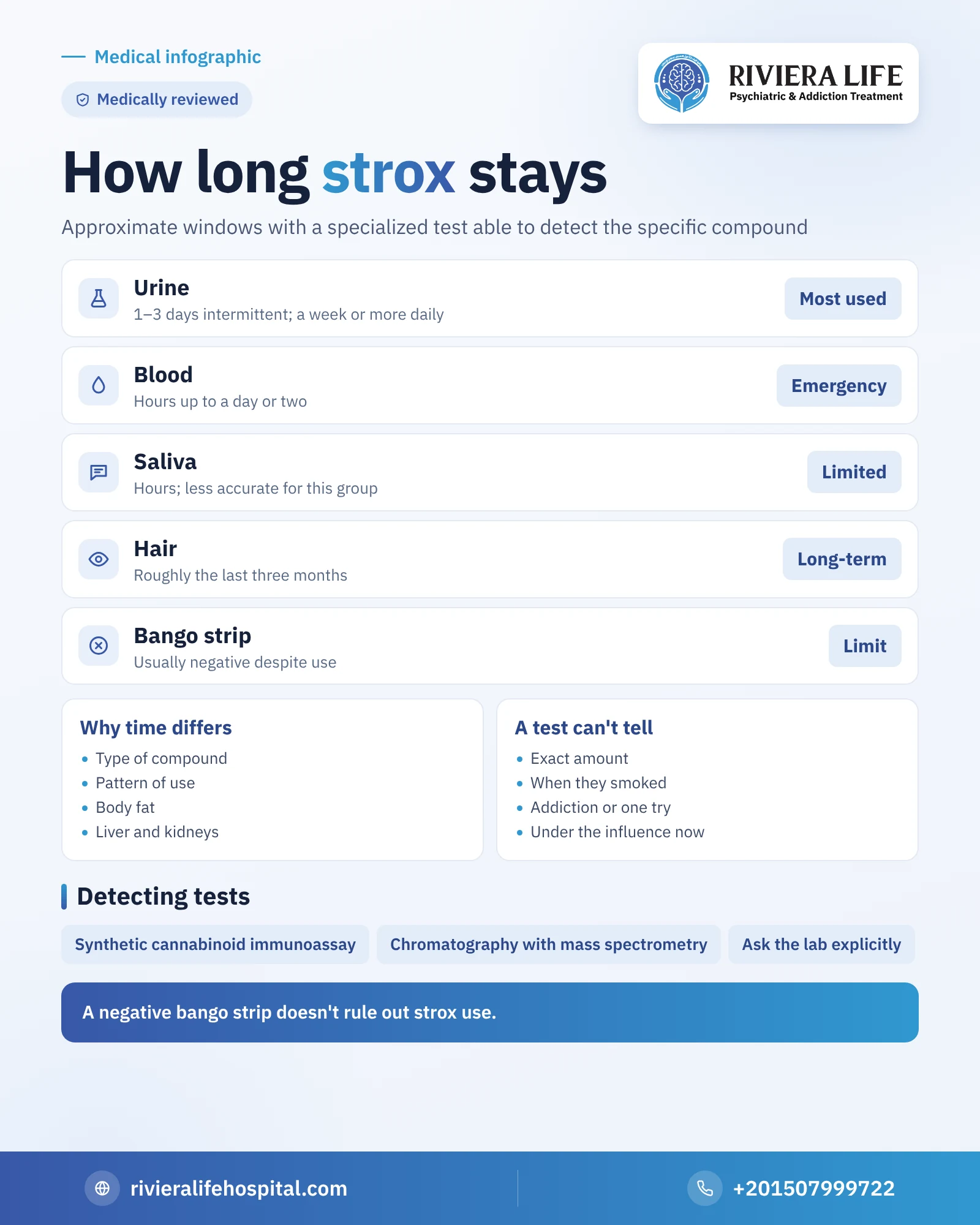
How long strox shows in each type of test
The following figures are approximate, and depend on having a specialized test able to detect the specific compound:
Urine test
It is the most used. Breakdown products usually show in it for about one to three days after intermittent use. With daily smoking over a long period, the period may extend to a week or more, and some reports mention longer periods with particular compounds.
Blood test
Its window is short, from hours to about a day or two. It is useful mainly in emergencies and in assessing poisoning, because it reflects what is in the body now more than what happened days ago.
Saliva test
It detects recent use within hours or so, but it is less widespread and less accurate with this group of substances, and isn’t relied on much.
Hair test
It has the longest window, as it may reflect roughly the last three months. But it doesn’t detect the last few days, is carried out in few specialized labs, and interpreting its result needs expertise because surrounding smoke may leave a trace on hair from the outside.
Why does the time differ from person to person?
- Type of compound: some strox compounds break down in hours, and some leave products that stay for days.
- Pattern of use: a single cigarette is different from ten cigarettes a day for months.
- Body fat mass: fat-soluble compounds may stay longer in some people.
- The efficiency of the liver and kidneys and general health.
- The sensitivity of the equipment and the list the lab searches in.
What tests can detect strox?
There are two methods. The first is immunoassays specific to synthetic cannabinoids, which detect a number of known compounds but may miss newer generations. The second is confirmatory testing with chromatography coupled with mass spectrometry, the most accurate method because it identifies the compound by name, provided the lab’s library is updated with the compounds in circulation. So if the goal is to confirm strox use, it must be requested explicitly from an equipped lab, rather than settling for the usual panel. You will find an explanation of tests for natural cannabis in the article on how long bango stays in the body.
If bango shows in the test, does that mean strox?
Not necessarily. A positive bango strip usually means natural cannabis itself is present, either because the person uses it too, or because the mix they smoked contained it. Many patients in Egypt move between bango and strox, or combine them with pills such as tramadol. That is why the doctor asks in the assessment for an expanded test covering more than one group, instead of relying on a single result.
Tests for work, university and licenses
Many bodies in Egypt require a drug test before hiring, issuing a driving license, or in periodic checks. These tests usually rely on a screening panel covering known groups such as opioids, tramadol, bango, stimulants and sedatives, and may not include synthetic cannabinoids unless requested.
But that doesn’t mean strox is “safe” in this respect, as labs constantly develop their lists, and a synthetic cannabinoid test can be added at any time. More importantly, relying on a gap in testing changes nothing of what strox does to the brain, heart and kidneys, and doesn’t protect against an episode of psychosis or a seizure that may happen at work or while driving.
What can’t a test tell you?
Even the most accurate test only answers whether the substance or its products are present in the sample. It doesn’t determine the amount precisely, nor exactly when the person smoked, nor whether they are addicted or tried it once, nor whether they are under the influence now. Diagnosis relies on history, symptoms and behavior before the test, and the signs the family sees daily carry great weight; their list is in the article on strox addiction symptoms.
Tests in emergencies
When a young man arrives at the emergency department having a seizure or in a state of agitation, doctors don’t wait for a test result to start treatment. The rapid test in hospital may come back negative, and the specialized test result may take days. The team deals with the symptoms in front of them: calming the agitation, stopping the seizure, and checking the heart, kidneys and fluids. So the most important thing the family offers the paramedics is honest information about what the person used and when, not hiding it out of fear of scandal.
Advice for the family before buying a home strip
A home bango strip won’t answer the strox question, and may give you false reassurance. If the signs are worrying, the better step is a medical assessment that includes a targeted test at an equipped lab. And make the goal of any test opening the door to treatment, not proving an accusation, as a confrontation that starts with a result sheet often ends in denial and stubbornness.
Strox leaving the body doesn’t mean the end of addiction
Strox products disappearing from the urine after days doesn’t mean the brain has regained its balance. The receptors that adapted to the substance need weeks to recover, and during this time the patient goes through withdrawal symptoms and then waves of anxiety and craving, as the article on strox withdrawal symptoms explains. In treatment programs, regular tests are used as a tool of follow-up and support, not a means of punishment, within a wider plan explained in the article on strox addiction treatment.
More from the strox guide
- Strox: the complete guide
- Strox addiction symptoms
- The harms of strox to the body and brain
- Strox addiction treatment
Questions many people ask
Usually not, because the bango strip looks for a breakdown product of natural cannabis, and strox compounds are chemically different. Detecting it needs a specialized test for synthetic cannabinoids.
With specialized tests it usually shows for one to three days after intermittent use, and may extend to a week or more with heavy daily smoking, depending on the compound.
It can in specialized labs, and may reflect roughly the last three months, but it doesn't detect the last few days and interpreting it needs expertise.
At a lab equipped for synthetic cannabinoid tests or with chromatography and mass spectrometry equipment, asking for it explicitly. The treating doctor can direct you to the suitable test within the assessment.
It isn't enough on its own, especially if it was an ordinary screening test. The judgment rests on symptoms, behavior and medical assessment alongside a specialized test.