“Does voodoo show up in testing?” Along with it comes another question about how long voodoo stays in the body, and both recur for two contradictory reasons: a young man who heard that voodoo “isn’t detected” and so chose it as a substitute for hashish, and a mother who did a home test for her son and the result came back negative even though all the signs say otherwise. The short answer is that the ordinary hashish strip usually doesn’t detect voodoo, but specialized laboratories can detect it with tests aimed at synthetic cannabinoids.
As for how long voodoo stays in the body, it varies by sample: its products usually remain in urine from one to a few days after occasional use, and may extend to a week or more with long daily use, while hair keeps a trace of them for about three months. In this article we explain why voodoo is hard to detect, what each sample detects, and how the result is read.
Why doesn’t voodoo show on the hashish strip?
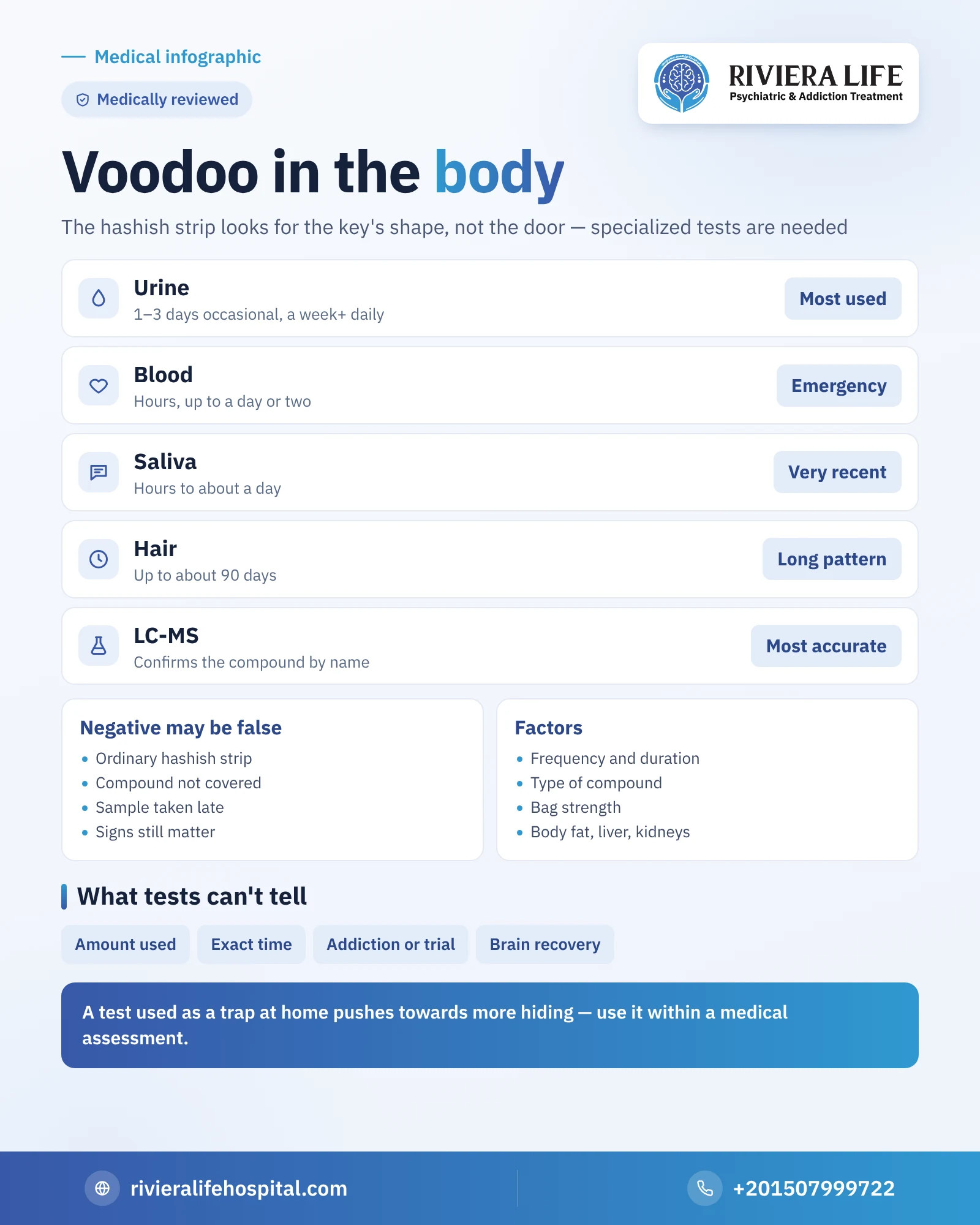
The hashish test strip is designed to recognize a specific product of the breakdown of hashish’s active substance. Voodoo compounds have a completely different chemical structure, even though they affect the same receptors in the brain. It is like a lock and two keys of different shapes that open the same door: the strip looks for the shape of the key, not the door. That is why the result comes back negative in most cases even if the person smokes voodoo daily. And this is precisely the source of the rumor that voodoo “doesn’t show up in tests”.
So how is voodoo detected?
Specialized laboratories have two means:
- Immunoassays dedicated to synthetic cannabinoids, targeting a group of common compounds and their products. Their advantage is speed, and their drawback is that they don’t cover all new compounds.
- Confirmatory analysis by liquid chromatography coupled with mass spectrometry, which is the most accurate, as it identifies the compound by name and can detect a large number of substances if they are within the laboratory’s database.
Because the makers of these substances constantly change the structure, laboratories work on updating their lists, so what wasn’t detected a year ago may be detected today.
What happens to voodoo inside the body?
After smoking, the substance moves quickly from the lungs to the blood and then to the brain, which is why the effect appears within minutes. The liver converts most of it into multiple products that leave with the urine, and some of these products may remain active and prolong the effect. These substances also dissolve in fat, so part of them is stored in body tissues with repeated use and released slowly, which explains the long detection window in the daily user compared with someone who tried it once.
How long voodoo stays in each type of test
The following figures are approximate, and differ according to the compound itself, the sensitivity of the test and the pattern of use:
| Sample | Approximate window | Notes |
|---|---|---|
| Urine | One to three days after occasional use, and may reach a week or more with daily use | The most used, and needs a test specific to synthetic cannabinoids |
| Blood | Hours, and may extend to a day or two | Usually used in emergencies to assess poisoning |
| Saliva | Hours to about a day | Detects very recent use |
| Hair | Up to about ninety days | Doesn’t detect the last days, and needs a specialized laboratory |
Urine test
It is the usual choice when asking about use during the past days. But it is only useful if a synthetic cannabinoid test is explicitly requested in it; the usual drug panel in many laboratories doesn’t include it.
Blood test
Its window is short, and its real value is in emergency departments when someone arrives in a state of seizure or disturbed consciousness and the doctors need to know what they used.
Hair test
It gives a picture of roughly the last three months, and is useful in assessing a long pattern of use, but it is less widespread and more expensive.
Factors that lengthen or shorten the duration
- The frequency and duration of use: the daily user for months is different from someone who tried it on a holiday.
- The type of compound: some compounds and their products remain longer than others.
- The strength of the bag: the actual dose is unknown and may be large without the user knowing.
- The percentage of body fat: because the substance is stored in fatty tissues.
- The efficiency of the liver and kidneys, age and general health.
- The sensitivity of the test and the list of compounds it covers.
A negative result: does it mean they aren’t using?
Not necessarily. The result may come back negative because the test used is the ordinary hashish strip, because the compound in the bag isn’t among what the immunoassay detects, or because the sample was taken after the detection window ended. That is why a negative result isn’t considered a certificate of innocence if the behavioral signs are clear. You will find these signs arranged in the article on voodoo addiction symptoms.
And a positive result: can it be wrong?
Rapid immunoassays may sometimes be affected by other substances and give an inaccurate positive result, and this applies to most initial drug tests. That is why confirmatory analysis by mass spectrometry is relied upon before any important decision. And if the person also uses hashish, hashish may show on the ordinary strip while voodoo is absent, so the problem seems smaller than it is.
What the test can’t tell you
The test doesn’t determine the amount the person used, nor exactly when, nor whether they are in a state of addiction or experimentation. Also, the end of the detection window doesn’t mean the brain has recovered; disturbances of sleep, mood and craving may continue for weeks, which is explained in the article on voodoo withdrawal symptoms. And many attempts to tamper with samples are detected by laboratories with specimen validity tests, so the result is treated as unacceptable.
Testing in emergencies: a different goal
When a young person arrives at the emergency department in a state of seizure, agitation or heart disturbance, the doctors don’t wait for the result of the synthetic cannabinoid test to start treatment, because the result of the specialized test may take days in a reference laboratory. Treatment here depends on symptoms and vital signs, and rapid tests are used to rule out other substances that may be mixed in, such as tramadol or sedatives. That is why the most important thing the family provides to the medical team is honest information about what the person used, and the bag or its remains if found, not insisting on a particular test.
The role of testing during treatment and follow-up
In treatment programs periodic testing is used in a completely different way from at home. Here it is a tool agreed upon with the patient, helping them prove their commitment to themselves and their family, and giving the team an early signal if they begin to slide towards relapse. Research indicates that linking negative results with tangible rewards improves continuation in treatment. And with voodoo specifically, the team is careful to choose a test that covers synthetic cannabinoids, because settling for the hashish strip empties follow-up of its meaning. The details of this role within the recovery plan are in the article on voodoo addiction treatment.
Workplace and pre-marriage tests
Bodies differ in the type of test they request. Some settle for a usual drug panel that doesn’t include synthetic cannabinoids, and some have added tests specific to them after the spread of strox and voodoo. No one can know in advance exactly what the sample will include, and more importantly, anxiety about testing is a sign worth pausing on: if a person is rearranging their life around passing a test, the problem is bigger than the test itself.
Advice for the family before buying a home strip
If your worry is about voodoo specifically, the hashish strip won’t answer you, and may give you false reassurance. It is better to talk with a doctor who determines the appropriate test and reads the result in its context. Most importantly, testing isn’t a tool for winning an argument at home; using it as a trap pushes the young person to hide more. At Riviera Life testing is part of a comprehensive confidential assessment, not a goal in itself. For the full picture of the substance, see the complete guide to voodoo.
More from the voodoo guide
- Voodoo: the complete guide
- Symptoms of voodoo addiction
- Voodoo withdrawal symptoms
- Voodoo addiction treatment
Questions many people ask
Usually not, because the hashish strip looks for a product of hashish, and voodoo compounds are chemically different. Detecting voodoo needs a test dedicated to synthetic cannabinoids.
Roughly one to three days after occasional use, and it may extend to a week or more with long daily use, depending on the compound and the sensitivity of the test.
Yes, in specialized laboratories, and it reflects use over about the previous three months, but it doesn't detect the last few days.
It depends on the panel requested; many usual panels don't include synthetic cannabinoids, while other bodies add them with dedicated tests.
A negative result doesn't rule out use if the test was unsuitable or taken late. A medical assessment that combines the signs and specialized testing is better.