“Voodoo” is a street name for a synthetic drug sold in Egypt in the form of chopped herbs that look innocent, but are sprayed with manufactured chemicals that mimic the effect of hashish far more strongly and with no guarantee of what they contain. It got its name from the state it leaves in many of its users: a fixed stare and a frozen body, as if the person has lost control of themselves.
Its danger doesn’t come from addiction alone, but from sudden poisoning that may strike the heart, brain or kidneys from a single cigarette. On this page the Riviera Life team gathers what you need to know about voodoo: what it contains, how it works, and why it differs from hashish, then detailed links for each aspect from symptoms to treatment.
What is voodoo?
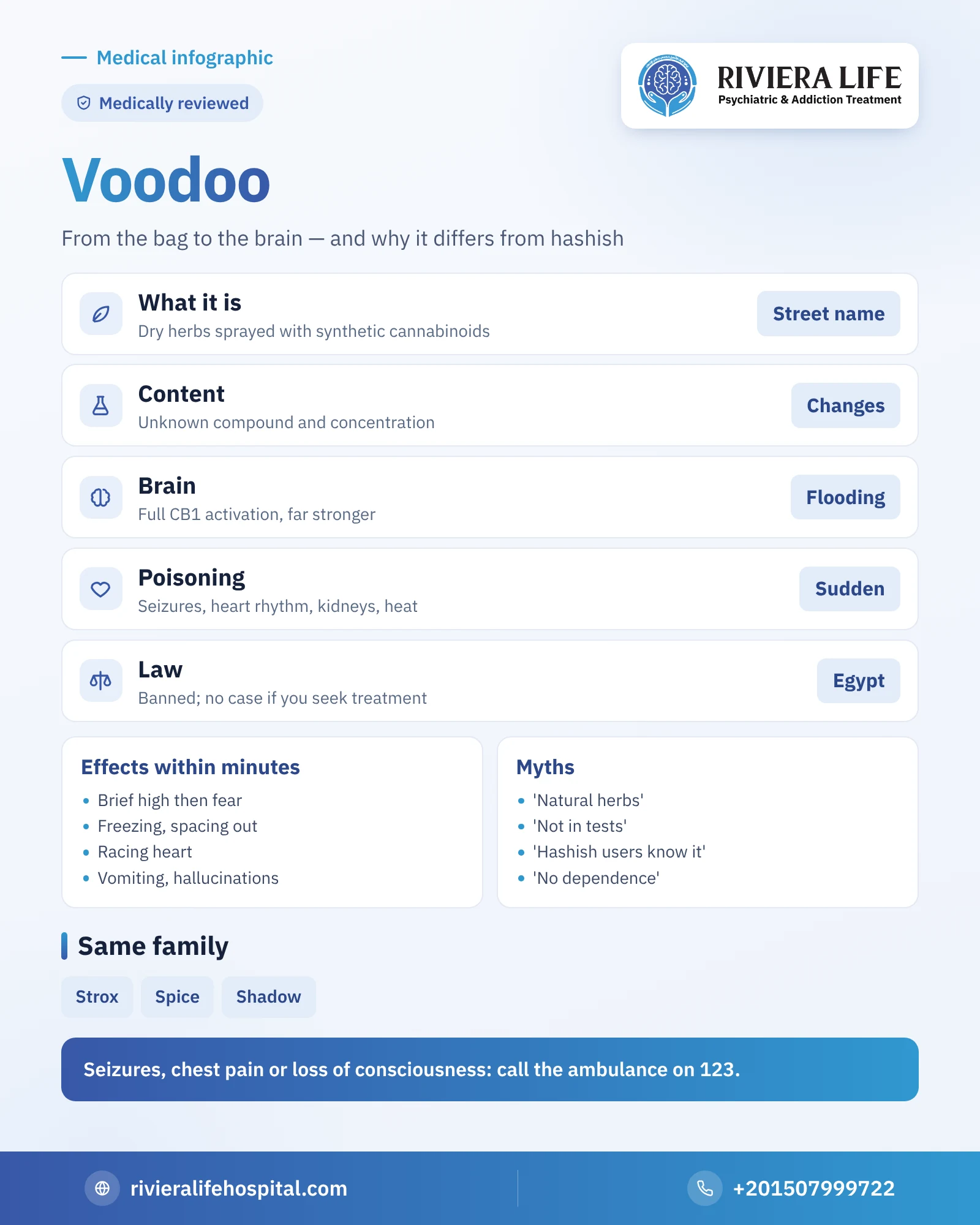
Voodoo isn’t a plant or a particular herb. It is a mixture of dry plant leaves that have no effect originally, sprayed or soaked in a solution of substances scientifically known as “synthetic cannabinoids” or “synthetic cannabinoid receptor agonists”. These substances were first made in laboratories for research purposes to understand how the body’s endocannabinoid system works, then their formulas leaked to illegal laboratories that produce them in large quantities and sell them mixed with herbs.
The essential problem is that the word “voodoo” doesn’t refer to a single chemical substance. It is a street trade name, and under this name dozens of different compounds may be sold, and whenever countries ban a compound, a substitute appears with a slight modification in its structure. That is why today’s bag may contain a substance completely different from last month’s bag, even if the look and name are the same.
Names of voodoo and how it is sold in Egypt
The name voodoo has spread in Egypt in recent years alongside related names such as strox, spice and shadow, and these names are often used interchangeably on the street. Voodoo is usually offered in small bags or paper wraps, and sometimes in colored packages carrying drawings or phrases suggesting that it is “incense” or a “herbal blend” to avert suspicion. Some may call it “synthetic hashish” or “sprayed bango”.
Part of its spread is due to a reputation passed around among young people: that it is cheaper than hashish, that its effect appears quickly, and that it “doesn’t show up in tests”. The last part specifically is behind many cases of starting, and it is misleading information, as the article on how long voodoo stays in the body explains.
Forms of voodoo and ways of using it
Voodoo usually comes in the form of chopped dry herbs green, brown or yellowish in color, resembling bango or dried tea leaves, and it may have a pungent chemical smell or an added perfumed smell to hide the original odor. It is mostly used by smoking, either rolled in a cigarette, mixed with tobacco, or in a shisha. Liquid forms used in e-cigarettes sometimes appear.
Because the spraying is done by hand in primitive laboratories, the solution isn’t distributed evenly on the herbs. One part of the bag may carry a tiny amount, while another part in the same place carries a double concentration. This is what makes two cigarettes from the same bag differ greatly in their effect, and explains why many emergency cases come from people who were used to using without apparent problems.
What does voodoo do in the brain and body?
The body has a natural system called the endocannabinoid system, which takes part in regulating mood, memory, appetite, pain and sleep. This system works through receptors, the most important being a type called CB1, which is abundant in the brain. The active substance in hashish binds to these receptors partially, while many of the substances in voodoo activate the receptor fully and with a far higher strength, so something like a “flooding” of the whole system happens.
The effect appears within minutes of smoking, usually lasts a few hours, and may include:
- Relaxation and a short high often followed by anxiety or severe fear.
- Confusion of perception and time, and spacing out or freezing of movement and speech.
- A racing heartbeat and raised or lowered blood pressure.
- Nausea and vomiting, sometimes repeatedly.
- In the most severe cases: agitation, hallucinations, persecutory thoughts or seizures.
With repetition the brain adapts, so the user needs a larger amount to reach the same effect, and shows distress, insomnia and tension when late for their usual cigarette. Here dependence begins, often faster than expected by someone coming from the experience of hashish.
Does voodoo have any medical use?
No. There is no medical use for voodoo or for what is sprayed on it, as they are compounds of unknown source and concentration that haven’t been tested on humans and aren’t approved by any drug authority. Some confuse this with a few medicines derived from cannabis or similar to it that are dispensed in some countries for specific conditions such as the nausea accompanying chemotherapy, but these are medicines with a known composition, calculated doses and medical supervision, and have nothing to do with what is sold on the street under any name.
Why is voodoo considered dangerous?
Several causes of danger come together in voodoo that rarely come together in a single substance:
- Unknown content: neither the user nor the seller knows the actual compound or its concentration.
- Unexpected strength: some compounds are dozens of times stronger than the active substance in hashish, or more.
- Acute poisoning: cases of seizures, heart rhythm disturbance, acute kidney injury and high temperature are recorded, even in healthy young people.
- A violent psychological effect: panic attacks and psychosis that may continue after the effect wears off, especially in those with a predisposition.
- Rapid dependence: it may appear within weeks of daily use, with unpleasant discontinuation symptoms that push back towards use.
The details of these harms on each organ are in the article on the harms of voodoo on the brain, heart and body.
Voodoo within the synthetic cannabinoid family
Voodoo belongs to the same family that includes strox, spice and shadow. The difference between them is mostly a difference in name, packaging and marketing method rather than a fixed chemical difference, as the same compound may be sold under more than one name, and a single name may carry different compounds. As for its relationship with hashish and bango, it is one of imitation: it targets the same receptors but acts on them more violently, which is why it isn’t right to judge its danger by the experience of hashish.
Voodoo and the law in Egypt
Egyptian law deals with synthetic cannabinoids as prohibited narcotic substances; they have been listed in the drug schedules and penalties relating to synthetic drugs have been tightened in recent years, whether for possession, use or trafficking. On the other hand, no criminal case is brought against a user who comes forward on their own seeking treatment, a point that reassures many hesitant families. For any legal question about a particular case it is preferable to consult a specialized lawyer, and the Fund for Drug Control and Treatment of Addiction also provides a free, confidential hotline on 16023.
The voodoo guide: each aspect in a separate article
Start with the question that concerns you about voodoo, as each question has an article that answers it in depth:
- Symptoms of voodoo addiction: the signs the family notices in appearance, behavior and mood, and when use becomes addiction.
- Causes of voodoo addiction: the psychological, environmental and family factors that raise the risk, and why some fall into it faster than others.
- The harms of voodoo: what affects the brain, heart, kidneys and mental health, and when the case needs emergency care.
- How long voodoo stays in the body: what urine, blood and hair tests can detect, and why the ordinary strip fails.
- Voodoo withdrawal symptoms: the timeline of what happens after the last cigarette, and signs that call for a doctor.
- Voodoo addiction treatment: the stages of treatment, the role of medicines and psychotherapy, the duration, and how to choose a hospital.
Common myths about voodoo
The myth: voodoo is natural herbs, so it is lighter than pills and powder. The truth is that the herbs are just a carrier, and what actually has an effect is a manufactured chemical that may be more toxic than many known drugs.
The myth: voodoo doesn’t show up in testing. The truth is that the home hashish strip usually doesn’t detect it, but specialized laboratories have tests aimed at synthetic cannabinoids, and they are constantly developing.
The myth: someone who has used hashish for years knows how to deal with voodoo. The truth is that experience with hashish doesn’t protect from an unknown concentration, and many cases of poisoning happen in people who thought they knew their limits.
The myth: voodoo doesn’t cause physical addiction. The truth is that regular use causes clear dependence and discontinuation symptoms that may be harder than the symptoms of stopping hashish.
Discovered your son is using voodoo? Start here
Many families discover the matter after a shocking incident: a bout of vomiting, sudden freezing or unusual agitation. At that moment focus on three steps. First, make sure he is safe now; if there is a danger sign from the signs mentioned in the next paragraph, the priority is the ambulance, not discussion. Second, postpone the confrontation to a time when he is calm and alert, and talk about what you saw and your fear for him, not about punishment. Third, ask for a specialized medical assessment even if he refuses at first, as the family itself needs guidance. The article on voodoo addiction symptoms helps you organize your observations before talking with the doctor.
Signs of voodoo poisoning
Call the ambulance on 123 immediately if any of these appear
Voodoo poisoning may develop within minutes, and it isn't right to wait for the person to calm down on their own.
- Seizures or loss of consciousness
- Chest pain or severe, irregular palpitations
- A clear rise in body temperature with sweating or dryness
- Violent agitation, hallucinations or behavior that exposes him or others to harm
- Repeated vomiting that doesn’t stop or very little urine
Until the ambulance arrives, keep the person in a quiet, dimly lit place, remove sharp objects from around them, and don’t try to restrain them by force except to protect them from harm. If they lose consciousness while breathing, put them on their side. And if possible, keep the bag or the remains of what they used to show to the medical team.
When should you ask for help?
Don’t wait for use to turn into a daily habit. Merely repeated use, or any episode of poisoning even if it passed safely, is reason enough for a medical assessment. At Riviera Life the consultants in psychiatry and addiction treatment take on the assessment of the case in complete confidentiality, then set a plan that suits it, with residence inside the hospital or outpatient follow-up, and the first consultation is free.
Medical sources and referencesThe information in this article is based on reliable scientific sources
1NIDA — Synthetic cannabinoids: their nature and risksnida.nih.gov2EUDA — Synthetic cannabinoids and spice products drug profileeuda.europa.eu3StatPearls — Natural and synthetic cannabinoid toxicityncbi.nlm.nih.gov4WHO — Cannabis and psychoactive substanceswho.int5MedlinePlus — Drug use and addictionmedlineplus.gov