Voodoo addiction symptoms don’t always resemble what a family expects from an “addict”. They may begin with strange spacing out after coming back from outside, a bout of vomiting with no clear cause, or irritability that explodes at the simplest request. What most distinguishes voodoo is that its signs fluctuate: one day the young man looks calmer than he should, and another day tense, afraid and suspicious. In this article we arrange the signs you can notice in the body, behavior, mood and surrounding objects, then explain when use turns into addiction, and what to do when these signs come together in front of you.
Why is voodoo hard to detect early?
There are three reasons that make the family late in noticing. The first is that the cigarette’s effect is relatively short, so the young person may return to his apparent normal state after a few hours. The second is that voodoo usually doesn’t leave the known smell of hashish, but a chemical or perfumed smell that may be attributed to an air freshener or ordinary cigarettes. The third is that many psychological signs, such as irritability, isolation and little sleep, get mixed up in the parents’ minds with adolescent mood swings or the pressure of study and work. That is why reading the signs together and over weeks helps, not judging from one incident.
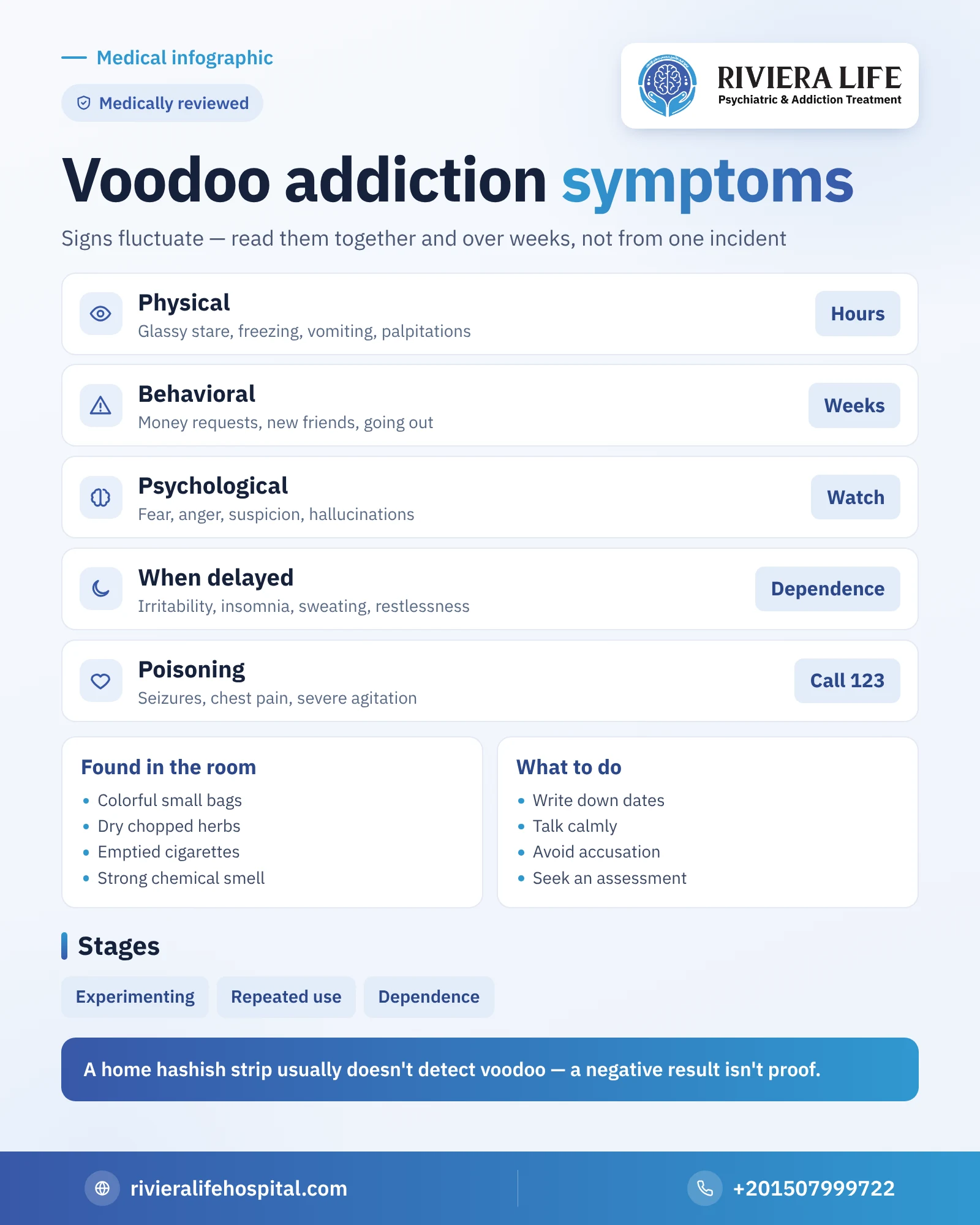
Physical signs during use or shortly after
These are signs that appear in the hours after smoking, and you may notice them if the person comes home while still under the influence:
- Red eyes or a glassy stare fixed on one point.
- Temporary freezing of movement or very slow response, the state young people describe as “going wooden”.
- Stammering or incoherent speech and difficulty completing a sentence.
- Sweating and pallor, and palpitations the person complains of or that you notice in their pulse.
- Nausea and vomiting, and the vomiting may recur in bouts.
- Unsteady walking, or sudden limpness and deep sleep at an unusual time.
Behavioral signs that catch the family’s attention
Behavior is more truthful than the body in revealing continued use, because it changes even on days the person doesn’t use:
- Going out repeatedly at unusual times, or spending a long time in the bathroom, on the roof or in the street.
- Asking for money with changing excuses, or small sums and sellable things disappearing from the house.
- A sudden change in the circle of friends, and evading the parents’ questions about them.
- A clear decline in studies or repeated lateness and absence from work.
- Neglecting appearance and personal hygiene, and losing interest in hobbies he used to love.
- Locking the phone with a new password, and getting very agitated when someone approaches it or his room.
Things you may find in the room or clothes
Finding something from this list isn’t conclusive proof on its own, but it is a good reason to pay attention:
- Small colorful or paper bags with strange drawings or the word “incense”.
- Remains of dry chopped herbs resembling tea or bango.
- Cigarette rolling papers, or ordinary cigarettes emptied of tobacco.
- Many lighters or small burn marks on clothes and bedding.
- A sharp chemical or perfumed smell that remains in clothes.
Psychological and mood signs
Here what most distinguishes voodoo from hashish appears. Instead of the usual relaxation, many families complain that their son has become “another person”:
- Anxiety and bouts of fear with no apparent cause, or a feeling that someone is watching him.
- Sharp irritability and outbursts of anger, sometimes with breaking things or verbal aggression.
- Mood swinging between complete lethargy and tense activity on the same day.
- Poor concentration and forgetfulness, and difficulty following a long conversation.
- Talk about voices or visions that aren’t there, or strange thoughts that increase with continued use.
The appearance of hallucinations or pathological suspicion is a sign that deserves an urgent psychiatric assessment, even if it disappears after hours.
Health signs that accumulate with continued use
After weeks or months of regular use you may notice weight loss and loss of appetite, chronic insomnia or interrupted sleep, a cough and shortness of breath from smoking, and repeated bouts of vomiting that improve temporarily then return. The person may complain of palpitations or recurrent headaches. These signs don’t necessarily mean permanent harm, but they are an indication that the body is paying the price, and you will find a detailed explanation of what happens inside the organs in the article on the harms of voodoo.
What happens when he’s late for his cigarette?
Among the strongest signs of dependence is what appears when the person can’t find voodoo: distress and irritability within hours, insomnia, loss of appetite, sweating, and restlessness and inability to sit still. If you notice that his mood suddenly improves after a short outing, and worsens the longer he stays at home, this is a pattern worth attention. The details and duration of this stage are in the article on voodoo withdrawal symptoms.
How do the signs develop from experimenting to addiction?
The experimenting stage
A cigarette in a gathering of friends, usually out of curiosity or because hashish wasn’t available. The signs are few, and may be limited to spacing out or vomiting that night.
The repeated use stage
Voodoo becomes part of the weekend and then of other days. Asking for money, repeated going out and changing friends begin.
The dependence stage
Daily or near-daily use, an increasing amount, and clear distress when stopping. Study or work declines, and getting voodoo becomes the center of the day.
When is use addiction according to medical criteria?
The number of times of use isn’t enough to judge. The doctor assesses a group of signs over about a year, including:
| Domain | How it looks in reality |
|---|---|
| Loss of control | Uses more than intended, and fails to cut down despite trying |
| Preoccupation | Spends a long time looking for voodoo or recovering from its effect |
| Craving | Repeated thinking about the next cigarette |
| Neglecting responsibilities | Absence from study or work and a decline in performance |
| Continuing despite harm | Continues despite clear health, psychological or family problems |
| Tolerance and withdrawal | Needs a larger amount, and feels unpleasant symptoms when stopping |
The more domains apply, the more severe the disorder, and the final diagnosis is the task of the specialist doctor, not the family.
Can voodoo signs be confused with something else?
Yes. Anxiety and insomnia may be the beginning of an independent psychological disorder, repeated vomiting may be a digestive problem, and aggression may come from other substances such as stimulants. Also, many young people mix voodoo with tramadol, pregabalin or hashish, so the signs overlap. And because the home hashish test strip usually doesn’t detect voodoo, the result may come out negative despite use, as the article on how long voodoo stays in the body explains. A medical assessment is what sorts out these possibilities.
Signs specific to teenagers and school students
A teenager is less able to hide the effect, but more skilled at justifying it. Watch for a sudden drop in grades, school complaints about sleeping in class or fighting, asking for pocket money before it’s due, and constantly excusing himself from going out with the family. Among some school students the idea spreads that voodoo is “just incense” or that it is lighter than cigarettes, so don’t be surprised if your son says it to you confidently; it is a sentence he heard from others, not information he knows.
What do you do if you notice these signs?
Write down what you saw with its dates instead of relying on memory, and choose a time when the person is clear-headed to talk to him calmly about your worry. Avoid accusation and interrogation, and start with an open question about what he is going through. Then ask for an assessment from an addiction treatment specialist. At Riviera Life this step begins with a free and confidential first consultation, in which the family takes part even before the patient is convinced. You can also read the complete guide to voodoo to understand the substance itself.
Signs that can’t wait
Call the ambulance on 123 immediately if any of these appear
These are signs of acute poisoning, not just signs of use.
- Seizures or loss of consciousness
- Chest pain or a very fast heartbeat
- Severe agitation or hallucinations with dangerous behavior
- High temperature with heavy sweating or confusion
More from the voodoo guide
- Voodoo: the complete guide
- Causes of voodoo addiction and risk factors
- Voodoo addiction treatment: stages and duration
- Voodoo withdrawal symptoms and their duration
Questions many people ask
It may, but it isn't a constant sign. Clearer, usually, are spacing out, temporary freezing, vomiting and severe anxiety after use.
Yes, irritability and outbursts of anger are common both under the influence and when use is delayed. But alone it isn't enough to judge, and it is read with the other signs.
Adolescent mood swings are usually gradual, while use is accompanied by a sudden change in friends, money and sleep, and unexplained bouts of vomiting or spacing out. These signs together call for an assessment.
At first yes, because the effect is short and the smell isn't distinctive. But continuing leaves a mark on behavior, mood and health that is hard to hide over time.
A psychiatrist or addiction treatment specialist diagnoses it after an interview and assessment of the history and symptoms, and may request specialized tests to help confirm use.