Xanax withdrawal symptoms usually begin within hours to about a day of the last dose — sooner than most other sedatives — because alprazolam leaves the body quickly. Symptoms include acute anxiety, insomnia, tremor, sweating and palpitations, and in severe cases they can reach seizures or delirium. They usually peak in the first days, and the acute symptoms settle over a week to several weeks, while mild anxiety and insomnia may continue longer in some patients. The rule without exception: Xanax isn’t stopped suddenly after regular use, but tapered gradually with a medical plan.
Why does Xanax withdrawal come faster and harder?
Alprazolam’s half-life is relatively short, estimated in healthy adults at roughly ten to twelve hours, with wide variation between people. This means its level in the blood falls quickly after stopping, so the brain doesn’t have enough time to adapt. Compare that with diazepam, for example, which along with its by-products stays in the body for days, so its level falls slowly, like a natural taper. With Xanax the opposite happens: a sharp drop, followed by a rebound in the activity of a nervous system that had been held back for weeks or months.
For the same reason, Xanax is one of the benzodiazepines that is hard to withdraw directly, and doctors often switch it to a longer-acting sedative before reducing. The general picture of withdrawal for this whole family is in our article on benzodiazepine withdrawal symptoms; here we focus on what is specific to Xanax.
The timeline of Xanax withdrawal
The following timings are approximate, and change with the dose, the length of use and the type of tablet — symptoms from extended-release tablets are delayed a little.
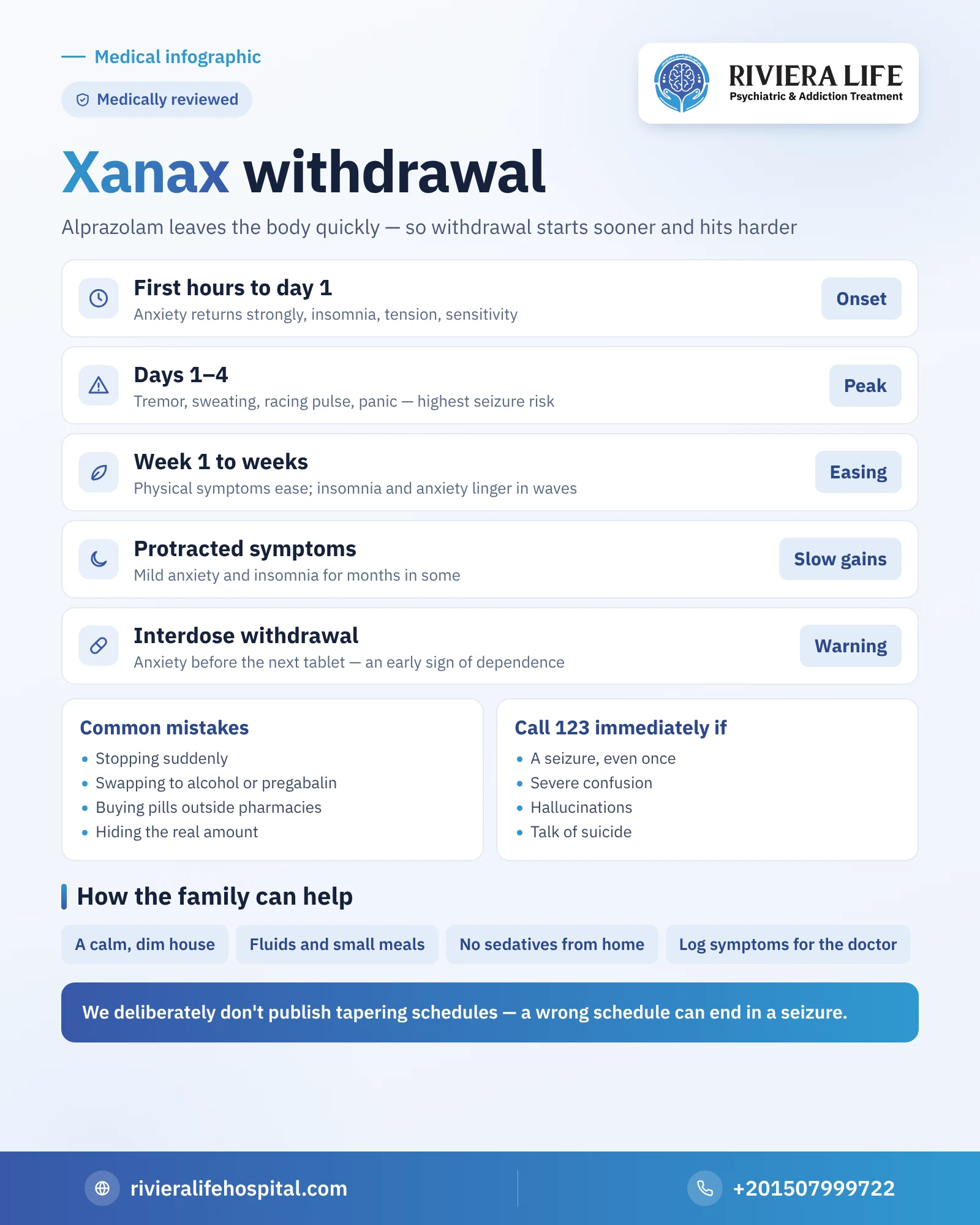
The first hours to the end of the first day
Anxiety returns strongly, sleep becomes difficult, and irritability, muscle tension and sensitivity to sound and light appear. Many patients describe this stage as “worse than the anxiety I started with”.
From the first day to roughly the fourth
This is the peak in most cases. Tremor, sweating and a fast pulse increase, blood pressure may rise, and panic attacks, nausea and headache appear. And in these days in particular the risk of seizures is highest for those who stopped suddenly after high doses.
From the end of the first week to several weeks
Physical symptoms ease gradually, while insomnia, anxiety, poor concentration and mood swings remain. Symptoms may come in waves: calm days followed by a difficult one, and this doesn’t mean the withdrawal has failed.
Protracted symptoms
In a proportion of patients, especially after long use, mild anxiety, insomnia and sensitivity to stress continue for months after stopping, with slow, steady improvement. Knowing this in advance protects the patient from interpreting it as a permanent illness that needs a return to the pill.
The physical and psychological symptoms of withdrawal
The symptoms overlap, but they can be divided to make them easier to understand:
- Physical: tremor in the hands, sweating, palpitations, headache, muscle tension, nausea, loss of appetite, ringing in the ears, and numbness in the limbs.
- Psychological: severe anxiety, panic attacks, irritability, insomnia and nightmares, depression, and a strange feeling of detachment from oneself or one’s surroundings.
- Sensory: distressing sensitivity to light, sound and touch, and sometimes disturbed perception.
Interdose withdrawal: an early sign many people miss
A Xanax user may experience a small withdrawal every day without ever stopping. A few hours after the tablet, the effect starts to wear off, so tension, a mild tremor and anxiety appear that push them to the next dose; then it settles, then it comes back again. Doctors call this interdose withdrawal, and it is one of the clearest signs that dependence has formed. A patient who notices they are watching the clock waiting for their tablet needs to review their plan with their doctor rather than raising the dose on their own.
Serious complications: seizures and delirium
Benzodiazepine withdrawal is one of the few situations in which withdrawal itself can be a danger to life, not just suffering. The main complications are:
- Seizures: they can happen even in someone who has never had epilepsy, and the risk is higher with large doses, sudden stopping and mixing sedatives with alcohol.
- Delirium: severe confusion and loss of a sense of time and place, which may come with hallucinations.
- Thoughts of self-harm: depression may intensify in the days of withdrawal, and any talk of death must be taken seriously.
Call an ambulance immediately on 123 if you see
Xanax withdrawal can turn into an emergency within hours, so don't wait until the morning.
- A seizure or epileptic fit, even once
- Severe confusion or not recognizing people or the place
- Visual or auditory hallucinations
- Violent tremor with a very fast pulse and heavy sweating
- Talk of suicide or self-harm
Rebound anxiety, or the original illness returning?
After stopping, anxiety usually returns, and the important question is: is it temporary rebound anxiety caused by withdrawal, or a return of the anxiety disorder Xanax was prescribed to treat? Rebound anxiety usually comes more severely than the original anxiety, starts quickly after stopping, then eases gradually over the weeks. A return of the original illness follows the same pattern as the old symptoms and persists. Telling the two apart needs a psychiatrist, because the plan differs: the first needs patience and support, and the second needs a treatment for anxiety that doesn’t cause dependence.
What determines how severe and long the withdrawal is?
- The size of the daily dose and the length of use: years differ from weeks.
- The speed of stopping: stopping suddenly is far more dangerous than a gradual reduction.
- Mixing Xanax with alcohol, pregabalin, tramadol or opioids.
- Using tablets of unknown origin that may contain substances stronger than alprazolam.
- Previous seizures or an accompanying mental disorder.
- Age and general health: older people are more prone to confusion and falls.
How is Xanax withdrawn medically?
The aim isn’t to get rid of the medicine as fast as possible, but to stop it safely. The doctor begins by assessing the actual dose, any substances taken with it and any history of seizures, then sets a reduction schedule suited to the case. In many cases alprazolam is replaced with a longer-acting sedative from the same family, because its level in the blood falls more slowly and is easier to control, and then the dose is reduced in stages that may stretch over weeks or months. The schedule is adjusted if symptoms become severe: the pace follows the patient’s response, not a fixed number. We deliberately don’t publish reduction schedules or doses here, because the wrong schedule can end in a seizure.
Common mistakes during Xanax withdrawal
- Stopping suddenly out of enthusiasm or after a family argument.
- Replacing Xanax with alcohol or pregabalin “to calm the nerves”, which simply moves the dependence, with greater risk.
- Buying tablets outside the pharmacy when symptoms get worse.
- Reducing very fast and then giving up after the first sleepless night.
- Not telling the doctor the real amount out of embarrassment, so the plan is built on inaccurate figures.
How can the family support the patient during withdrawal?
Having a calm person beside the patient makes a real difference. Reduce noise and lighting at home, encourage them to drink fluids and eat small meals, and don’t interpret their irritability as a personal challenge — it is part of withdrawal. Don’t give them any sedative or sleeping pill from the home medicine cabinet however much they insist, record the symptoms and their timing to show the doctor, and know in advance the ambulance number and the nearest hospital in case a danger sign appears.
Options for treating withdrawal
Some mild cases can be managed with a gradual reduction and regular outpatient follow-up, while high doses, mixing with other substances or previous seizures usually need an inpatient stay under continuous medical supervision. After getting through withdrawal comes the most important stage, which is treating anxiety and insomnia and preventing relapse, as our article on Xanax addiction treatment explains. To understand how the dependence formed in the first place, see our article on Xanax addiction.
More from our Xanax and sedatives guide
- Benzodiazepines: the complete guide
- Xanax addiction symptoms
- Benzodiazepine withdrawal symptoms
- Xanax addiction treatment
Questions many people ask
Acute symptoms peak in the first days and usually settle within a week to several weeks, and mild anxiety and insomnia may remain for months in some long-term users.
It can be dangerous when stopped suddenly after high doses or long use, because of the possibility of seizures and delirium. That is why Xanax is tapered gradually under medical supervision.
Not always, but it eases them considerably and reduces the risk of serious complications, and it lets the doctor adjust the pace if symptoms become severe.
Because its effect is short, so its level in the blood falls before the next dose and small withdrawal symptoms appear. This is a sign of dependence and deserves a review with the doctor rather than raising the dose.
No. That swaps one dependence for another and doubles the risk of depressed breathing. Any helping medicine is decided by the doctor alone within the withdrawal plan.