Treating addiction to benzodiazepines is possible and safe, provided it doesn’t start with the step most people start with: stopping suddenly. Correct treatment is based on a gradual reduction of the medicine under medical supervision that usually extends from weeks to months, accompanied by psychotherapy for the anxiety or insomnia that was the cause at the beginning, then follow-up that prevents return. The duration of treatment differs according to the dose, the duration of use, the type of medicine and the presence of other substances mixed with it. In this article we explain the stages of treatment one by one, when hospital residence is necessary, and how to choose the right place for this particular condition.
What makes benzodiazepine treatment different?
In many types of addiction the detox stage is relatively short, and the greatest effort lies in what comes after it. With benzodiazepines, the first stage itself needs patience and careful calculation, because a brain used to the medicine may respond to its sudden absence with a seizure or delirium. That is why there is no such thing as a “one-week cleanse” for someone who has been using these medicines daily for months.
The second thing is that many patients didn’t start looking for euphoria, but escaping real anxiety or insomnia. If the medicine is withdrawn without treating this problem, the patient returns to it at the first crisis. Good treatment therefore runs on two parallel tracks: withdrawing the medicine slowly, and building a healthy substitute for what it was doing.
Stages of benzodiazepine addiction treatment
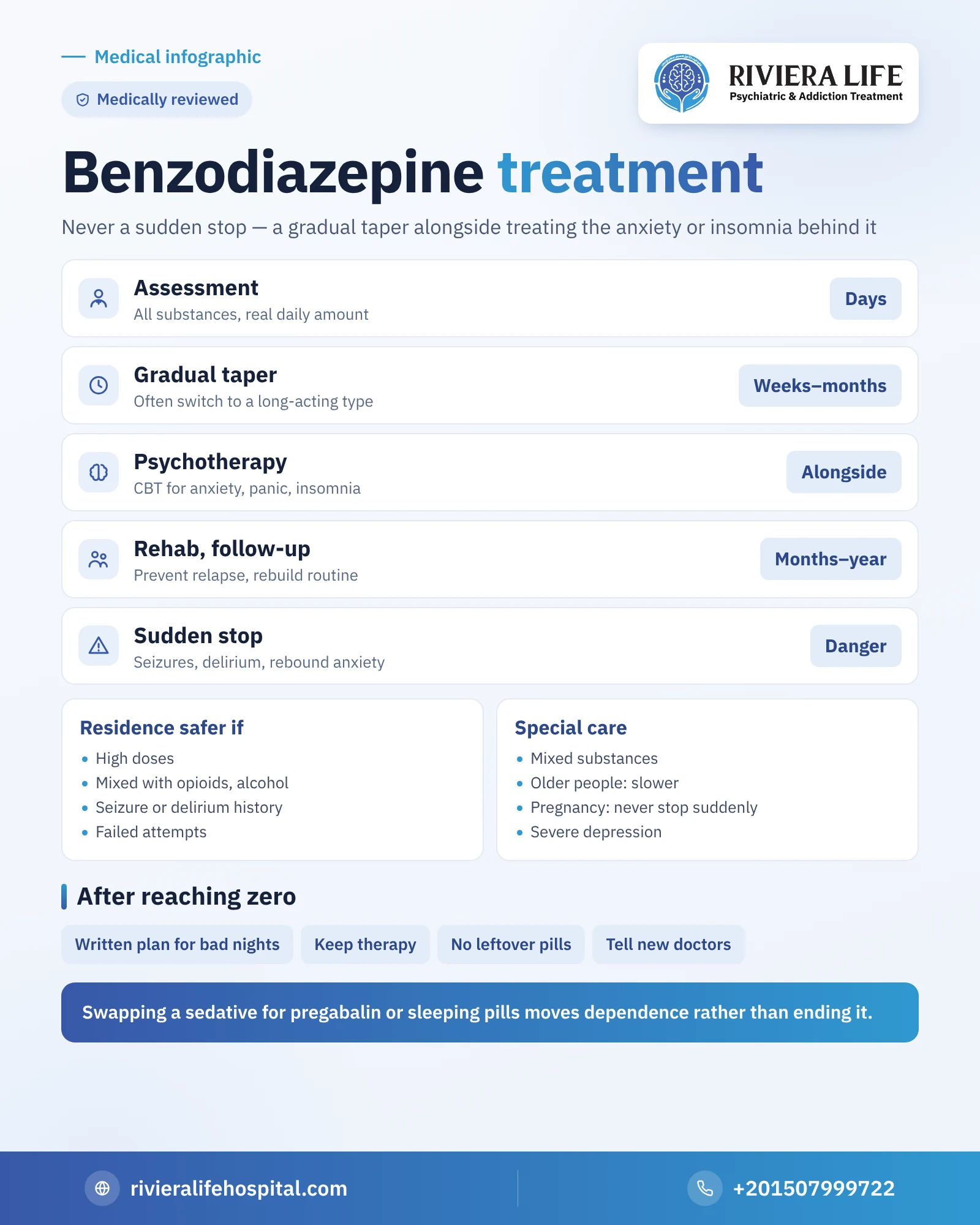
| Stage | Aim | Approximate duration |
|---|---|---|
| Comprehensive assessment | Knowing all substances used, the severity of dependence and accompanying illnesses | A few days |
| Gradual withdrawal | Reducing the medicine safely without seizures or relapse | Weeks to months |
| Psychotherapy | Treating anxiety and insomnia and building alternative skills | Begins with withdrawal and continues after it |
| Rehabilitation and follow-up | Preventing relapse and rebuilding routine and relationships | Months, and may extend to a year |
The initial assessment: what does the doctor need to know?
The doctor begins with questions that may seem many, but every answer changes the plan: the exact name of the medicine or medicines, since when, the actual daily amount rather than the amount written on the prescription, whether there were previous attempts to stop and what happened in them, and whether seizures have occurred before. Then they ask about other substances: tramadol, pregabalin, alcohol, hashish and stimulants. They carry out blood and urine tests, and assess the psychological state looking for chronic anxiety, depression or post-traumatic stress disorder. It is useful for the family to bring the strips and prescriptions found at home, as the figures the patient mentions are often lower than the truth.
Gradual withdrawal: the heart of treatment
The basic idea is simple: instead of the medicine being torn from the brain all at once, it is withdrawn in steps to each of which the brain adapts before moving to the next. The doctor often starts by moving the patient from a fast-leaving type such as alprazolam to a long-acting type, because its level in the blood remains steadier so fluctuations between doses decrease.
Then the amount is reduced in stages, the speed is slowed if symptoms intensify, and the plan may pause temporarily at a certain level until the patient stabilizes. The last stage of reduction is usually the hardest psychologically even though the amounts in it are small. The patient shouldn’t set their own schedule, as what worked for someone else may be dangerous for them. The details of what the patient feels during these weeks are in the article on benzodiazepine withdrawal symptoms.
Call the ambulance on 123 immediately if any of these appear
During an attempt to stop outside hospital, or after cutting the medicine suddenly.
- A seizure or loss of consciousness
- Severe confusion or hallucinations
- Thoughts or talk of self-harm
Are there medicines to treat benzodiazepine addiction?
There is no approved substitute medicine for this condition in the way there is medication treatment for opioid addiction. The basic medication tool is the benzodiazepine itself, used in decreasing doses under supervision. Alongside it the doctor may prescribe medicines to treat what has appeared or what was already present: antidepressants suitable for anxiety and panic disorders, or sleep aids that don’t cause dependence, according to each case. Among the common mistakes is replacing the sedative with another calming substance such as pregabalin or some sleeping medicines without assessment, so dependence moves from one medicine to another instead of ending.
Psychotherapy: how do you live without the sedative?
This is where real recovery happens. The patient needs to learn how to calm down and how to sleep without a pill, and among the most effective methods are:
- Cognitive behavioral therapy for anxiety and panic: helps understand the cycle of fear and break it gradually instead of escaping it with medicine.
- Cognitive behavioral therapy for insomnia: a structured program to reset sleep, which has proven longer-lasting effectiveness than sleeping pills.
- Relaxation and breathing exercises: simple tools the patient uses in moments of tension instead of reaching for the strip.
- Motivational interviewing: to strengthen the patient’s motivation on days when they feel the reduction isn’t worth the trouble.
- Treating trauma and depression if present, as they are among the strongest causes of return.
How long does benzodiazepine addiction treatment take?
This is among the most pressing questions, and the honest answer is that it varies greatly. Someone who used a small dose for a few months may finish the reduction in weeks, while someone who used high doses for years or mixed them with other substances may need months. The residence stage usually lasts longer in mixed or complex cases, then outpatient follow-up and psychotherapy continue after it. More important than the speed of reaching zero is that the patient reaches it stable, because hasty reduction is among the most common causes of relapse.
Residential treatment or outpatient follow-up?
Many stable patients who use the medicine by prescription without mixing can reduce it gradually with regular outpatient follow-up. But residence under round-the-clock medical supervision is the safest option if doses are high, the sedative is mixed with opioids, alcohol or pregabalin, the patient has previously had seizures or delirium on stopping, previous attempts have failed, or there is severe depression or suicidal thoughts. The path often begins with residence to cross the most dangerous part, then the reduction is completed in the outpatient clinic.
Cases that need special care
Mixing with other substances
When the sedative is combined with tramadol, pregabalin or alcohol, the medical team decides the order of withdrawing each substance so the risk of seizures doesn’t accumulate, and supervision is tighter. You will find what drives these mixtures in the first place in the article on the causes of benzodiazepine addiction.
Older people
They need a slower reduction and monitoring for the risk of falls and confusion. The good news is that many of them notice a clear improvement in memory and balance after getting rid of the medicine.
Pregnant women
The medicine isn’t stopped suddenly during pregnancy, and the decision is managed in coordination between the gynecologist and the psychiatrist, with preparation to follow the newborn after delivery.
Preventing relapse and the family’s role
After reaching zero come months in which anxiety or insomnia return in waves, and every wave is a temptation to go back to “just one pill”. What protects the patient here: a written plan for what to do on the night they can’t sleep, continuing psychological sessions, not keeping any leftover pills at home, and telling any new doctor about their history with sedatives. The family is a partner in the plan: it learns how to support without suffocating surveillance, and how to act if it notices signs of return, the signs explained in the article on benzodiazepine addiction symptoms.
The right hospital for benzodiazepine addiction treatment: how to choose
The right hospital for benzodiazepine addiction treatment is one that provides what the sedative patient specifically needs: a calculated gradual withdrawal instead of a sudden cut, medical readiness to deal with seizures, and real treatment of the anxiety and insomnia underlying the medicine. Ask before you decide:
- Does the place adopt gradual reduction with an individual plan, or does it promise to withdraw the medicine in days?
- Is there medical staff who monitor the patient night and day and can intervene immediately if a seizure or delirium occurs?
- Are there psychiatry consultants working there who treat anxiety, panic and insomnia without replacing one sedative with another?
- Does it have experience with cases mixed with tramadol, pregabalin or alcohol?
- Does it offer cognitive behavioral therapy for anxiety and insomnia within the program?
- Is there clear follow-up after discharge and a program for the family?
And don’t trust a provider that promises you a guaranteed recovery rate, or claims it will end dependence on sedatives in a few days.
How Riviera Life meets these standards in benzodiazepine addiction treatment
The details of how Riviera Life applies these criteria are as follows:
- Ministry of Health license: a psychiatry and addiction hospital licensed by the Ministry.
- Fourteen years of practice: during which we have treated addiction, and thousands of cases have left recovered.
- Specialized consultants: consultants in psychiatry and addiction treatment who set the reduction plan and treat the accompanying anxiety and insomnia.
- Continuous medical monitoring: a medical team present 24 hours throughout the benzodiazepine withdrawal stage, ready to intervene in any seizure or complication.
- Experience with mixed cases: ordered withdrawal plans for those who combine the sedative with tramadol, pregabalin or alcohol.
- Complete privacy: the information of the patient or their family isn’t disclosed at any stage.
- Family support and after discharge: a program that involves the family, and follow-up after leaving that protects against relapse.
If you want to stop sedatives safely, your first consultation is free; call us at any hour on +201507999722, and we welcome you at our location in Sheikh Zayed, Giza.
More from the benzodiazepines guide
- Benzodiazepines: the comprehensive guide
- Benzodiazepine withdrawal symptoms
- Xanax addiction treatment
- The harms of benzodiazepines
- Rivotril addiction treatment: slow withdrawal, treating panic and epilepsy and preventing relapse
- Valium (diazepam) addiction treatment: safe withdrawal, older people and the danger of alcohol
- Sleeping pill addiction: types, how dependence starts and the risk for older people
- Barbiturates: history, uses and why benzodiazepines replaced them
Questions many people ask
Yes, many get rid of the medicine completely and live without it, especially when withdrawal is gradual and the anxiety or insomnia that was behind the use is treated.
Because stopping quickly after regular use may cause seizures or delirium and severe rebound anxiety that pushes towards relapse. Gradual reduction is slower but safer and more successful.
There is no approved substitute like the medicines for opioid treatment, and treatment relies on gradually reducing the sedative itself, with non-addictive medicines to treat anxiety or depression when needed.
With high doses, mixing with opioids, alcohol or pregabalin, a history of seizures or delirium, failed previous attempts, or severe depression.
Look for a licensed hospital offering gradual withdrawal under round-the-clock medical supervision, psychiatry consultants who treat anxiety and insomnia, and follow-up after discharge. Riviera Life in Sheikh Zayed, Giza meets these criteria.
Lorazepam is an intermediate-acting benzodiazepine, and the doctor may rely on it in some withdrawal plans, especially if the liver is weak or the patient is elderly, and may prefer other longer-acting types. Choosing the medicine and the speed of reduction is an individual medical decision, and the sedative shouldn't be swapped for another on one's own.