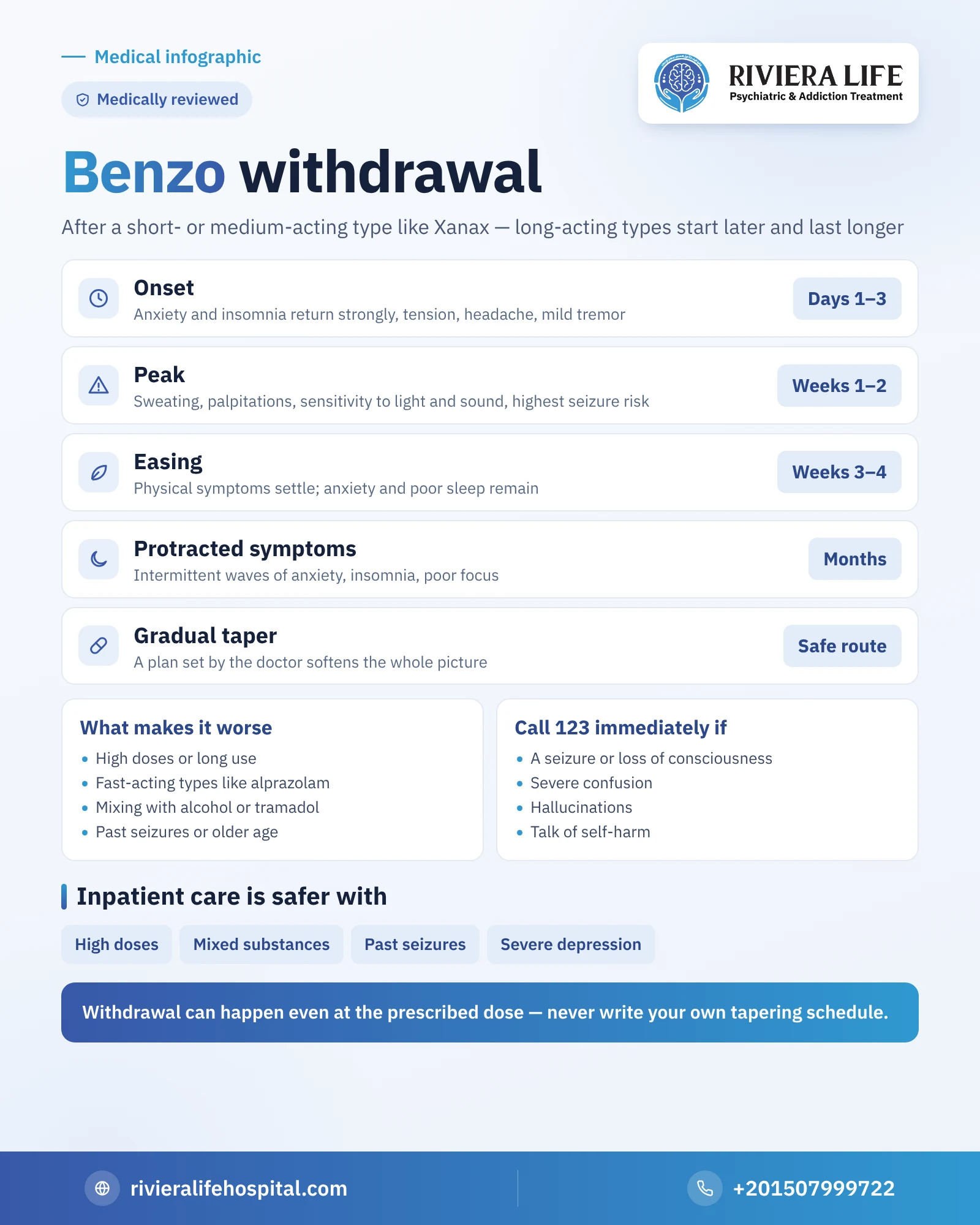
Benzodiazepine withdrawal symptoms usually begin within about one to two days of the last dose of short- and medium-acting types such as Xanax, and may be delayed to several days with long-acting types such as Valium. Symptoms usually peak during the first and second weeks, then ease gradually over weeks, and some may remain for months in a small number of patients.
If the medicine is clonazepam, known by the brand names Rivotril and Clozapam, the delayed timing of its withdrawal is explained in our article on Clozapam and Rivotril withdrawal symptoms.
What sets this withdrawal apart from others is that it can be genuinely dangerous, as it can cause seizures or delirium when the drug is stopped suddenly. So this article explains what happens day by day, why sudden stopping is forbidden, and when the symptoms become an emergency.
Why does benzodiazepine withdrawal happen?
Imagine a brain that works with a natural braking system that calms excess nerve signals. Benzodiazepines press on these brakes from the outside for weeks or months, so the brain adapts by easing its own pressure on them, and in return raises the activity of its alerting systems to keep its balance. When the medicine disappears suddenly, the brain finds itself with weak brakes and the accelerator pressed down. This is withdrawal: an overexcited nervous system, showing up as anxiety, tremor, insomnia and oversensitivity, and in its most severe form as a seizure.
And it doesn’t take “addiction” in the common sense of the word for withdrawal to happen. Someone who takes their tablet regularly, as the doctor prescribed, for several months may go through clear withdrawal if they stop suddenly, just like someone misusing large amounts, even if the severity differs.
When do withdrawal symptoms start?
The most important factor in the timing is how long the medicine stays active in the body. Types that leave the body quickly, such as alprazolam and lorazepam, start their symptoms early, usually on the first or second day, and sometimes even earlier, between doses themselves.
Types that stay for days, such as diazepam and chlordiazepoxide, may not show symptoms until about three days to a week later, and they usually come more gently but last longer. This delay fools many people, who think they have got through safely, and then the symptoms suddenly begin. To find out how long each type stays in the body and shows up in a test, see our article on how long benzodiazepines stay in your system.
The stages of benzodiazepine withdrawal
The durations differ from person to person, but the general picture after stopping a short- or medium-acting type usually passes through the following stages:
| Stage | Approximate timing | What usually happens |
|---|---|---|
| Onset | Day one to day three | Anxiety and insomnia return strongly, tension, headache, mild tremor |
| Peak | Week one to week two | Sweating, palpitations, muscle spasms, sensitivity to light and sound, and the highest likelihood of seizures |
| Easing | Roughly week three to week four | Physical symptoms gradually settle, while anxiety and disturbed sleep remain |
| Protracted symptoms | Weeks to months in some patients | Intermittent waves of anxiety, insomnia and poor concentration |
With long-acting types, each stage is delayed by several days and lasts a little longer. And with an organized gradual taper, the picture is much milder, and the acute peak may not appear at all.
Common symptoms during withdrawal
Physical symptoms
- Tremor in the hands, sweating and palpitations.
- Muscle aches, spasms and twitching, and a persistent headache.
- Nausea and loss of appetite, and sometimes dizziness and unsteadiness.
Psychological symptoms
- Severe anxiety that may reach panic attacks, even in people who never had panic before.
- Distressing insomnia and nightmares, with nervousness and short temper.
- Low mood and poor concentration and memory.
Strange sensory symptoms
Many people complain of things that are hard to describe: ordinary light seems irritating, sounds seem louder than they really are, there is numbness or tingling in the skin, a metallic taste in the mouth, or a sense that the world isn’t real and that the person is watching themselves from outside. These symptoms are frightening, but they are medically recognized and pass with time, and knowing about them in advance greatly reduces the panic when they appear.
When does withdrawal become dangerous?
In a proportion of cases, especially after suddenly stopping high doses or long-term use, life-threatening complications may appear: generalized seizures, delirium in which the patient loses awareness of place and time, or hallucinations and persecutory ideas. Suicidal thoughts may also appear in someone with accompanying depression. It isn’t possible to predict precisely who will develop these complications, which is why doctors treat any stop after regular use as a possibility that deserves caution.
Call an ambulance immediately on 123 if you see
While stopping the sedative or in the days after it, even if the condition seemed stable before.
- A seizure or loss of consciousness, even for a minute
- Severe confusion, or not knowing the place, the time or the people around
- Auditory or visual hallucinations, or incoherent speech
- Violent tremor with heavy sweating and a high temperature, or a very fast heartbeat
- Talk of self-harm or suicide
Rebound anxiety, or the original problem returning?
Many people who started the medicine because of anxiety stop it and feel more anxious than ever, and conclude that they “can’t live without it”. The truth is that a large part of this anxiety in the first weeks is rebound anxiety caused by the withdrawal itself, and it is temporary and recedes gradually. But if the anxiety continues in the same pattern as before the medicine, long enough after the withdrawal period is over, this is the original problem returning, and it needs its own treatment, not a return to the sedative. Telling the two apart needs a psychiatrist who follows the patient week by week.
Protracted symptoms after withdrawal
After the acute symptoms pass, some patients go through a long period of intermittent improvement: good days followed by waves of insomnia, anxiety, tingling or poor concentration for no clear reason. These waves may last months in a minority, and usually lessen in severity and frequency over time. Their real danger is that they push the patient to go back to the medicine in a moment of weakness. What helps in this stage is regular sleep, physical activity, psychotherapy, and knowing that these waves are an expected part of recovery, not a sign of relapse.
What makes withdrawal more severe?
- Daily use over a long period, months or years.
- High doses, or going beyond what the doctor prescribed.
- Types that leave the body quickly, such as alprazolam.
- A previous history of seizures or a difficult withdrawal.
- Mixing the sedative with alcohol or other substances.
- An accompanying mental disorder such as panic disorder or depression.
- Older age or chronic illnesses.
Why is sudden stopping forbidden?
The medical rule is clear: someone who uses benzodiazepines regularly doesn’t stop them all at once. The safe route is a gradual reduction set by the doctor, which sometimes begins by switching the patient to a long-acting type that keeps the level of medicine in the blood steadier, then the amount is lowered in stages according to their response. The pace of reduction differs greatly from one patient to another, and tapering may stretch over weeks or months. No patient should set their own reduction schedule or copy someone else’s experience. You will find the details of this plan and the full stages of treatment in our article on benzodiazepine addiction treatment.
Withdrawal when the sedative is part of a mix
In Egypt, a patient rarely comes with a sedative alone. Xanax or Rivotril is often mixed with tramadol, pregabalin or alcohol. This completely changes the picture of withdrawal: the symptoms overlap so it is hard to know where each one comes from, the risk of seizures rises because more than one substance lowers the seizure threshold, and the doctor needs to arrange the withdrawal of each substance in a way that doesn’t set off withdrawal from another. If the person uses Xanax specifically, the details of its withdrawal are in our article on Xanax withdrawal symptoms, and you will find the comparison with withdrawal from a related substance in our article on pregabalin withdrawal symptoms.
Older people and pregnant women
Older people are more prone to confusion and falls during withdrawal, and symptoms may appear in them as mental fogginess that is wrongly taken to be the start of dementia. So the reduction is slower for them and under closer monitoring. A pregnant woman who uses benzodiazepines regularly should never stop suddenly, because withdrawal may harm her and the baby, and the decision here is shared between the obstetrician and the psychiatrist.
When does withdrawal need a hospital stay?
A gradual taper can be managed in outpatient clinics for many stable patients. But a stay under round-the-clock medical supervision is the safer option in specific cases: high doses, mixing with alcohol, opioids or pregabalin, a previous history of seizures or delirium, failed previous attempts, a severe mental disorder or suicidal thoughts, and the absence of someone who can stay with the patient at home.
Valium withdrawal symptoms: what sets them apart?
Valium withdrawal appears later than with the short-acting types, so several days may pass after the last tablet before the patient notices anything, because the body clears the medicine slowly. Then it builds gradually: anxiety, insomnia, tremor, sweating and muscle tension, and the peak may be delayed to the second week.
This slow character fools some patients into thinking they have passed the danger, while the possibility of a seizure remains during that period. Psychological symptoms may last for weeks, and it is sometimes hard to tell rebound anxiety from the original problem returning.
- Stopping suddenly after regular use is a risk, especially with large doses or long-term use.
- A gradual reduction under the doctor’s supervision eases the symptoms considerably.
- A seizure or severe confusion calls for an ambulance immediately on 123.
If the person mixes Valium with alcohol or tramadol, the risks are greater, and it is better for the reduction to start in a medical setting that can deal with any complication. Our article on Valium addiction treatment shows how a safe taper is carried out, and the medicine diazepam (Valium) explains its medical uses and warnings.
How can Riviera Life help you?
At Riviera Life, tapering begins with an assessment that identifies everything the patient is actually taking, then consultants in psychiatry and addiction treatment set a reduction plan suited to their condition, with round-the-clock medical supervision for those who need an inpatient stay, and treatment for the anxiety and insomnia that appear along the way. To understand what drives people to keep taking the sedative in the first place, see our article on the causes of benzodiazepine addiction.
More from our benzodiazepine guide
- Benzodiazepines: the complete guide
- Benzodiazepine addiction symptoms
- The harmful effects of benzodiazepines on the brain and body
- Benzodiazepine addiction treatment
- Rivotril withdrawal symptoms: why they’re delayed, how long they last and when they become dangerous
- Parkinol withdrawal symptoms: the timeline, cholinergic rebound and when to worry
- Lorazepam (Ativan): uses, effects, dependence and withdrawal
Questions many people ask
It can be, especially after suddenly stopping high doses or long-term use, as it can cause seizures or delirium. That is why the drug is tapered gradually under medical supervision.
The acute stage usually lasts about two to four weeks, and longer with long-acting types. Waves of anxiety and insomnia may remain for months in some patients.
Usually because of rebound anxiety caused by the withdrawal itself, which is temporary and eases gradually. If it continues after withdrawal is over, it may be the original problem returning and needs its own treatment.
Yes. Regular use for weeks or months, even at the prescribed dose, can cause physical dependence, so withdrawal appears when it is stopped suddenly.
This isn't advised. The pace of reduction differs from person to person and needs medical follow-up to avoid seizures and relapse. Ask your doctor for a written plan and regular follow-up.