Benzodiazepine addiction usually doesn’t start on the street, but in a clinic or pharmacy. Most people who depend on these medicines started with a prescription to treat anxiety, insomnia or panic attacks, then the period lengthened or the dose increased without review. The causes of benzodiazepine addiction come down to several factors that combine to turn use into addiction: a fast-acting medicine, daily use for weeks, an untreated psychological problem, a history with other substances, and easy access to tablets. In this article we explain these factors one by one, why some people fall into them and not others, and how someone taking a sedative on prescription can reduce the risk of falling into them.
How does the road usually start?
A common story: an employee in his forties goes through a period of intense pressure, sleeping only two hours, so a doctor prescribes him a sedative tablet “for two weeks”. He sleeps for the first time in months, and feels his life has come back. The pack runs out and the insomnia returns stronger, so he buys another pack from a pharmacy that knows him.
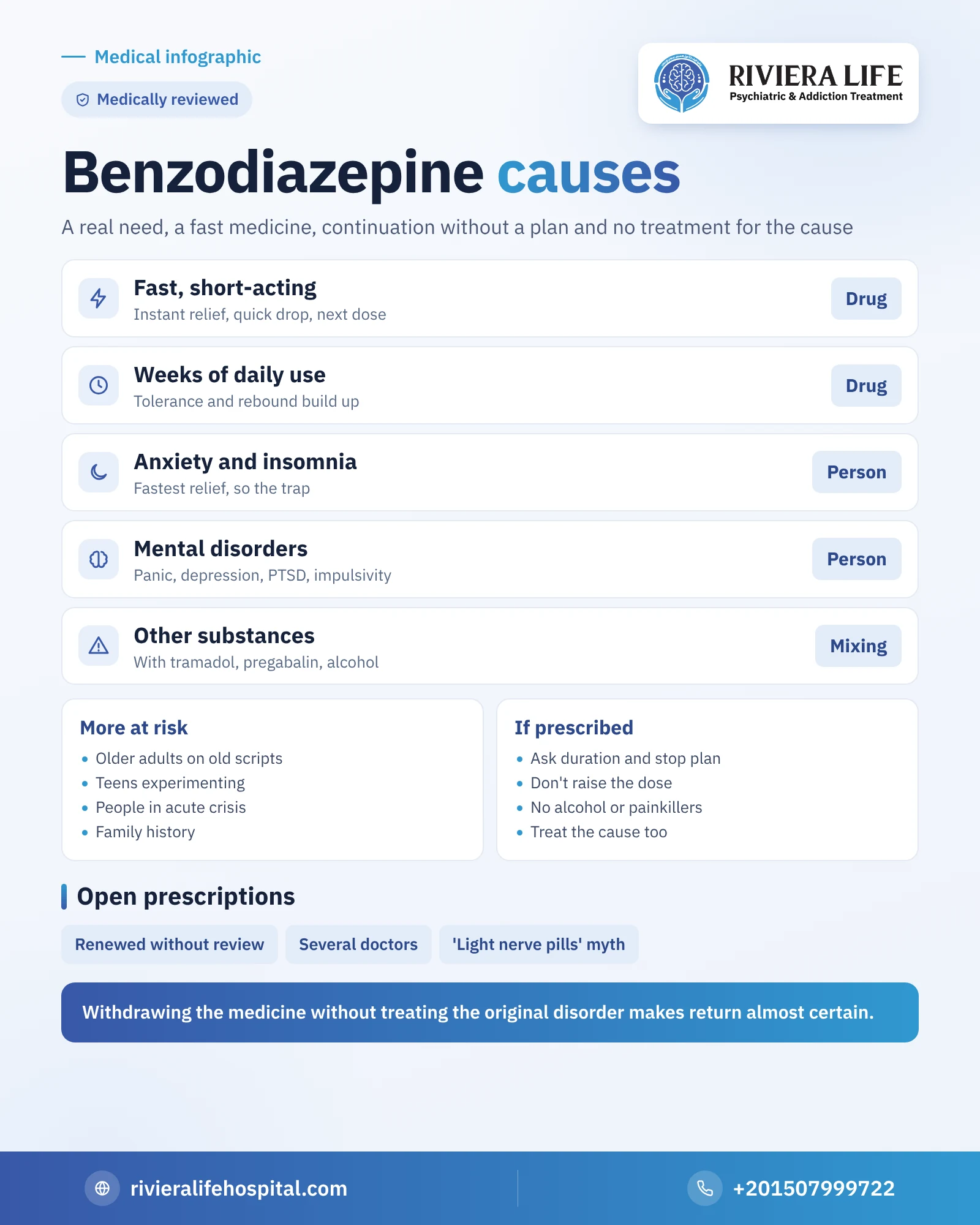
After six months, one tablet is no longer enough, and he has started taking half a tablet at midday “to calm down” at work. He never once looked for a high, and doesn’t see himself as an addict, but he can no longer manage a single day without the medicine. This story sums up most of the factors we will talk about: a real need, a medicine that works quickly, continuation without a plan, and no treatment for the cause.
What happens in the brain?
Benzodiazepines strengthen the action of GABA, a natural substance that calms nervous activity. With daily use the brain adapts to this outside support and reduces its sensitivity to it, so the person needs a larger dose for the same effect, which is tolerance. At the same time the medicine’s absence becomes unpleasant, as anxiety and insomnia return strongly. Added to this, the quick relief the tablet gives is fixed in memory as a ready solution to every tension, so it turns from a treatment into a habit, then into a need. The details of what happens when the medicine is absent are in the article on benzodiazepine withdrawal symptoms.
Factors related to the medicine itself
Not all benzodiazepines are equal in the risk of dependence. Some properties clearly raise it:
- Speed and short duration of action: types that work within minutes and then wear off quickly, such as alprazolam, give immediate relief followed by a quick drop, pushing to the next dose.
- Duration of use: the risk rises clearly after weeks of continuous daily use.
- The dose: the higher the dose, the greater the tolerance and the harder the reduction.
- An uncontrolled “as needed” pattern: when the patient is left to take the tablet whenever they feel tense, their nerves learn the solution is always in the strip.
Anxiety and insomnia: seeking calm at any price
Chronic anxiety and insomnia are among the strongest motives behind continuing, because the medicine treats them with a speed no other treatment matches in the first days. But this very speed is the trap. Psychotherapy needs weeks to bear fruit, and the antidepressants used for anxiety need time to work, while the sedative tablet gives relief within half an hour. And someone who hasn’t learned another way of dealing with their tension finds themselves after months relying on the fastest and shortest-acting solution.
Accompanying psychological disorders
The likelihood of dependence on sedatives rises in those with psychological disorders, especially:
- Panic disorder and sudden attacks of fear.
- Depression, where the medicine may be used to smother inner distress.
- Post-traumatic stress disorder, and painful memories that intrude at night.
- Personality disorders linked to impulsivity and mood swings.
In these cases the sedative isn’t the only problem, but a cover for a deeper one. And if the medicine is withdrawn without treating the original disorder, going back to it is almost certain.
A history with other substances
Someone who uses other substances, or has done before, is much more prone to misusing benzodiazepines. In Egypt well-known patterns recur: a sedative tablet with tramadol to strengthen the “head”, or with pregabalin, or after a night of stimulants or hash “to come down” and sleep, or with alcohol. Here the sedative isn’t a medicine but part of a mix, and this raises the risk of addiction and the risk of stopped breathing together. And someone who has previously recovered from addiction to another substance needs special caution if prescribed a sedative, and the doctor must know their full history. You can learn about similar patterns in the article on the causes of pregabalin addiction.
Heredity and family history
Having a first-degree relative who suffered from addiction to alcohol or any substance raises the likelihood of addiction in general, including sedatives. This doesn’t mean addiction is an inevitable fate; heredity increases predisposition and doesn’t settle the outcome. But it is a good reason for the person to tell their doctor their family history before starting any sedative medicine, and to be more committed to the set duration.
Easy access to tablets
The easier the medicine is to get, the higher the risk of misuse. Among the known pictures: dispensing without a prescription in some places despite the law forbidding it, repeated prescriptions from more than one doctor, a family member’s leftover medicines in the home cupboard, tablets passed between friends, and smuggled or counterfeit tablets sold as Xanax or Rivotril that are of unknown composition. These last add another danger, because the person may take a much stronger substance than they think.
The open prescription: when no one reviews
Part of the problem doesn’t concern the patient alone. A prescription renewed month after month without a review appointment, or without a question about the duration and stopping plan, turns over time into chronic use that no one really decided on. The patient may move between more than one doctor, each prescribing a sedative without knowing what the other prescribed, so doses accumulate. Making matters worse is a common belief that these are “light nerve pills” that don’t need follow-up. That is why medical guidelines stress that every sedative prescription should be short and specific, reviewed regularly, and that the patient should tell every doctor they visit about all the medicines they take.
Groups at higher risk
Older adults
Many of them have been prescribed a sedative or sleeping pill for many years without review, so use continues out of habit, and stopping becomes frightening for them and their families.
Young people and teenagers
They try the tablets out of curiosity or imitating friends, or to calm study pressure, and often mix them with other substances without realizing the danger of combining.
People going through acute crises
Loss, divorce, job loss and financial pressure are moments when sedatives are often prescribed and the wish to continue on them after the crisis has passed is common.
How do you reduce the risk if you are prescribed a sedative?
- Ask your doctor from the start: how long? And what is the stopping plan?
- Don’t increase the dose or change its times yourself, even if you feel it is no longer enough.
- Don’t combine the sedative with alcohol, painkillers or pregabalin.
- Ask for treatment of the cause, such as cognitive behavioral therapy for anxiety or insomnia, alongside the medicine.
- Don’t keep leftover tablets or give them to anyone.
- See the doctor as soon as you notice you are thinking about the tablet more than you should.
How does Riviera Life help you?
Understanding the cause is half the treatment. That is why the consultant psychiatrists at Riviera Life start by looking for what stands behind the sedative: anxiety, insomnia, trauma or another substance, then a plan is built combining safe gradual withdrawal with treatment of this cause. You will find the stages of the plan in the article on benzodiazepine addiction treatment, and the signs of the problem in the article on benzodiazepine addiction symptoms.
More from the benzodiazepines guide
- Benzodiazepines: the complete guide
- Benzodiazepine addiction symptoms
- The harms of benzodiazepines
- Xanax addiction
Questions many people ask
Yes, daily use for weeks on end may cause dependence even at the prescribed dose, and the risk increases if the period lengthens or the dose increases without review.
Because it works quickly and its effect wears off within a few hours, giving immediate relief followed by a quick drop that pushes to the next dose.
Chronic anxiety and insomnia are among the strongest motives for continuing, especially if they aren't treated with psychotherapy or non-dependence-causing medicines alongside the sedative.
A family history of addiction raises the predisposition, but doesn't settle the outcome. Someone with this history needs greater commitment to the set duration and to tell their doctor.
Ask about the duration of use and the stopping plan, don't increase the dose yourself, don't mix it with alcohol or painkillers, and ask for treatment of the cause alongside the medicine.