Benzodiazepine addiction symptoms are calmer than the symptoms of most drugs, which is why they pass for months without anyone noticing them. The most prominent things the family notices: drowsiness at the wrong times, heavy speech, forgetting recent events, a clear attachment to the tablet before sleep or before any anxious situation, and tension and irritability if the dose is late. Over time clearer signs appear such as increasing the amount without consulting the doctor, looking for prescriptions from more than one place, and mixing the sedative with painkillers or alcohol. In this article we arrange these signs from the earliest to the most dangerous, and explain when the next step is a visit to the doctor, and when it is a call to the ambulance.
When does a nerve medicine turn into addiction?
Not everyone who takes a sedative is an addict. There is an important difference between three situations. The first: short medical use with a prescription and follow-up, which is the normal situation. The second: physical dependence, when the body gets used to the medicine after regular use so withdrawal symptoms appear when it is stopped, even if the person has kept to the prescribed dose. The third: addiction, a behavioral pattern in which the person loses control over use,
increases the amount and continues despite harm, and getting the medicine becomes the center of their day. The signs we mention here mainly concern the third situation, but the second also needs medical follow-up. And for those whose questions revolve around a particular medicine, we explained how dependence on clonazepam starts and what distinguishes it in the article on Rivotril (clonazepam) addiction.
Early signs that are easy to ignore
At first nothing seems strange. The person says the tablet “calms their nerves” or “helps them sleep”. But there are small details that deserve attention:
- They take the tablet before every anxious situation, not just before sleep: a work meeting, an errand, or a family visit.
- They always carry the strip with them, and get tense if they forget it at home.
- They take the next dose a little earlier than its time, then earlier.
- They say the usual dose “no longer works” as it did.
- The box runs out before its expected time and they invent explanations for that.
Physical signs
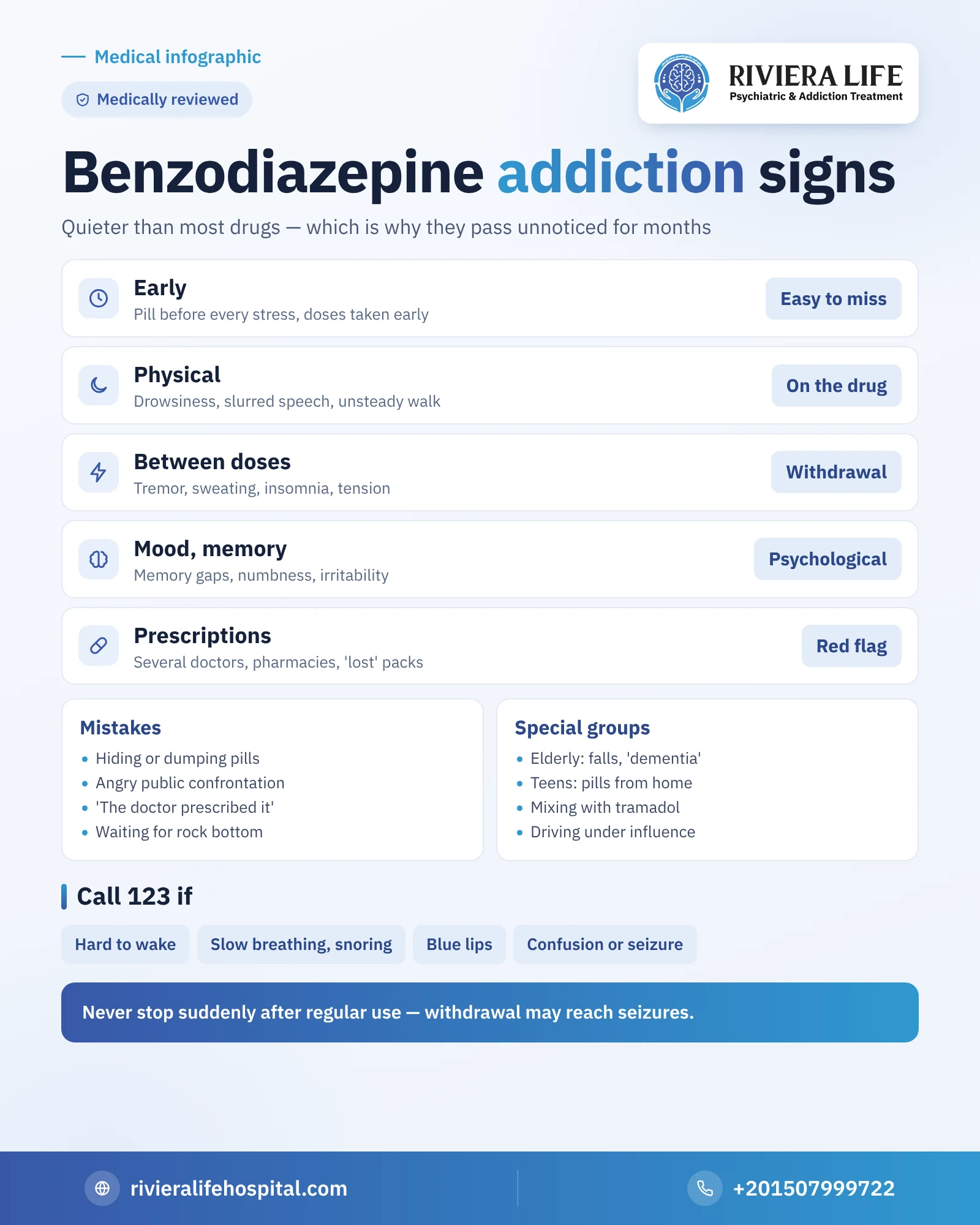
Physical signs usually appear in the hours of effect, and closely resemble the appearance of someone who has drunk alcohol without its smell:
- Drowsiness and heavy eyelids at unusual times, and dozing off while sitting or talking.
- Heavy or slurred speech.
- An unsteady walk, stumbling, and bruises they don’t remember the cause of.
- Slowness in movement and reaction, and general limpness.
- Dizziness and blurred vision at times.
In the hours when the medicine is absent the picture is reversed: slight tremor, sweating, headache, insomnia and muscle tension. This swinging between lethargy and tension is among the clearest signs for those watching closely.
Behavioral signs
Behavior is the most truthful thing the family sees, because addiction rearranges priorities:
- Increasing the amount without going back to the doctor, or taking tablets not prescribed for them.
- Hiding strips in scattered places, and lying about the amount remaining.
- Withdrawing from activities and friends, and spending more time sleeping or in the room.
- Declining work or study, lateness, absence and forgetting appointments.
- Asking for money repeatedly or selling things without a convincing explanation.
- Driving the car while under the influence, or repeated small accidents.
Psychological and mood signs
The paradox is that the medicine that started as a treatment for anxiety may become over time a source of anxiety. Between doses the person lives with rebound anxiety, so they take the dose to feel relief, then the anxiety returns stronger, and so on. The family also notices:
- Memory gaps: they don’t remember a conversation that took place yesterday or what they did at night.
- Emotional numbness, as if the person were present only in body.
- Irritability and quick agitation, especially if the tablet is late.
- A depressed mood and loss of enthusiasm.
- Unusual impulsive actions in some people, a known paradoxical reaction to these medicines.
These changes aren’t only signs, but part of the harm itself, and you will find the details of their effect on memory and mood in the article on the harms of benzodiazepines.
Signs related to prescriptions and pharmacies
Because benzodiazepines are medicines, the way of getting them reveals a lot. Pay attention if you notice prescriptions from more than one doctor in the same period, frequent visits to different pharmacies, or stories of the medicine being lost that repeat in order to ask for a new prescription. Among the worrying signs also is buying tablets from unofficial sources or through acquaintances, because these tablets may be counterfeit and of unknown concentration. And if the family needs medical confirmation, a test is useful but isn’t enough on its own, and you will find what it reveals and doesn’t in the article on how long benzodiazepines stay in the body.
Signs of mixing with other substances
In the Egyptian reality it is rare for the matter to be limited to the sedative. Commonly it is combined with tramadol to strengthen its effect, or with pregabalin, or used to calm the nerves after stimulants or hash, or alcohol is drunk with it. The signs of mixing are usually more severe: deep drowsiness that is hard to wake from, slow breathing or unusual snoring during sleep, and clear confusion. Here the matter isn’t just a sign of addiction, but the possibility of an overdose.
Call an ambulance on 123 immediately if there appear
Especially if the sedative is mixed with a painkiller, pregabalin or alcohol.
- Severe difficulty waking them or no response to calling
- Very slow or intermittent breathing or unusual snoring
- Blue lips or cold, pale skin
- Severe confusion or a seizure
How does the doctor diagnose addiction?
The doctor doesn’t rely on a single sign, but on a group of known criteria for sedative use disorder, looked at over roughly the last twelve months. Among them: using a larger amount or for a longer period than intended, failed attempts to reduce, spending a long time getting the medicine or recovering from its effect, urgent craving for it, neglecting work or home, continuing despite problems in relationships, giving up important activities, use in dangerous situations such as driving, continuing despite known physical or psychological harm, as well as tolerance and withdrawal.
The presence of two or more criteria indicates the disorder, and its severity increases with their number. Note that tolerance and withdrawal alone aren’t enough for diagnosis in someone using the medicine under medical supervision.
Signs in the elderly and teenagers
In the elderly the signs may be confused with advancing age: forgetfulness, repeated falls and mental confusion thought to be the start of dementia, while the cause may be a sedative they have been taking for years. A teenager, however, doesn’t usually get a prescription, and may use tablets taken from the home cupboards or from friends, and the matter appears as drowsiness at school, a sudden decline in grades, and a change of friends. In both cases any unexplained change deserves a review of the medicines in the house.
Common mistakes when noticing the signs
- Hiding the tablets or getting rid of them suddenly: may cause dangerous withdrawal reaching seizures.
- Angry confrontation in front of others: pushes toward denial and hiding.
- Settling for saying “the doctor prescribed it”: a prescription doesn’t prevent addiction if the duration lengthens or the dose increases.
- Waiting for “rock bottom”: every extra month makes tapering longer and harder.
When do you seek help?
Ask for a medical assessment if use has exceeded the period the doctor set, the amount has increased, a previous attempt to stop has failed, memory gaps and daytime drowsiness have appeared, or the sedative has started being mixed with any other substance. The first visit doesn’t mean being forced into residence, but an assessment that sets a safe plan. You will find the stages of this plan in the article on benzodiazepine addiction treatment, and if the sedative is Xanax in particular see Xanax addiction symptoms. At Riviera Life the first consultation is free, and the assessment is done in complete confidentiality by consultants in psychiatry and addiction treatment.
More from the benzodiazepines guide
- Benzodiazepines: the complete guide
- Benzodiazepine withdrawal symptoms
- Causes of benzodiazepine addiction
- Benzodiazepine addiction treatment
Questions many people ask
Physical dependence means the body has got used to the medicine so withdrawal symptoms appear when stopping it, and it may happen with regular medical use. Addiction, however, is losing control over use and continuing despite harm.
Yes, memory gaps and forgetting recent events are among the known effects of benzodiazepines, especially with high doses or mixing with other substances.
Possibly, if the duration has lengthened, he has increased the amount himself, or looked for extra prescriptions. It is best to see the doctor who prescribed it or a psychiatrist to assess the whole use.
Don't cut them off suddenly, as sudden stopping after regular use may cause dangerous withdrawal. The right thing is to request a medical assessment that sets a safe reduction plan.
Difficulty waking the person, slow breathing or blue lips, especially if the sedative was mixed with a painkiller or alcohol, and also any seizure. Call the ambulance on 123.