Xanax is the best-known brand name for alprazolam, a sedative medicine from the benzodiazepine family that doctors prescribe for anxiety disorders and panic attacks. It starts working quickly and wears off quickly, and this very property is what lets dependence on it form within a few weeks in some users. Xanax addiction isn’t limited to those who buy it outside the pharmacy; it may start with a genuine doctor’s prescription, then the doses grow larger and closer together without the person noticing. This article explains what Xanax is, why it is one of the most addictive sedatives, how dependence on it develops, and when medical intervention becomes necessary.
And if you are looking for information about the medicine itself, why it is prescribed, when it starts working and its side effects, you’ll find it in our guide to Xanax.
What is Xanax (alprazolam)?
Alprazolam is a medicine that acts on the central nervous system by enhancing the effect of a neurotransmitter called GABA, which is responsible for calming nerve cell activity. When this effect increases, tension eases, a racing heart slows and the person feels relaxed, possibly to the point of sleepiness. That is why it is used medically to treat generalized anxiety disorder and panic disorder, and is usually prescribed for short periods and under follow-up.
Xanax belongs to the benzodiazepine family, which includes other medicines such as clonazepam and diazepam, but it differs from them in two points: how fast it reaches the brain, and how short a time it stays there. It comes in an immediate-release form, which is the most widespread, and an extended-release form that releases the substance over longer hours. In Egypt it is subject to the controls on psychoactive medicines, so it is only dispensed on prescription, and trading or selling it outside that framework is an offense punishable by law.
Why is Xanax one of the most addictive sedatives?
Not all benzodiazepines are equal in their risk of addiction. Xanax combines several properties that raise this risk:
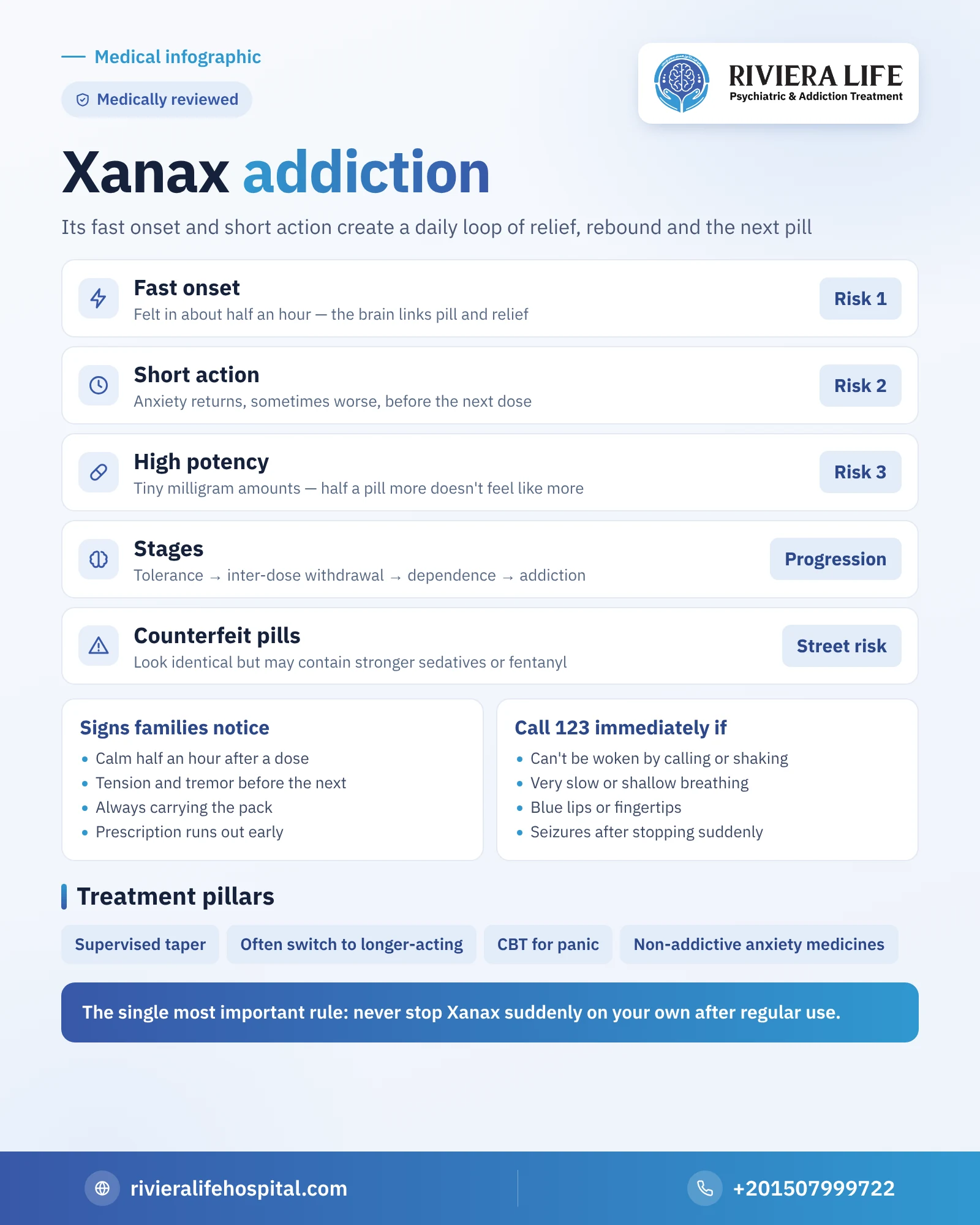
- Fast onset: many feel its effect within about half an hour, and this immediate sense of relief strongly links the pill with escape from tension in the brain.
- Fast wear-off: its sedating effect lasts a few hours, so anxiety returns, sometimes more strongly than before, ahead of the next dose.
- High potency: a very small amount in milligrams has a clear effect, so it is hard for the user to feel they have “increased” the dose when they add half a pill.
- Its link to a real problem: the person using it usually has genuine anxiety or panic, so stopping is frightening because it means facing the original symptoms.
This mix creates a repeating loop: a pill that relieves, then rebound anxiety hours later, then another pill to silence it. As the loop repeats, the brain learns that relief only comes from the pill.
How does dependence on Xanax develop?
Addiction doesn’t happen in a day; it usually passes through stages that can be traced if we know what to look for.
Tolerance
After weeks of regular use, the brain adapts to the presence of the substance, so the same dose has less effect, especially its sleep-inducing effect. The person notices that the pill that used to put them to sleep easily is no longer enough, so they tend to increase it or bring the times closer.
Inter-dose withdrawal
This stage is particular to Xanax because of its short action. Mild tremor, anxiety or insomnia appear in the hours before the next dose, and the patient interprets them as their original illness returning, while in reality they are an early sign of withdrawal.
Physical dependence
The body comes to need the substance in order to function normally, and any sudden reduction causes clear symptoms. Physical dependence can happen even when following the prescription, and doesn’t on its own mean addiction.
Addiction
It goes beyond the body to behavior: looking for extra sources, taking the medicine for reasons other than those it was prescribed for, and continuing despite problems at work, in the family or when driving. Here we are talking about a substance use disorder that needs specialist treatment.
The difference between physical dependence and addiction
Many patients feel insulted when they hear the word “addiction”, because they started with a doctor’s prescription. The distinction here matters: physical dependence is an expected response of a body that has got used to a particular medicine, and it is managed by a planned gradual reduction. Addiction means loss of control and compulsive use despite harm. The two may occur together, or one may exist without the other, but the first step in both cases is the same: don’t stop on your own, and ask for a medical assessment.
Xanax outside the pharmacy: the danger of counterfeit pills
When the prescription runs out or the doctor refuses to increase the dose, some users turn to unofficial sources. Here a danger enters that has nothing to do with alprazolam itself: international health reports point to the spread of fake pills designed to look exactly like Xanax in shape, color and imprint, while they may contain stronger synthetic sedatives or extremely dangerous synthetic opioids such as fentanyl. Someone who thinks they are taking “an ordinary Xanax pill” may be exposed to a dose their body can’t tolerate, and the genuine and counterfeit pills can’t be told apart by eye.
Mixing Xanax with other substances
The biggest danger of Xanax usually doesn’t come from it alone, but from mixing it. In Egypt it is common to combine sedatives with tramadol, pregabalin or alcohol, all substances that suppress the nervous system. Together, their effect on the brain’s breathing center multiplies, so breathing slows and may stop during sleep. Some stimulant users take Xanax “to come down” from their effect, entering a double loop of a stimulant by day and a sedative by night. The full details of this family’s harm to the body and memory are explained in our article on the harms of benzodiazepines.
Who is most at risk of Xanax addiction?
The risk is higher in those with a previous history with alcohol or drugs, those with chronic anxiety or insomnia that hasn’t been treated by anything other than medicine, those who use it for long periods beyond what the doctor planned, and those who get it from more than one source. Family history and constant stress also play a role. You’ll find these factors in detail in our article on the causes of benzodiazepine addiction.
Signs that point to a problem
The clearest signs are the medicine running out before it should, the person talking a lot about when the next dose is due, and periods of sleepiness, slurred speech and forgetting recent events. Because Xanax’s effect is short, a daily rhythm forms around the user that the family can see:
- A striking calm about half an hour after the dose.
- Tension, irritability and mild tremor returning hours before the next dose.
- Constant preoccupation with the pill’s time, and carrying the pack in a pocket or bag all the time.
- Clear anxiety if they are late home or forget the medicine.
- Insomnia at night, then waking tense and looking for the pill before anything else.
This rhythm is a small withdrawal that repeats every day; you’ll find its mechanism in our article on Xanax withdrawal symptoms, and the signs shared by all the medicines in this family in benzodiazepine addiction symptoms.
Why shouldn’t Xanax be stopped suddenly?
This is the most important piece of information in the whole article. Stopping Xanax suddenly after regular use, especially at high doses, can cause seizures or delirium, complications that threaten life. And because its action is short, withdrawal symptoms appear faster than with long-acting benzodiazepines. The safe way is a gradual withdrawal plan set and monitored by a doctor, which differs from person to person. The timing and stages are detailed in our article on Xanax withdrawal symptoms.
How is Xanax addiction treated?
Treatment rests on three pillars: safe, supervised gradual withdrawal; treating the anxiety or insomnia that led to use in the first place with methods that don’t cause addiction; then follow-up that prevents relapse. A patient who stops the pill without learning an alternative way to deal with their anxiety usually goes back to it at the first crisis.
Gradual withdrawal from Xanax
In many cases the doctor starts by switching the patient from alprazolam to a longer-acting benzodiazepine, because its level in the blood is steadier, so the patient doesn’t suffer sharp drops between doses. Then the amount is reduced in stages, leaving enough time between each step for the nervous system to adapt. This may take weeks in short cases, and months for someone who used the medicine for years; if symptoms intensify, the plan is slowed.
Treating anxiety and panic without Xanax
- Cognitive behavioral therapy for anxiety and panic: teaches the patient to understand the physical symptoms of panic and not run from them, and changes the thoughts that magnify danger.
- Long-term anxiety medicines: some antidepressants are used to treat anxiety and panic disorders and don’t cause addiction; the doctor decides according to the case.
- Stress-regulation skills: breathing exercises, muscle relaxation and gradual exposure to feared situations.
- Treating co-occurring disorders: such as depression and post-traumatic stress disorder, because leaving them untreated drives a return.
You’ll find the stages of the full program, its duration and when an inpatient stay is needed in benzodiazepine addiction treatment.
When do you need urgent intervention?
Call an ambulance on 123 immediately if you see
Especially if Xanax was mixed with alcohol, tramadol, pregabalin or pills of unknown origin.
- Severe sleepiness from which the person doesn’t wake when called or shaken
- Very slow or shallow breathing, or unusual snoring
- Blue lips or fingertips
- Seizures after stopping the medicine suddenly
- Severe confusion or hallucinations within days of stopping
At Riviera Life we treat patients who started with a prescription for panic as well as others who reached the point of mixing several substances, and in both cases we start with a confidential assessment that determines the level of dependence and the safe plan for stopping.
The harms of Xanax: what does it do to the brain and body with repeated use?
The harms of Xanax aren’t limited to sleepiness. It works by calming the whole brain, and with repetition the nervous system gets used to its presence, so its effect decreases and the need for it increases. Its short action makes this fluctuation clearer than with others: calm for hours, then rebound anxiety that pushes toward the next dose.
What families most notice in reality:
- Memory and concentration: forgetting recent events, and difficulty following a conversation or getting work done.
- Movement and safety: dizziness, unsteadiness and slowed reactions, raising the risk of falls and driving accidents, especially in older people.
- Mood: emotional blunting or quick temper, and the original anxiety may increase after the pill wears off.
- Sleep: broken, unrefreshing sleep, and rebound insomnia when trying to stop.
- Physical dependence: withdrawal symptoms that may reach seizures if the medicine is stopped suddenly after regular use.
The risks multiply with alcohol and other suppressant substances, and also increase with pills sold outside the pharmacy because their content is unknown. You’ll find the full picture of this family’s effect on the body and mental health in our article on the harms of benzodiazepines, and what happens on stopping is explained in Xanax withdrawal symptoms.
Xanax and tramadol together: why is combining them dangerous?
Some people think combining Xanax and tramadol gives “deeper relief”, and the medical truth is the opposite. The first is a benzodiazepine sedative, and the second is an opioid-like painkiller, and both slow breathing and dull consciousness. Together, severe sleepiness and slow breathing may appear within a short time, and the person may not wake from sleep.
Tramadol adds a danger of its own: it can lower the seizure threshold, and seizures are also a complication of stopping sedatives suddenly. So it is hard to predict what happens to someone who mixes the two substances and then tries to stop one of them without supervision.
This situation calls for urgent intervention if:
- Breathing is slow or irregular, or there is unusual snoring with difficulty waking.
- Lips or nails turn bluish.
- Seizures, delirium or severe confusion appear.
In these situations don’t wait; call an ambulance on 123. And if mixing is a continuing habit, the safe way to deal with it is a medical plan that addresses both substances together; learn about the tramadol side in the harms of tramadol, and about the organized way of stopping in Xanax addiction treatment.
More from our Xanax and sedatives guide
- Benzodiazepines: the complete guide
- Xanax withdrawal symptoms: stages and duration
- How long benzodiazepines stay in your system
- Rivotril (clonazepam) addiction: how dependence starts and when to seek help
Questions many people ask
Xanax is an approved medicine for anxiety and panic attacks, but it is a controlled medicine because misusing it causes dependence and addiction. The difference is in how it is used and medical supervision, not in the substance itself.
There is no fixed number, but physical dependence may start after a few weeks of daily use, and the risk rises with high doses and use for reasons other than prescribed.
Physical dependence can happen even with adherence, which the doctor knows and manages with gradual reduction. Addiction is linked to loss of control and compulsive use, and deserves review as soon as its signs are noticed.
Xanax starts working faster and lasts a shorter time than medicines such as diazepam, which makes the craving for it stronger and stopping symptoms appear sooner.
Yes. Combining them multiplies breathing suppression and raises the risk of unconsciousness and death, even at amounts that may seem ordinary for each substance alone.