The short answer
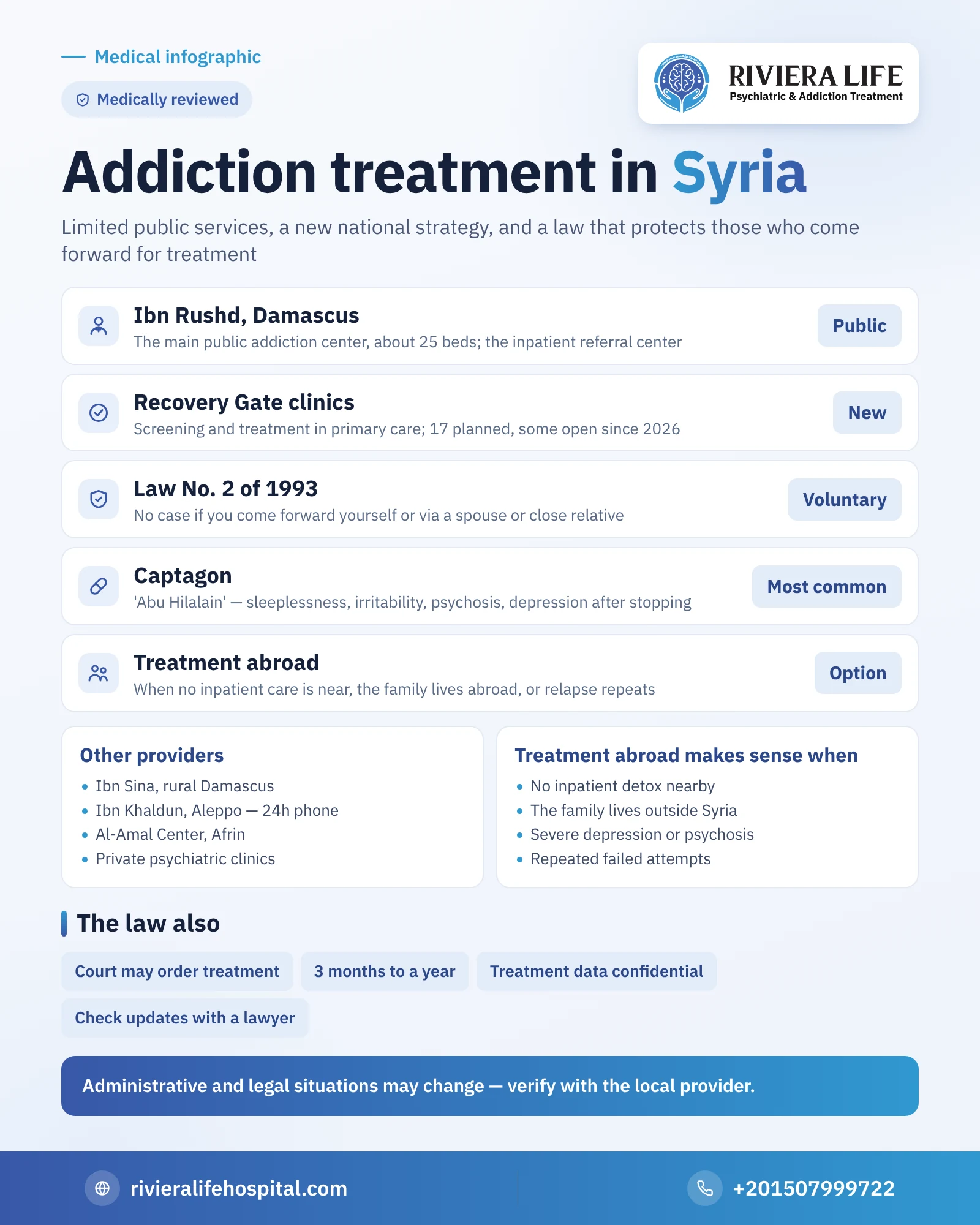
Public addiction treatment services in Syria are limited, the most notable being Ibn Rushd Hospital in Damascus, which works mainly as an addiction treatment center with about 25 beds. Narcotics Law No. 2 of 1993 provides that no public case is brought against a user who comes forward to an official authority for treatment in a clinic on their own, or at the request of their spouse or a relative up to the second degree, unless they are caught in the act of using or a case has been brought against them, with treatment data kept confidential. The law also allows the court to place an addicted person in a clinic instead of punishment. Captagon remains the most prominent substance Syrian families face.
- The public providerIbn Rushd Hospital in Damascus
- Voluntary treatmentYourself, or at the request of a spouse or relative up to the second degree
- The most prominent substanceCaptagon
For years, Syria’s name has been linked worldwide with captagon, and the biggest price has been paid by Syrian young people themselves, inside the country and in countries of refuge. With changing circumstances and strained health services, families need clear information: where to start, what protects their son legally, and when treatment in another country makes sense. This is what this guide tries to answer, with the caveat that administrative and legal situations may change, so checking with the local provider is essential.
Where is addiction treated in Syria?
Ibn Rushd Hospital in Damascus, formerly known as the National Youth Care Observatory, is the most prominent public provider of addiction treatment, working mainly as an addiction treatment center with about 25 beds. There are other public psychiatric hospitals, such as Ibn Sina in rural Damascus and Ibn Khaldun in Aleppo, which can be contacted for assessment and to learn what they offer. Because capacity is limited, many turn to private psychiatric clinics for assessment and follow-up.
What is new since 2025?
The Ministry of Health is now leading a national strategy on substance use for 2026 to 2030, based on bringing screening and treatment into primary care centers through “Recovery Gate” clinics. The plan is to establish 17 of these clinics in the governorates; some have already opened, at the Daraya Health Center in January 2026 and the Al-Shatee Health Center in Latakia in March 2026. These clinics offer confidential assessment, psychological support and medication treatment for mild cases, and refer moderate and severe cases to Ibn Rushd Hospital, the referral center for inpatient treatment.
In Aleppo, Ibn Khaldun Hospital provides addiction treatment and round-the-clock phone support, and is being equipped alongside Ibn Rushd for advanced treatment. In the north, the Al-Amal Rehabilitation Center opened in Afrin in January 2025, run by non-governmental organizations, offering three-week residential detox.
What does Syrian law say?
The matter is governed by Narcotics Law No. 2 of 1993, whose most notable provisions include:
- Punishing anyone who possesses or buys drugs for use or personal consumption with temporary detention and a fine.
- Allowing the court to suspend the sentence and place someone proven to be addicted in a treatment clinic for between three months and a year, unless they have been placed there twice before.
- No public case is brought against a user who comes forward to an official authority for treatment in a clinic on their own, or at the request of their spouse or a relative up to the second degree; this doesn’t cover someone caught in the act of using or against whom a public case has been brought.
- Confidentiality of the data of those being treated.
It is advisable to check any later amendments with a lawyer before taking any step, but the principle is clear: coming forward for treatment early, by the patient or the family, protects against prosecution.
Captagon: what does the family need to know?
Captagon is known in the region by names including “Abu Hilalain”, after the two crescents printed on the pill. The pills in circulation today aren’t the old medicine, but stimulant mixtures usually of unknown composition, which cause sleeplessness, irritability and loss of appetite, and may cause psychosis and aggression. The hardest part of stopping is the mood crash and depression in the first weeks, a stage that needs psychological follow-up so the patient doesn’t relapse or harm themselves. The details are in captagon addiction treatment.
When is treatment outside Syria a sensible option?
- When no inpatient detox or regular rehabilitation is available nearby.
- When the family itself lives outside Syria.
- When there is severe depression, psychosis or mixing of several substances.
- When stopping fails time after time in the same environment.
If you decide on treatment in Egypt
Many Syrian families today live in different countries, so the journey often begins with a confidential call in which more than one family member takes part from several places. The doctor assesses the case and suggests the program, then the closest family members arrange travel and accompaniment. Because the depression that follows captagon lasts for weeks, a detailed follow-up plan that continues remotely is written before discharge. The details of the journey are in addiction treatment in Egypt for Arab patients.
How can Riviera Life help you?
Riviera Life offers Syrian families, inside Syria or in their countries of residence, a confidential remote assessment, programs for treating stimulant addiction and the depression that follows it, and online follow-up after the program ends. The first consultation is free and confidential on +201507999722.
Read also
- Captagon: the complete guide
- Addiction treatment in Lebanon
- Addiction treatment in Jordan
- Addiction treatment in Egypt for Arab patients
Questions many people ask
The main public provider is Ibn Rushd Hospital in Damascus, which works mainly as an addiction treatment center, alongside other public psychiatric hospitals and private clinics.
Yes. Law No. 2 of 1993 provides that no public case is brought against someone who comes forward for treatment on their own or at the request of their spouse or a relative up to the second degree, unless they are caught in the act of using or a case has been brought against them.