Cocaine addiction treatment is possible, and many people get their lives back after it, but it differs from opioid treatment on one essential point: to this day there is no approved medicine that replaces cocaine or blocks its effect. That is why treatment is built on well-studied psychological and behavioral methods, starting with getting safely through the crash stage, then building skills to resist craving, then long follow-up that prevents relapse. Medicines are used to treat insomnia, depression, anxiety and the accompanying disorders. In this article we set out the stages in order, the most effective treatments, the expected duration, and how to choose the right hospital.
Stages of cocaine addiction treatment
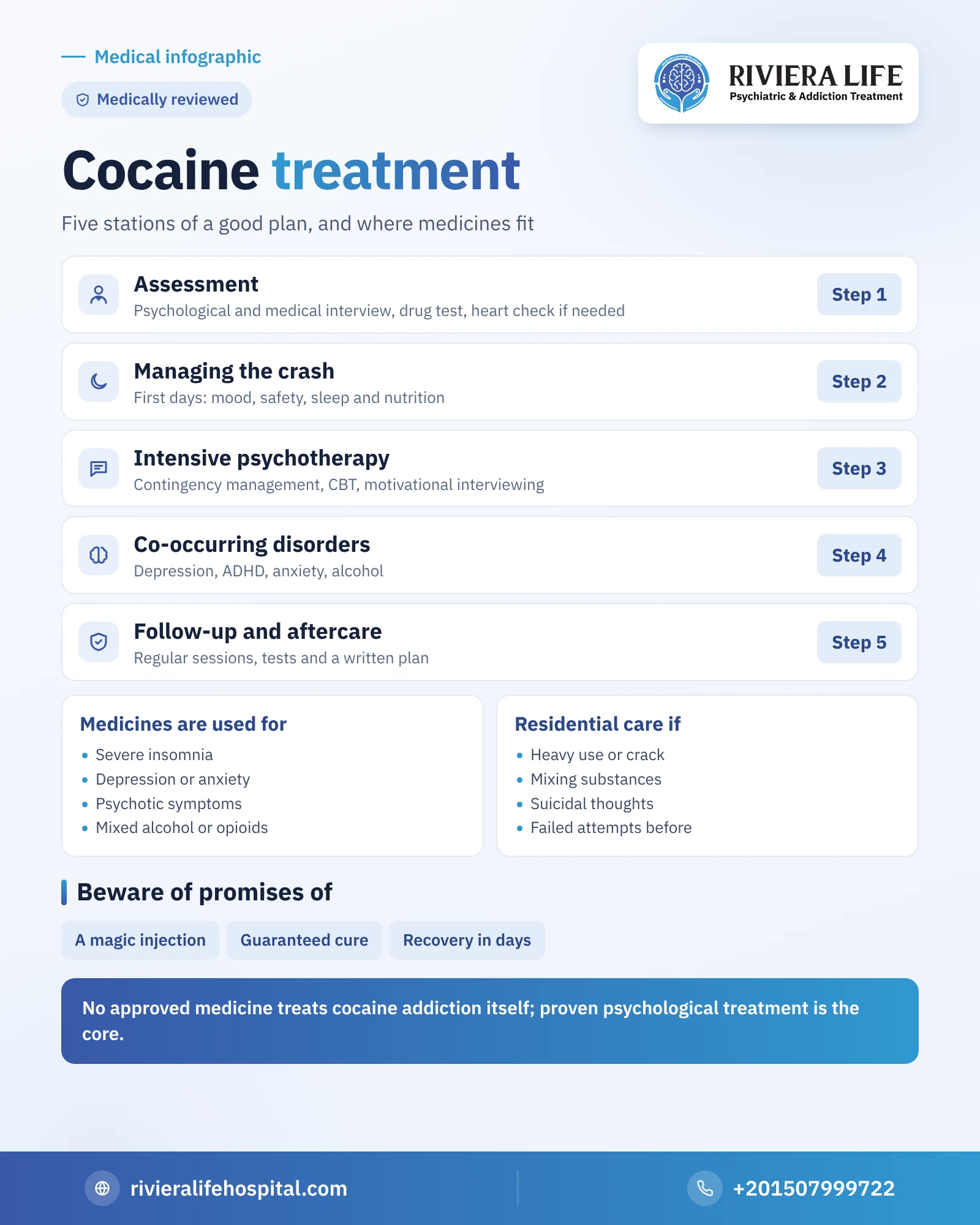
A good plan usually passes through five stations, the length of each depending on the case:
- Assessment: a psychological and medical interview, a test to find out every substance used, and a heart examination when needed.
- Managing the crash: care in the first days after stopping, monitoring mood and sleep.
- Intensive psychotherapy: individual and group sessions that build skills for dealing with craving and triggers.
- Treating what accompanies the addiction: such as depression, attention deficit hyperactivity disorder or alcohol use.
- Follow-up and aftercare: regular sessions, tests and a written plan for difficult times.
Jumping from the second station straight home is the most common mistake, because craving peaks in the following weeks, not in the first days.
Detox and managing the crash
Cocaine does not usually need detox in the sense that opioids or alcohol do, as there are no violent physical symptoms requiring substitute medicines. But the first days are not easy: long sleep, hunger and gloom that may reach suicidal thoughts in some patients. That is why the team focuses on monitoring mood and safety, organizing sleep and nutrition, and assessing any remaining psychotic symptoms. The details and timing of this stage are in the article Cocaine withdrawal symptoms.
If the patient mixes cocaine with alcohol, sedatives or opioids, however, medical detox becomes necessary for those substances, and it may be the most dangerous part of the plan.
Are there medicines for treating cocaine addiction?
Many medicines have been tried in research, and some showed encouraging results in specific groups, but none of them has so far received official approval for treating cocaine addiction itself. This does not mean medicine has no role, as the doctor prescribes what is needed for:
- Severe insomnia in the first weeks.
- Depression or anxiety if they persist or preceded the addiction.
- Psychotic symptoms if present.
- Attention deficit hyperactivity disorder after careful assessment.
- An accompanying addiction to alcohol or opioids, which has its own approved medicines.
And beware of any party that promises an “injection” or a “magic medicine” that ends cocaine addiction, as this is a claim science does not support.
The most effective psychological treatments
Contingency management
It is considered one of the strongest evidence-based methods in treating stimulants. The patient receives tangible rewards that grow with every consecutive negative urine test, and go back to the start if the chain is broken. It seems simple, but it addresses a basic problem in cocaine addiction: the brain needs a near, clear reward to hold on to instead of the substance.
Cognitive behavioral therapy
In it the patient learns to draw a map of their own moments of risk: when craving comes, what thoughts precede it, and what to do instead of using. One of its advantages is that the skills they gain stay with them after the sessions end.
Motivational interviewing
A style of conversation that helps the hesitant patient discover their own reasons for change, instead of feeling they are being driven into treatment. It is very useful at the start with someone who sees their use as “under control”.
The community reinforcement approach and family therapy
It rebuilds life around the patient: work or study, enjoyable drug-free activities, and supportive relationships. It is often combined with family sessions that change the way of communicating at home.
Treating co-occurring disorders
Ignoring depression, anxiety or hyperactivity disorder in a cocaine patient is like repairing a leaking roof without turning off the tap. Many patients started using because cocaine gave them a temporary feeling of focus or confidence, and treating the cause with suitable psychological or medical treatment reduces the chance of going back. We explain these roots in detail in the article Causes of cocaine addiction.
Residential or outpatient treatment?
Residence in hospital usually suits those who use heavily or smoke crack, mix other substances, have shown psychotic symptoms or suicidal thoughts, have failed in previous attempts, or live in an environment where the substance is easy to reach. Intensive outpatient treatment, on the other hand, may suit milder cases with good family support, or the stage after residence. The first assessment is what determines what suits best.
How long does recovery from cocaine take, and how long does treatment last?
Does a cocaine addict recover? Yes, recovery is possible, but it is measured in months, not days. The acute crash symptoms usually calm within days to two weeks, while mood, sleep and urgent craving usually need weeks to months to settle, and preventing relapse remains a long-term goal after that.
There is no single duration for everyone. The crash stage takes days, the intensive program usually weeks to a few months, and then outpatient follow-up extends for long months that may reach a year or more. Research indicates that staying in organized treatment for at least three months is linked to better results. And the most important rule is that the patient should not drop out suddenly between one stage and the next.
Treating crack addiction and mixed cases
Someone who smokes crack often needs a longer and tighter program, because craving is more violent and mood swings faster, and it is frequently accompanied by lung problems and severe weight loss. The details of this form are in the article Crack addiction. As for someone who combines cocaine with alcohol, tramadol or pregabalin, their plan is built on all the substances together, because quitting one while keeping the other often leads them back to the first.
Preventing relapse after discharge
The most dangerous moments for a cocaine patient are tied to money, late nights and people. That is why a relapse prevention plan usually includes: organizing how money is handled in the first months, cutting means of contact with dealers, changing the weekend routine, continuing sessions and periodic tests, and having a person the patient calls when craving hits. Relapse, if it happens, means reviewing the plan, not declaring failure.
The family’s role in the treatment journey
The family needs to learn how to support without funding the use, how to set limits without cutting ties, and how to read warning signs early. That is why serious programs dedicate sessions to the family itself. You will find practical steps in the article How to deal with a cocaine addict.
How do you choose a hospital for cocaine addiction treatment?
The right hospital for cocaine addiction treatment is not the one with the biggest advertising, but the one that offers what a stimulant patient specifically needs: strong psychological and behavioral treatment, close monitoring of mood, and a long plan after discharge. Ask before you decide:
- Does the program rely on treatments proven with stimulants, such as contingency management and cognitive behavioral therapy, or on residence alone?
- Does the team monitor the risk of depression and suicidal thoughts in the crash weeks?
- Is there a psychiatrist who assesses and treats psychosis, anxiety and hyperactivity?
- Is the heart examined when there are palpitations or chest pain?
- Are mixed substances such as alcohol and sedatives treated within the same plan?
- Is there follow-up after discharge and a family program?
And don’t trust a party that sets you a guaranteed cure rate or says cocaine addiction ends within days.
How Riviera Life meets these standards in cocaine addiction treatment
This is what the patient and their family find at Riviera Life in practice:
- Official licensing: a hospital licensed by the Ministry of Health.
- Experience built over the years: fourteen years in the field of addiction treatment, and thousands who have recovered.
- A team of consultants: doctors in psychiatry and addiction treatment who diagnose depression, psychosis and the other disorders that accompany cocaine and stimulants.
- A medical eye that never leaves: continuous supervision throughout the day during the crash stage and withdrawal symptoms.
- An individual plan: psychological and behavioral treatment that suits the pattern of cocaine or crack use and the substances mixed with it.
- Family program: sessions that teach the family support, setting limits and handling money.
- Aftercare: follow-up after discharge to prevent relapse.
- Complete confidentiality: full privacy for the data of the patient and their family.
Our team answers on +201507999722 at any hour, the first consultation costs you nothing, and you will find the hospital in Sheikh Zayed, Giza Governorate.
More from the cocaine guide
- Cocaine: the comprehensive guide
- Cocaine addiction symptoms
- The harms of cocaine
- How long cocaine stays in the body
Questions many people ask
So far there is no approved medicine for treating cocaine addiction itself. Treatment relies on proven psychological and behavioral methods, and medicines are used to treat insomnia, depression and the accompanying disorders.
The crash stage takes days, the intensive program weeks to months, and follow-up may extend for a year or more. Staying at least three months in organized treatment is linked to better results.
Some milder cases with good family support benefit from an intensive outpatient program. Heavy use, crack, mixing substances or severe depression, however, usually need residential care.
Look for a licensed hospital with proven psychological treatments for stimulants, close monitoring of mood and suicide risk in the crash weeks, psychiatric assessment of accompanying disorders, treatment of any mixed substances, and follow-up plus a family program after discharge. Riviera Life in Sheikh Zayed meets these criteria: it is licensed by the Ministry of Health, has fourteen years of experience and a team of consultants in psychiatry and addiction treatment, with round-the-clock supervision, a family program and aftercare.
No. Relapse is common in chronic illnesses, addiction among them, and it is a signal to review the plan and intensify follow-up, not to give up on treatment.