Zolpidem is a sleeping medicine prescribed to treat insomnia for short periods, and it is known in pharmacies under various trade names, the best known being Stilnox. Most people who come to depend on it start with a genuine prescription for difficult nights, then the weeks turn into months, and the idea of sleeping without it becomes frightening. Yes, zolpidem can cause physical and psychological dependence, and stopping it suddenly after long use or high doses can be dangerous. Zolpidem addiction treatment is possible, and it is based on gradual tapering under medical supervision together with treating the insomnia itself by methods that do not rely on pills, and that is what we explain here stage by stage.
Why does zolpidem cause dependence?
Zolpidem belongs to a group called “Z-drugs”, which are not benzodiazepines chemically, but they act on the same system in the brain: they strengthen the effect of the calming substance GABA, so the person falls asleep quickly. To understand this system and its relationship to addiction you can read GABA and addiction.
With continuous nightly use the brain adapts, so the effect weakens, and the person needs a larger amount to get the same result. And when they try to stop, insomnia rebounds more severely than before, so they go back to the pill convinced that they cannot sleep without it. This cycle is the beginning of dependence.
Is dependence on zolpidem the same as addiction?
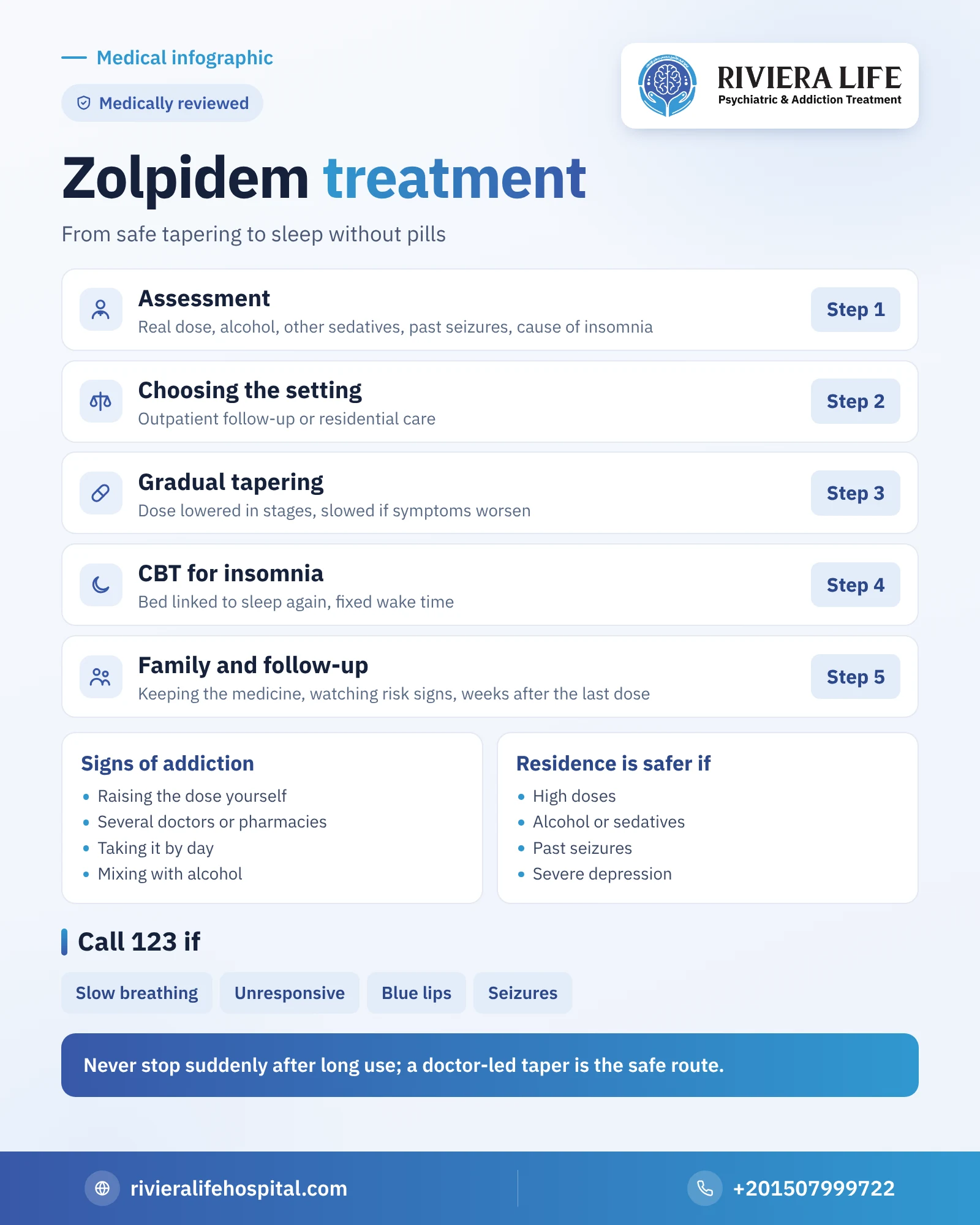
Not always. The body may depend on the medicine in someone who takes it exactly at the prescribed dose, and this needs a stopping plan, nothing more. Addiction, however, shows itself in clear behaviors:
- Raising the dose by themselves or taking an extra pill when waking at night.
- Getting it from more than one doctor or pharmacy.
- Taking it during the day to calm down or for the feeling of relaxation and dizziness.
- Mixing it with alcohol, sedatives or opioid painkillers.
- Failed attempts to stop despite the harms.
When is zolpidem a danger to life?
The greatest danger comes from mixing. Zolpidem alone rarely stops breathing, but combining it with alcohol or opioids such as tramadol or with benzodiazepines multiplies the depression of the nervous system. And there is another danger specific to this group: complex behaviors during sleep, such as the person driving a car, cooking or leaving the house while not conscious, and then remembering nothing. This happening even once is reason enough to see the doctor immediately.
Call the ambulance on 123 immediately if there appears
After a large amount of zolpidem, especially with alcohol, sedatives or other painkillers, or during sudden stopping, ask for urgent help if there appears:
- Slow or weak breathing or unusual snoring with difficulty waking
- Loss of consciousness or no response when called
- Blueness of the lips or limbs
- Seizures while stopping the medicine
- Severe confusion or hallucinations
- Thoughts of self-harm
Why is sudden stopping not right?
Stopping all at once after long use may cause severe rebound insomnia, anxiety, tremor, sweating and palpitations, and in rare cases with high doses, seizures. That is why proving willpower by throwing the box in the bin is not advised. The safe route is gradual tapering on a schedule the doctor sets and adjusts according to the patient’s response.
What do withdrawal symptoms look like and how long do they last?
Symptoms may start within hours to a day of the last dose or of lowering it, because the medicine is short-acting. The most prominent are difficulty falling asleep and frequent waking, then anxiety and irritability, tremor, sweating, headache and nausea, and difficulty concentrating. The first days are usually the hardest, then the acute symptoms improve within days, while sleep and mood need weeks to settle. And the duration differs greatly from one person to another depending on the dose, the length of use and other substances.
Stages of zolpidem addiction treatment
Assessment and determining the level of risk
The doctor asks about the actual amount the patient takes, not the amount written on the prescription, and about alcohol and other sedatives, any previous seizures, and the original cause of the insomnia: anxiety? depression? pain? interrupted breathing during sleep?
Choosing where to be treated
Based on the assessment, it is decided whether outpatient follow-up is enough or residence is needed. We will come back to this point in detail shortly.
Gradual tapering
The doctor lowers the dose in stages, and slows the pace if symptoms intensify. Slow tapering is not failure; what matters is that it continues without jumps or going back to the old dose.
Cognitive behavioral therapy for insomnia
This is the cornerstone. The therapy links the bed with sleep again instead of anxiety, regulates waking times, reduces time wasted lying awake in bed, and confronts thoughts such as “if I don’t sleep tonight my day will collapse”. For help organizing sleep during recovery read Melatonin and sleep.
Treating what lies behind the insomnia
Many zolpidem patients have anxiety or depression that has not been treated. Treating it reduces the need for the sleeping pill and protects against relapse.
The family and follow-up
The family takes part in keeping the medicine and handing over only the scheduled dose if the doctor asks, and in watching for warning signs, then follow-up continues after the last dose for several weeks at least.
Is there a medicine for treating zolpidem addiction?
There is no medicine approved specifically for treating its addiction. The doctor may use medicines for a short period to ease particular symptoms or to treat the accompanying depression and anxiety, but replacing zolpidem with another sleeping pill without a plan means moving the problem, not solving it. And for someone who was mixing it with Xanax or other benzodiazepines, the details of their plan are in Benzodiazepine addiction treatment.
Treatment at home or in hospital?
Outpatient treatment usually suits someone who takes the medicine at doses close to those prescribed, without alcohol or other substances, has no history of seizures, lives in a supportive home and keeps appointments. Residence, however, is safer for someone who takes high doses, or mixes it with alcohol or sedatives, or has previously had a seizure or hallucinations while stopping, or has failed in previous attempts, or has severe depression or suicidal thoughts.
When does sleep return to normal?
Rebound insomnia is temporary, and this is the most important thing the patient needs to hear. Sleep improves gradually over weeks with a fixed wake-up time, exposure to daylight in the morning, physical activity, and cutting caffeine in the afternoon. One bad night does not mean the treatment has failed.
Patients’ experiences with zolpidem: how does a quick fix turn into a problem?
The experiences of those who got used to zolpidem follow an almost fixed path. At first the person falls asleep quickly after the pill, and feels they have finally found a solution for insomnia. Then after weeks they notice that the pill no longer works as it did, so they take it earlier or add another pill, until sleeping without it becomes almost impossible.
Some users mention actions they don’t remember: messages they sent at night, food they ate, or calls they made, and they discover this in the morning from the family or from the phone. These behaviors during sleep are among the known effects of the medicine, and they are reason enough to see the doctor without delay.
As for those who stopped with a medical plan, they usually describe difficult first nights in which insomnia returns more severely than before, then a gradual improvement in sleep with behavioral therapy for insomnia over weeks. This is what makes the gradual plan more successful than sudden stopping, which often ends with a return to the pill after a few nights.
How do you choose a hospital for zolpidem addiction treatment?
The right hospital for zolpidem addiction treatment is the one that treats the insomnia itself, not the one that merely withdraws the medicine and leaves the patient to face their nights alone. Ask:
- Does the doctor set an individual, flexible gradual tapering schedule?
- Is cognitive behavioral therapy for insomnia offered within the program?
- Is there night supervision for those who need residence or have a history of seizures?
- Does it deal with mixing zolpidem with alcohol, benzodiazepines or tramadol?
- Does it treat the accompanying anxiety and depression?
- Is there follow-up after the last dose?
And don’t be fooled by promises of guaranteed cure or getting rid of the sleeping pill within a few days.
How Riviera Life meets these standards in zolpidem addiction treatment
Here is how these standards are met at Riviera Life:
- Ministry of Health licensing: a hospital licensed for psychiatry and addiction treatment.
- Medical supervision night and day: round-the-clock follow-up during tapering, which is what nights of rebound insomnia need.
- Consultants in psychiatry and addiction: they set the tapering schedule and treat anxiety and depression.
- Behavioral treatment of insomnia: to restore natural sleep without pills.
- Experience spanning fourteen years: during which thousands of patients recovered from dependence on sedatives, sleeping pills and other substances.
- Complete confidentiality: the patient’s data does not leave the treating team.
- A family program and aftercare: that accompany the patient after discharge.
With zolpidem, the first consultation is free of charge; our phone +201507999722 answers night and day, and our hospital is in Sheikh Zayed, Giza.
Read also
- Benzodiazepines: the comprehensive guide to sedatives
- Benzodiazepine withdrawal symptoms
- Xanax addiction treatment
- Tryptizol addiction treatment
- Insomnia: the comprehensive guide
- Zolpidem (Night Calm): the comprehensive guide
- Night Calm withdrawal symptoms: the first nights, rebound insomnia and when to worry
Questions many people ask
It is a prescription sleeping medicine under regulatory control, not a narcotic drug in the common sense. But it can cause dependence and misuse, especially with long-term use or doses higher than prescribed.
Usually the first days after lowering the dose, when insomnia rebounds and anxiety rises. The acute symptoms usually improve within days, while sleep needs weeks to settle.
Yes, for most people, as rebound insomnia is temporary. Behavioral therapy for insomnia and fixed schedules speed up improvement more than any substitute sleeping pill.
Replacing it with another sleeping pill or sedative without a medical plan moves the dependence instead of treating it. Any helping medicine is chosen by the doctor for a set period within a full plan.
Choose a hospital that sets an individual, flexible tapering schedule, offers cognitive behavioral therapy for insomnia, provides night supervision for those who need residence, handles mixing with alcohol or sedatives, and treats accompanying anxiety and depression. Riviera Life in Sheikh Zayed meets these criteria: it combines gradual tapering under round-the-clock supervision with behavioral treatment of insomnia and treatment of anxiety and depression, and the first consultation is free.
Zolpidem is a sleeping medicine from the "Z-drug" group that doctors prescribe for short-term insomnia; it works by calming brain activity so that sleep comes more easily. It is not usually used for more than a few weeks because dependence on it builds with continued use.