The short answer
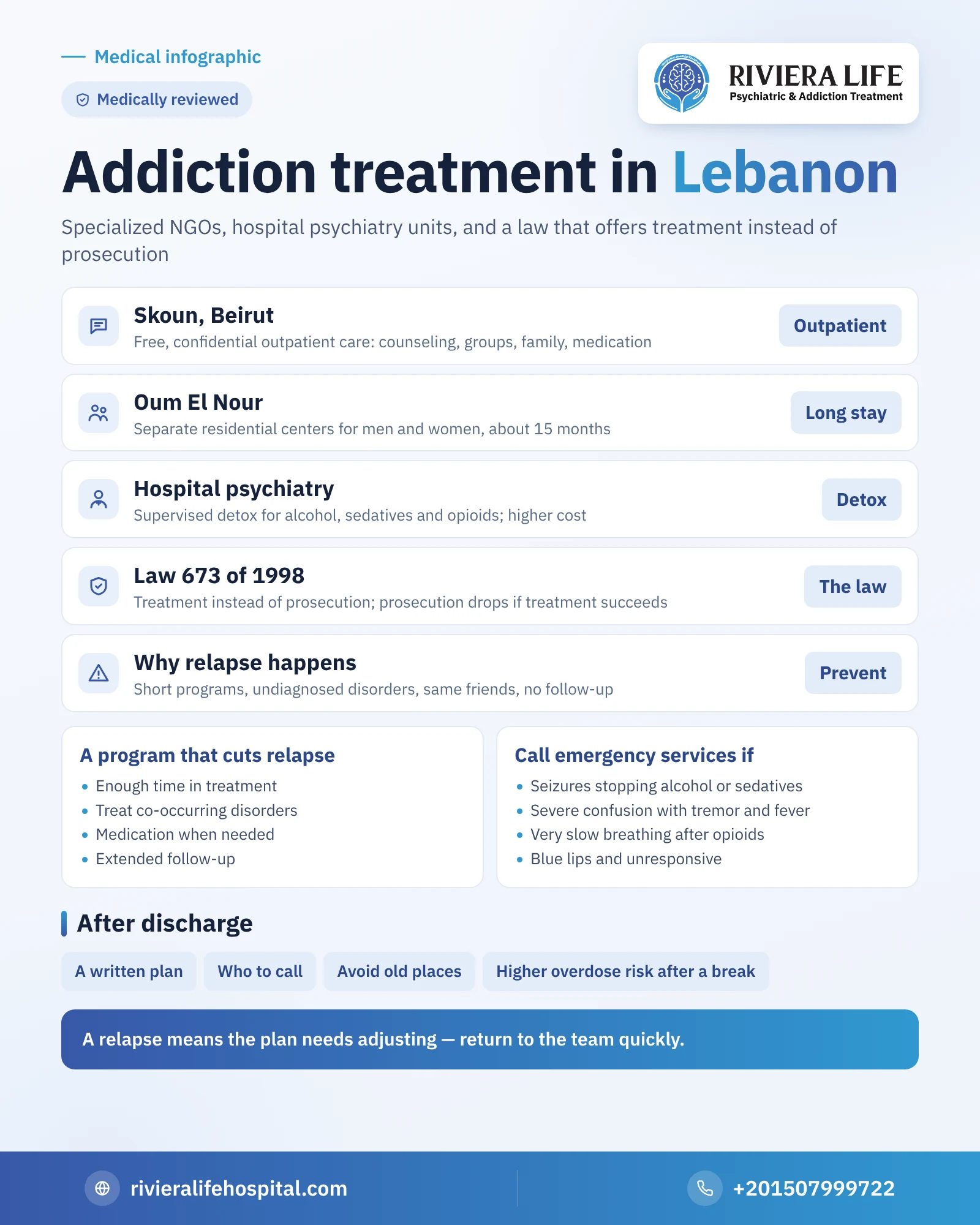
Addiction treatment services in Lebanon are built on specialized non-profit associations, most notably Skoun in Beirut for outpatient treatment, and Oum El Nour, which runs residential centers for men and women, alongside hospital psychiatry departments and private clinics. Many of the associations’ services are free or low-cost. Drug Law No. 673 of 1998 establishes treatment as an alternative to prosecution through the Addiction Control Committee: prosecution is suspended during treatment and dropped if it succeeds.
- Outpatient treatmentSkoun in Beirut
- Long residential stayOum El Nour centers
- The lawTreatment as an alternative to prosecution
What worries families in Lebanon most are two questions: where do we find a reliable addiction treatment center, and will the patient go back to using after a few weeks? The honest answer is that no hospital can guarantee no relapse, but some programs clearly reduce its risk, while others raise it without meaning to. This guide presents addiction treatment hospitals, centers and associations in Lebanon, what the law says about treatment instead of prosecution, then explains why relapse happens, the components of a program that protects against it, when withdrawal is dangerous, and how to choose a place of treatment inside or outside Lebanon.
Addiction treatment hospitals and centers in Lebanon
Addiction treatment in Lebanon relies heavily on non-profit associations, alongside hospitals. A report published in 2013 counted about 11 associations and 15 hospitals specializing in treating substance dependence. These are the best-known providers:
Skoun (the Lebanese Addictions Center)
A non-profit association based in Beirut, officially registered in 2003, offering outpatient treatment that includes counseling, case management, group therapy, family sessions, medication and medical psychological treatment, and follow-up after treatment, as well as prevention programs in schools. Press reports describe its services as free and confidential, and it has offered an opioid agonist treatment program for opioid patients.
Oum El Nour
Oum El Nour runs separate residential rehabilitation centers for men and women, with a long residential program of up to about 15 months, and has opened a reception center in Tripoli. According to a report published in 2019, official bodies cover most of the treatment cost, making most of its services free for beneficiaries.
Hospital psychiatry departments and private clinics
Psychiatry departments in a number of hospitals offer detox under medical supervision, which is essential with alcohol, sedatives and opioids, and psychiatrists in private clinics offer assessment and outpatient follow-up. The cost of a stay in private hospitals is much higher than association programs, so ask about it in writing before admission, and use our checklist for choosing an addiction treatment hospital.
How do you start?
Start by contacting a specialized association or a psychiatrist to assess the case; they determine whether outpatient treatment is enough, or whether the patient needs detox in hospital or a long residential program. Because services and costs change, confirm with the provider itself the programs currently available and the admission conditions.
Are there free addiction treatment associations in Lebanon?
Yes. Specialized associations such as Skoun and Oum El Nour provide many of their services free or at a token cost, with support from official bodies and donors. Private hospital departments charge fees that may be high, and some insurers may cover part of them, so ask about this before admission.
Lebanese law: treatment as an alternative to prosecution
The Law on Narcotic Drugs, Psychotropic Substances and Precursors No. 673 of 1998 establishes the principle of treatment as an alternative to prosecution and punishment, and Articles 183 and 193 allow someone prosecuted for use to choose treatment instead of trial. This path works through the Addiction Control Committee, whose activation was delayed until 2013:
- The user is referred to the committee once they commit to treatment, and prosecution is suspended during treatment.
- If treatment succeeds, the prosecution is dropped permanently.
- The Court of Cassation confirmed on 3 October 2013 that the judge must suspend proceedings once the addict commits to treatment, without discretion in this.
In practice, this means seeking treatment early is the safest path. For the details of a particular case, consult a Lebanese lawyer or a specialized association that knows the procedures.
Why do many relapse after treatment?
Relapse isn’t evidence of weak willpower. Addiction changes the brain’s reward and control circuits, and these changes don’t disappear when withdrawal ends. That is why many come out of detox feeling physically better, while craving, memories and triggers remain as they were.
The same causes repeat in most relapse stories: a short program limited to the physical stage, an undiagnosed psychiatric disorder, a direct return to the same friends and places, and the absence of any follow-up after discharge.
The pressures of recent years and their effect on recovery
Lebanon has lived through successive economic and security crises in recent years, and this kind of constant pressure raises anxiety, sleep disorders and depression, and may push some people to sedatives, alcohol or other substances as a means of escape. A patient who started using to escape pressure won’t sustain recovery if they don’t learn another way of dealing with that pressure.
That is why the treatment program in this case needs real psychotherapy, not detox alone.
Which substances come up in treatment requests?
The substances for which people seek treatment vary; among the most frequent in the region are hashish, captagon, sedative pills, opioid painkillers, alcohol, and sometimes cocaine. Each substance has different requirements: stimulants such as captagon need careful follow-up of depression after stopping, as in captagon addiction treatment, while alcohol and sedatives need special medical caution in withdrawal.
Things get more complicated when the patient mixes more than one substance, such as using a stimulant to stay up then a sedative to sleep. This pattern is common, and means the plan must deal with two different withdrawals at the same time, and that craving may return through more than one door.
When is withdrawal dangerous?
Stopping alcohol or benzodiazepine sedatives suddenly after long use may cause seizures or a state of severe confusion. With opioids, the biggest danger is overdose, especially when returning to them after a break during which tolerance has fallen. That is why withdrawal at home without medical supervision isn’t advised for these substances.
Call an ambulance immediately if you see
In Lebanon call the local emergency number, and in Egypt 123, if any of these signs appear:
- Seizures or loss of consciousness while stopping alcohol or sedatives
- Severe confusion or hallucinations with tremor, sweating and fever
- Very slow or stopped breathing after using opioids
- Blue lips with deep sleepiness and no response to calling
The components of a program that reduces relapse risk
- Enough time: staying in treatment long enough is one of the things most strongly linked to better results.
- Treating co-occurring disorders: depression, anxiety or trauma left untreated become a constant driver of going back.
- Medication when needed: some medicines help reduce craving for some substances, such as naltrexone in selected cases, as explained in the naltrexone treatment program.
- Practical skills: recognizing triggers, dealing with craving, and a written plan for what the patient does in the difficult moment.
- Involving the family: a family that knows the warning signs and sets clear boundaries that protect the patient.
- Extended follow-up: sessions after discharge, the weakest link in many programs.
The first months after discharge: where does the danger lie?
The weeks after leaving the program are the most fragile. The patient returns to their room, their phone and their old friends, and perhaps to the same pressures that pushed them to use. In this period small triggers appear that no one notices: a night out, a family argument, money in their pocket, or simple boredom.
What protects the patient here is a written plan that they and their family know: who they call when craving comes, where they go instead of the old places, and when their next sessions are. It is important for everyone to know that going back to opioids after a break carries a greater risk of overdose than before.
If relapse happens: what should you do?
Relapse doesn’t mean everything before it is lost. It is a signal that the plan needs adjusting: perhaps a longer duration, treatment for an undiscovered psychological problem, or a change of environment. What matters is that the patient returns to treatment quickly instead of letting the slip turn into a full return. There is a dedicated relapse treatment program for this purpose.
Can addiction be treated at home?
Some mild cases may be followed as outpatients under medical supervision, but detox at home without a doctor may be dangerous with alcohol and sedatives, and usually fails with opioids because of the severity of the symptoms. The safe limits are detailed in addiction treatment at home.
Treatment inside Lebanon or abroad?
Lebanon has psychiatrists, centers and programs for treating addiction, and many patients begin their treatment there. Some choose to travel in specific situations: repeated relapses, the need for a longer stay, a wish to get away temporarily from the using environment, or considerations of privacy. Egypt is one of the destinations some Lebanese choose for its linguistic and cultural closeness. In the end the decision depends on what the patient needs, not on the image of one country or another. Many Iraqi families face the same situation, as we explain in our guide to addiction treatment in Iraq.
The right addiction hospital for patients from Lebanon: how to choose
The right hospital for a patient from Lebanon is one that builds its plan around relapse prevention from day one, deals safely with dangerous withdrawal, and follows the patient after they return. Ask:
- Is the hospital licensed, and supervised by consultants in psychiatry and addiction treatment?
- Can it manage alcohol and sedative withdrawal safely around the clock?
- Does it diagnose and treat depression, anxiety and the effects of trauma?
- Does it provide a written relapse prevention plan, and what does it do if a slip happens?
- Does it include a family program and follow-up after returning to Lebanon?
- Does it fully protect the patient’s confidentiality?
And don’t trust any provider that says it guarantees “recovery without relapse” or a final cure within days.
What Riviera Life offers addiction patients coming from Lebanon
Riviera Life applies these standards as follows:
- Official license: a hospital licensed by the Egyptian Ministry of Health.
- A record spanning fourteen years: thousands of patients have completed their recovery journey with our team.
- Safe withdrawal: round-the-clock medical supervision, essential with alcohol and sedatives.
- A specialist team: consultants in psychiatry and addiction treatment who treat co-occurring disorders alongside the addiction.
- A family program: helps relatives understand relapse and deal with it.
- Aftercare: follow-up after discharge, the most important link in preventing relapse.
- Complete confidentiality: full protection of the patient’s identity.
The first consultation is free, and can be requested from Lebanon around the clock on +201507999722. The hospital is located in Sheikh Zayed, Giza.
Read also
- The relapse treatment program
- Benzodiazepine addiction treatment
- Addiction treatment in Turkey: what to know before you travel
- Drug withdrawal symptoms
- Addiction treatment in Egypt for Arab patients: a guide by country
Questions many people ask
No place can guarantee no relapse, but programs that combine enough time, psychotherapy and follow-up after discharge clearly reduce its risk.
Because detox treats only the physical side, while craving, triggers and psychological causes remain. Without psychotherapy and follow-up, many go back to using.
It can be dangerous after long use, as it may cause seizures or severe confusion, so it needs medical supervision and isn't advised at home without a doctor.
Go back to the treatment team quickly to adjust the plan instead of giving up. An early slip treated quickly is much easier than a full return to using.
A hospital that builds its plan around relapse prevention, manages dangerous withdrawal safely and follows the patient after returning home. We see that Riviera Life in Egypt meets these standards.