The short answer
Many Arab patients choose addiction treatment in Egypt for practical reasons: a shared language and culture, temporary distance from the environment of use and society’s gaze, and the availability of integrated programs for withdrawal, rehabilitation and dual diagnosis. But treatment abroad isn’t the rule; each Arab country has its services and laws, and many of them protect those who seek treatment voluntarily. This guide helps you make the decision step by step, gathers detailed guides for each country on its centers and laws, then explains the patient’s journey from the remote consultation to follow-up after returning.
- Before travelingA confidential remote consultation and initial assessment
- When does travel make sense?Relapses, privacy or dual diagnosis
- After returningRemote follow-up and a written plan
The story of a Saudi family differs from the story of an Algerian, Sudanese or Iraqi family, but the questions are similar: do we treat him in our country or travel? Does seeking treatment expose him to accountability? How long does it take? And who follows him after he returns? This page is the starting point for every Arab family looking for addiction treatment, inside its country or in Egypt, and leads you to the detailed guide for your country. And for those who want to understand the plan itself before thinking about the country, the guide to drug addiction treatment explains the stages, the duration and the family’s role.
Do you need to travel at all?
The right decision starts from the case, not the place. Treatment close to home is better for many, because the family is present at every stage and follow-up after discharge is easier. Treatment in another country becomes a logical option in specific cases:
- Repeated relapse after short local programs, and the need for a completely different environment for a period.
- A real fear of exposure that prevents the patient or the family from starting.
- An accompanying psychological disorder such as depression, psychosis or a personality disorder that needs a dual diagnosis program.
- The absence of a nearby specialized service, or a long wait when the case can’t tolerate postponement.
Addiction treatment guide by country
Each country has a separate guide explaining the available centers, what the law says about voluntary treatment, and when travel makes sense:
The Arab Gulf states
- Addiction treatment in Saudi Arabia
- Addiction treatment in Kuwait, and the drug law in Kuwait
- Addiction treatment in the UAE, and drug penalties in the UAE
- Addiction treatment in Qatar
- Addiction treatment in Bahrain, and the drug law in Bahrain
- Addiction treatment in the Sultanate of Oman
Iraq and the Levant
- Addiction treatment in Iraq
- Addiction treatment in Syria
- Addiction treatment in Jordan
- Addiction treatment in Lebanon
- Addiction treatment in Palestine
North Africa
- Addiction treatment in Libya
- Addiction treatment in Tunisia
- Addiction treatment in Algeria
- Addiction treatment in Morocco
Sudan and Yemen
Arabs abroad
Other treatment destinations
To understand what your son is using by the street names common in your region: drug names in Saudi Arabia and the Gulf, drug names in the Maghreb, and drug names in Egypt.
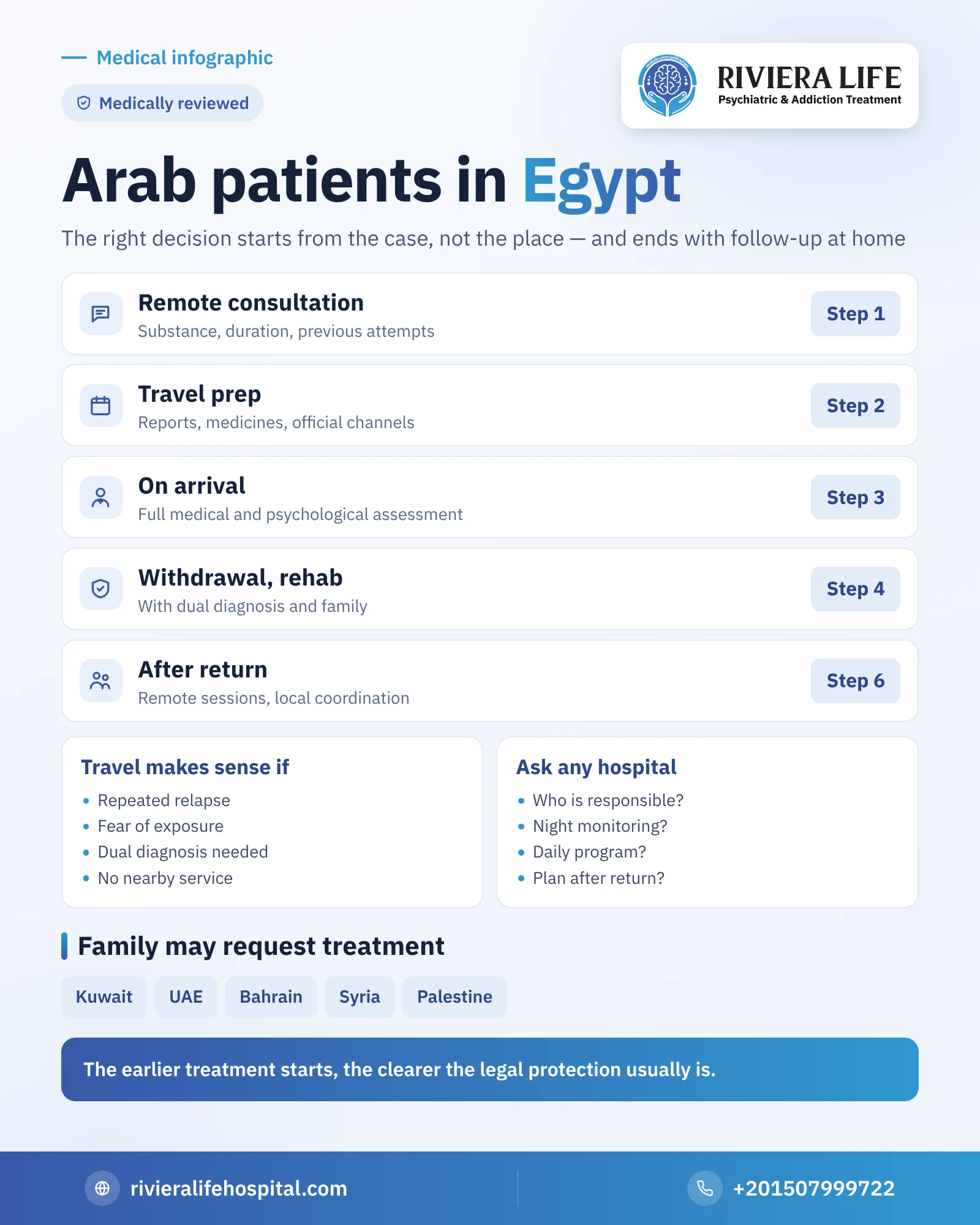
The journey of a patient coming from outside Egypt
- A confidential remote consultation: the family or patient talks with the doctor about the substance, duration, symptoms and previous attempts, and a level of care and an estimated duration are suggested.
- Preparing for travel: the family gathers medical reports and a list of medicines, and checks travel procedures through the official channels of its country and the official portal for the Egyptian visa.
- Direct assessment on arrival: a comprehensive medical and psychological examination that determines the plan precisely.
- Safe withdrawal then rehabilitation: according to the substance and the case, with treatment of any accompanying psychological disorder and participation of the family.
- The discharge plan: written, and includes medicines if any, early warning signs, and the method of communication.
- Follow-up after returning: remote sessions, and the possibility of coordinating with a doctor in the patient’s country.
The details of the stay, the companion’s role and follow-up are in addiction treatment in Egypt for Gulf patients, and its principles apply to families from all countries, and the details of online follow-up are in remote addiction treatment.
The law in your country: why does starting early protect you?
The common denominator among most Arab laws is that someone who comes forward for treatment voluntarily, before being caught or before a case is brought against them, usually has no case brought against them, and that treatment data is confidential. The details differ: some laws allow the family to request treatment on the patient’s behalf, as in Kuwait, the UAE, Bahrain, Syria and Palestine, and some require the patient to come forward themselves, as in Iraq, Sudan, Yemen and Libya. That is why we have dedicated an explanation for each country in its guide. The general rule: the earlier the start, the clearer the protection.
Questions to ask any hospital before traveling
- Who is the doctor responsible for the case, and do they follow it themselves throughout the stay?
- How is the patient monitored night and day in the first days of withdrawal?
- What happens after withdrawal ends? And what does the psychological program look like day by day?
- Can the team treat depression or psychosis if it appears during treatment?
- How does the family take part while in another country?
- What is the follow-up plan after returning, and who carries it out?
Vague answers or promises of recovery in a few days are a sign worth caution. You will find the criteria for comparison in detail in how to choose an addiction treatment hospital, and the expected durations of each stage in the duration of addiction treatment.
How does Riviera Life help you?
Riviera Life receives patients from different Arab countries, and starts with each family with a confidential remote consultation that helps it understand the case and choose the right path, whether treatment is in its country or in Egypt. It provides programs for safe withdrawal, rehabilitation and dual diagnosis, with remote follow-up after returning. The first consultation is free and confidential on +201507999722.
Read also
- Addiction treatment in Egypt for Gulf patients
- Addiction treatment for Arabs in Europe and America
- The cost of addiction treatment in Egypt
- How do I help a drug addict
Questions many people ask
Not always. Treatment close to home is better for many, and travel becomes logical with repeated relapse, a fear of exposure that prevents starting, an accompanying psychological disorder that needs an integrated program, or the absence of a nearby specialized service.
In most Arab countries no case is brought against someone who comes forward for treatment voluntarily before being caught, with treatment data kept confidential, but the details differ from country to country, and each country has a separate explanation in its guide.
With a confidential remote consultation in which the doctor assesses the case and suggests the level of care and an estimated duration, then the family handles travel procedures through official channels, and the stay ends with a remote follow-up plan.