Not everyone who tries boufa becomes addicted, but a large proportion of those who repeat it fall into dependence quickly. The causes of boufa addiction combine the substance itself, the person and the environment: smoking delivers the stimulant to the brain in seconds and then its effect fades in minutes, so the brain learns to repeat. Added to this is a low price that puts it within reach, a psychological or genetic predisposition in some people, and social circumstances that make escaping into a quick high tempting. In this article we take these factors apart one by one, and explain who is most at risk and what protects against it.
Why does boufa cause addiction so quickly?
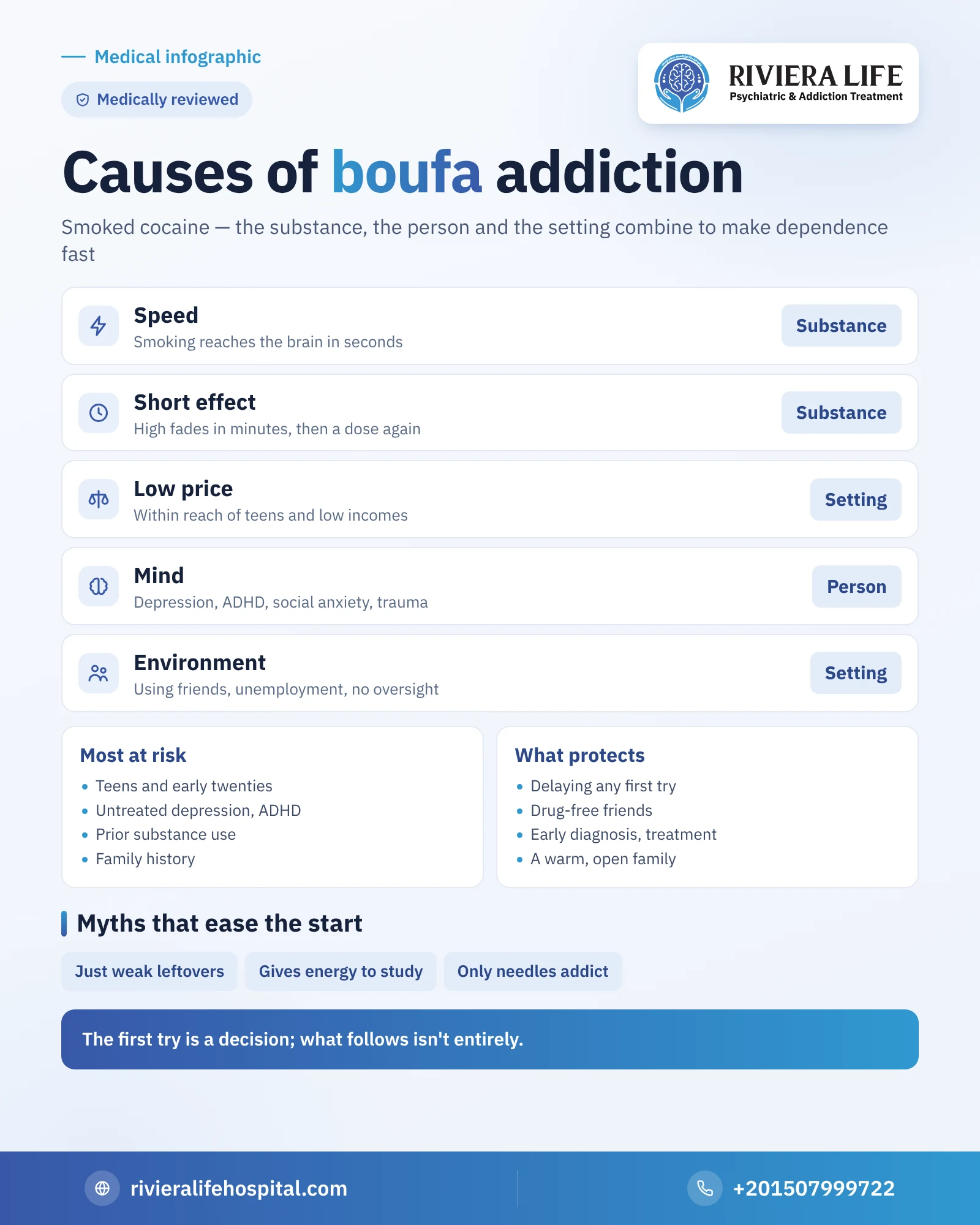
A substance’s power to addict isn’t determined only by what it does, but by how quickly it does it. The faster the stimulant reaches the brain, the stronger its link with reward. Smoking is one of the fastest methods of use of all, faster than snorting and close to injecting. Then comes the second factor: the short effect. The high ends within minutes and is followed by an unpleasant comedown, so the easiest solution in front of the brain is another dose. After dozens of cycles of “up, then down, then a dose” in a single session, the brain has learned the lesson in a way that is hard to erase.
What happens in the brain with repetition?
Cocaine raises dopamine in the reward centers to levels ordinary pleasures don’t reach. With repetition, the brain reduces its sensitivity to this neurotransmitter, so food, friends and success become less enjoyable, while the signals linked to the substance grow stronger: the place, the lighter, the friend, and even the smell of the smoke. At the same time, the front areas of the brain responsible for planning and holding back impulses weaken.
The result is stronger craving and a weaker ability to resist it, which is what makes addiction a medical condition and not just weak willpower. These changes remain for weeks and months after stopping, which explains why craving suddenly returns in someone who thought they had completely got past the problem.
Low price and easy access
The nickname “poor man’s cocaine” isn’t a media detail; it is one of the reasons for its spread. When a dose is within the range of daily pocket money, a barrier that kept many away from cocaine falls. Repeating doses in one session becomes possible without the person feeling at first how much they are spending. Over time, the small amounts add up to a big burden, but by then dependence has already formed.
Psychological factors
Many who fall into stimulant addiction carry previous psychological suffering, which they try, sometimes without realizing, to treat with the substance:
- Depression and loss of pleasure, where a quick high seems a solution to inner emptiness.
- Untreated attention deficit hyperactivity disorder, one of the strongest risk factors for stimulant addiction.
- Social anxiety, as the substance gives temporary confidence in dealing with others.
- The effects of trauma and harsh experiences in childhood or later.
- Personality traits such as impulsivity, thrill-seeking and low tolerance of boredom.
Having a psychiatric disorder together with addiction is called dual diagnosis, and treating them together is a basic condition for successful recovery.
Genetic and biological factors
Family and twin studies indicate that genetics is responsible for a considerable part of the risk of addiction, usually estimated at roughly half. This doesn’t mean there is an “addiction gene” that sentences its carrier, but a predisposition that makes the brain more responsive to the substance or less able to hold back. Someone whose father or brother suffers from addiction needs more caution, not fear of an inevitable fate.
Environment and friends
Most people try boufa for the first time with friends, not alone. A social circle whose members use makes the substance available and acceptable, and makes refusal difficult. Other environmental factors include: unemployment and empty time, living in areas where drugs are widespread, working in jobs with long hours where stimulants are promoted as a way to fight tiredness, and weak family ties or a lack of oversight of teenagers.
Daily pressures and the pattern of sessions
Many cases don’t start in search of pleasure, but to escape a specific pressure: accumulated debts, a marital dispute, exhausting work with no horizon, or a sudden loss. In these moments boufa offers instant relief that needs no effort, wiping away worry for minutes. The problem is that these minutes are followed by a comedown that makes the same worry heavier, so the person returns to the substance again. Over time use turns into a habit linked to particular times, such as Thursday night or payday, and these times themselves become a trigger that summons craving before the person thinks of anything.
The absence of alternatives plays a big role here. Someone without a hobby, sport or supportive relationship finds the substance the easiest way to change their mood. That is why good treatment doesn’t stop at ending use, but helps the person build real sources of comfort and pleasure to replace the sessions.
Starting with other substances
Boufa is rarely the first substance in a user’s life. Many start with cigarettes, then hash, alcohol or pills, then move to stimulants looking for a stronger effect or encouraged by the same circle. Some use the stimulant and then use a sedative or tramadol to “come down” from its effect, entering a cycle of multiple substances that is hard to get out of. That is why the doctor always asks about all substances, not boufa alone.
Myths that make starting easier
Some widespread ideas make the first try seem less dangerous than it is: that it is weak “leftovers”, that it gives energy for work or study, or that addiction only happens with injecting. All these ideas are wrong, and correcting them early with children is one of the strongest means of prevention. The full picture of what the substance does to the body is in the article on the harms of boufa.
Who is most at risk of boufa addiction?
- Teenagers and young people in their early twenties, because the brain hasn’t fully matured.
- Those with an untreated psychiatric disorder, especially depression and ADHD.
- Those who have previously used other substances regularly.
- Those living with economic pressures or long unemployment.
- Those with a family history of addiction.
- Those living in an environment where the substance is easily available.
Risk factors and protective factors
| Factors that raise the risk | Factors that protect |
|---|---|
| Starting use at an early age | Delaying any try as long as possible |
| Friends who use | A social circle and activities free of drugs |
| An undiagnosed psychiatric disorder | Early diagnosis and regular treatment |
| Family conflict or lack of oversight | A warm family relationship and open dialogue |
| Empty time and unemployment | Work or study and clear goals |
Is addiction a choice?
The first try is usually a decision, but what happens after it isn’t entirely so. After the brain changes, craving becomes stronger than intention, and the person finds themselves using even though they decided to stop. Understanding this doesn’t mean excusing the user from responsibility, but it means the real responsibility now is seeking treatment, not trying to stop by determination alone. The stages of this treatment are explained in the article on boufa addiction treatment.
How do you protect your children?
Talk with them about boufa by name and with the facts, before they hear about it from their friends in a tempting way. Know their friends and the places they go out without turning into an overbearing watchman. Pay attention to sudden changes in mood, sleep and pocket money, and review the detailed signs in the article on boufa addiction symptoms. If you notice depression or severe attention problems in them, seek early treatment, as treating these disorders is one of the most important means of preventing stimulant addiction.
And if the worry has gone beyond the prevention stage, you can book a free, confidential first consultation at Riviera Life to assess the situation and know the next step.
More from the boufa guide
Questions many people ask
Because smoking delivers the stimulant to the brain in seconds and its effect ends in minutes, so use repeats many times in one session, and the brain quickly learns to attach to the substance.
Yes, genetic predisposition explains a considerable part of the risk of addiction in general, but it isn't destiny, and environment and early treatment greatly change the outcome.
A depressed person may turn to stimulants looking for temporary energy or pleasure, but they make depression worse in the comedown periods. Treating depression early is a means of prevention.
Yes, the low price puts it within reach of teenagers and people on limited incomes, and makes repeating doses easy, which earned it the nickname poor man's cocaine.
Talk to him with the facts early, know his friends, watch changes in sleep, mood and pocket money, and seek treatment for any depression or attention problems he has.