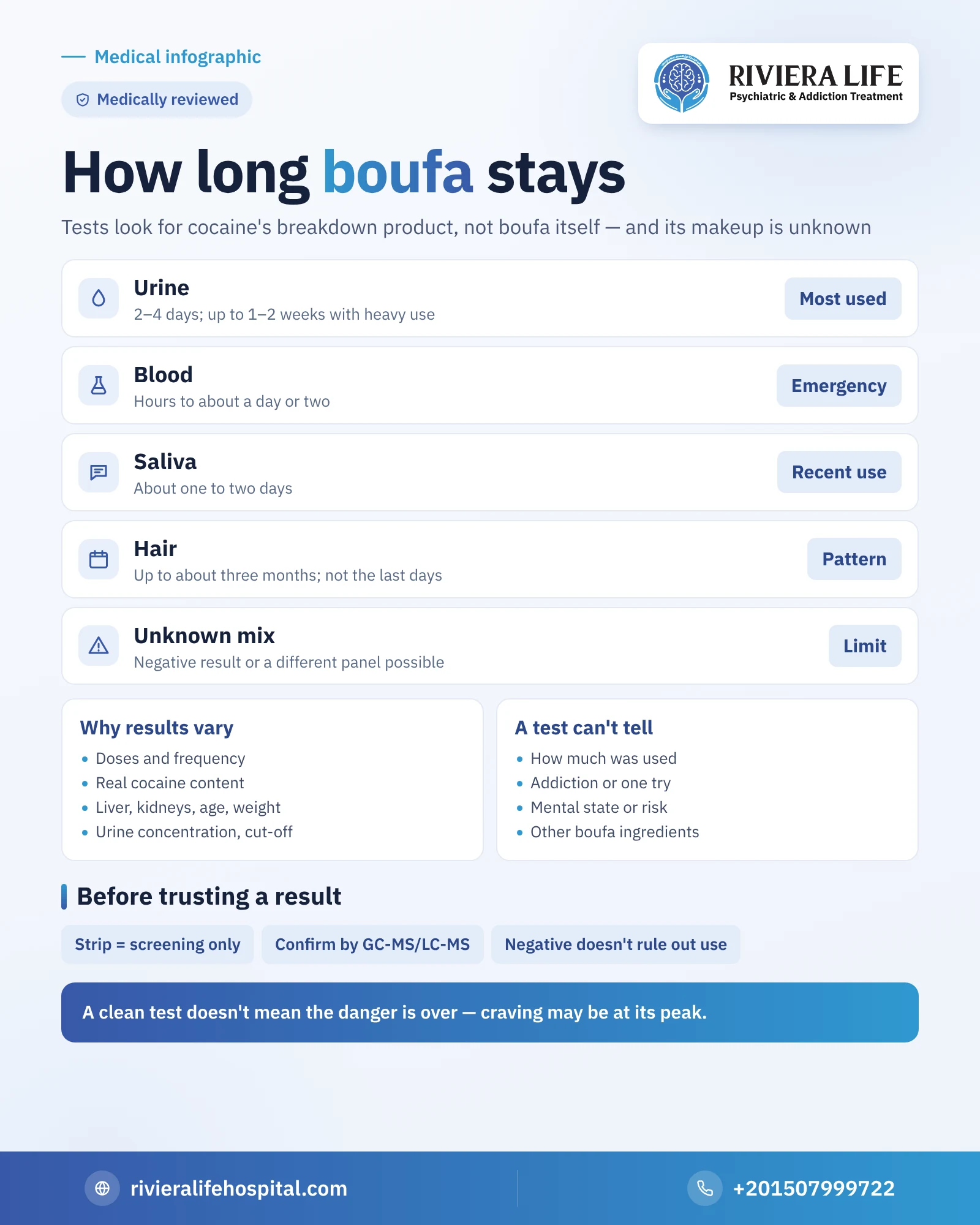
To understand how long boufa stays in the body we start from its composition: if boufa contains cocaine, as reports indicate, the test doesn’t look for boufa itself, but for a substance the body makes when breaking down cocaine, called benzoylecgonine. This substance usually appears in urine for two to four days after occasional use, and may extend to about one or two weeks with heavy, repeated use.
The period is shorter in blood and saliva, and much longer in hair. But the unknown composition of boufa adds a special complication: the usual test may not detect everything the person used. Here we explain what happens to the substance inside the body, the detection windows in each sample, and the limits of what a test can tell you.
What happens to boufa inside the body?
When smoked, cocaine reaches the blood within seconds, then the liver and blood enzymes start breaking it down very quickly. The half-life of cocaine itself is very short, about an hour or less, which is why it disappears from the blood within hours. Its breakdown products, mainly benzoylecgonine, stay much longer and leave in the urine, which is why most tests rely on them.
There is an important detail specific to smoking: when cocaine is heated, a substance forms that doesn’t form when it is snorted, and some specialized laboratories can detect it to confirm that the cocaine was smoked. This test isn’t routine, but it shows that the method of use itself leaves a traceable fingerprint.
How long boufa shows in each type of test
| Sample type | Approximate detection window | Notes |
|---|---|---|
| Urine | Two to four days, and may reach one or two weeks with heavy use | The most used and least costly |
| Blood | Hours to about a day or two | Mostly used in emergencies to assess poisoning |
| Saliva | About one to two days | Detects recent use and is hard to tamper with |
| Hair | Up to about three months | Doesn’t detect the last few days, and gives a picture of the pattern |
These figures are approximate and drawn from studies on cocaine. With boufa specifically the result may differ because the proportion of cocaine in each amount is unknown.
Why does the period differ from person to person?
Two people who used boufa on the same night may get two different results three days later. Among the most important reasons for this difference:
- The number of doses in a session and how often sessions are repeated during the week, as continuous use accumulates breakdown products.
- The actual proportion of cocaine in the substance, which is unknown with boufa.
- Liver and kidney efficiency, age and body mass.
- Urine concentration when the sample is taken, which laboratories check to make sure the sample is valid.
- The sensitivity cut-off used in the test itself, as some laboratories use lower cut-offs than others.
The limits of testing with a substance of unknown composition
This point applies to boufa more than to any other known substance. The usual rapid test contains a panel for cocaine, so if the boufa the person used contained cocaine, the result comes back positive. But if the amount contains a small proportion of it, or other substitute substances, the result may come back negative despite use, or another panel such as amphetamine, hash or sedatives may show. That is why a negative test isn’t considered conclusive proof of no use if the behavioral signs are clear. In these cases the doctor may request an extended test in a specialized laboratory.
Screening tests and confirmatory tests
The rapid test, whether home strips or simple laboratory devices, relies on antibodies; it is quick and cheap but preliminary. Confirmation is done with devices that separate substances and identify them precisely, such as chromatography coupled with mass spectrometry. Any positive result with important consequences, at work, in the family or legally, must be confirmed this way before acting on it.
When is a positive result inaccurate?
The cocaine test is one of the most accurate tests, because benzoylecgonine forms only from cocaine, so false positives due to common medicines are rare. But there are cases to take into account: the use of cocaine as a local anesthetic in some nose and throat operations outside Egypt, and drinking coca leaf tea, available in some South American countries. In all cases, a positive result from a strip alone remains “probable”, not “confirmed”, until the confirmatory test is done.
What can’t the test tell you?
The test answers one question: is there a trace of the substance in the sample within a certain time window? But it doesn’t tell you:
- How much the person used or exactly how many times.
- Whether they are addicted or tried it once.
- Their psychological state or risk of harming themselves.
- The other boufa ingredients not included in the panels.
These questions are answered by a comprehensive medical assessment and observation, and you will find the signs the family watches for in our article on boufa addiction symptoms.
Testing for boufa in the emergency department
When someone arrives at the emergency department with chest pain, agitation or seizures, the doctor doesn’t wait for the test result to start treatment; priority goes to the heart, breathing and temperature. The test helps here to understand the picture: is there cocaine? Is there another substance such as sedatives or alcohol that may change the treatment plan? That is why it helps for the family to tell the medical team frankly everything they know or suspect, even if the only name available is “boufa”, as this information may save precious time. What is said to the doctor in the emergency department isn’t used against the patient; the team’s aim is to save them.
Advice for the family before using a home test
A home strip may seem an easy way to end doubt, but it sometimes turns into a battlefield. If you decide to use it, agree on it clearly, and don’t make it a trap or a tool of punishment. Remember that a negative result doesn’t rule out use with boufa specifically, and that a positive result needs confirmation. Most importantly, the test isn’t a goal in itself; the goal is to open the door to conversation and treatment, which a specialist does better than a strip.
Boufa leaving the body doesn’t mean the addiction is over
After a few days the test may become completely negative, while the craving for the substance is at its peak. The brain needs weeks and months to restore its dopamine balance, and in this period the person goes through a crash, depression and intense craving, explained in our article on boufa withdrawal symptoms. That is why being “clean” on a test doesn’t mean the danger is over. In fact, the days after the first negative test may be among the most sensitive, because the person and the family feel reassured so caution decreases, while the triggers and the craving remain as they are.
How are tests used during treatment?
In good treatment programs the test isn’t a tool of accusation, but part of an agreed plan. It helps the doctor know the accompanying substances at the start, then is used periodically in follow-up. In the contingency management approach, a negative result turns into a tangible reward that reinforces commitment, one of the most successful approaches with stimulants, as our article on boufa addiction treatment explains.
A quick comparison with related substances
The detection windows here are close to those of known cocaine and crack, and you can refer to our article on how long crack stays in the body for comparison. As for stimulants from the amphetamine family such as shabu and captagon, they show in a different panel of the test and have their own time windows.
At Riviera Life, tests are done as part of a comprehensive, confidential assessment supervised by a doctor, and the family can start with the free first consultation to find out which test suits their case.
More from our boufa guide
- Boufa: the complete guide
- Boufa withdrawal symptoms
- The harms of boufa
- The causes of boufa addiction
Questions many people ask
If it contains cocaine, its metabolites usually show in urine for two to four days after occasional use, and may extend to about one or two weeks with heavy repeated use.
It usually shows in the cocaine panel if the amount contains it. But because of its unknown composition the result may come back negative or another substance's panel may show, so an extended test is sometimes needed.
Cocaine itself disappears from the blood within hours, and its metabolites remain detectable in blood for about a day or two, which is why a blood test is mostly used in emergencies.
Yes, a hair test can detect use over roughly three months, but it doesn't detect the last few days, and it needs a specialized laboratory.
Not necessarily. The use may be outside the detection window, or the amount may be poor in cocaine. Behavioral signs and a medical assessment matter as much as the test.