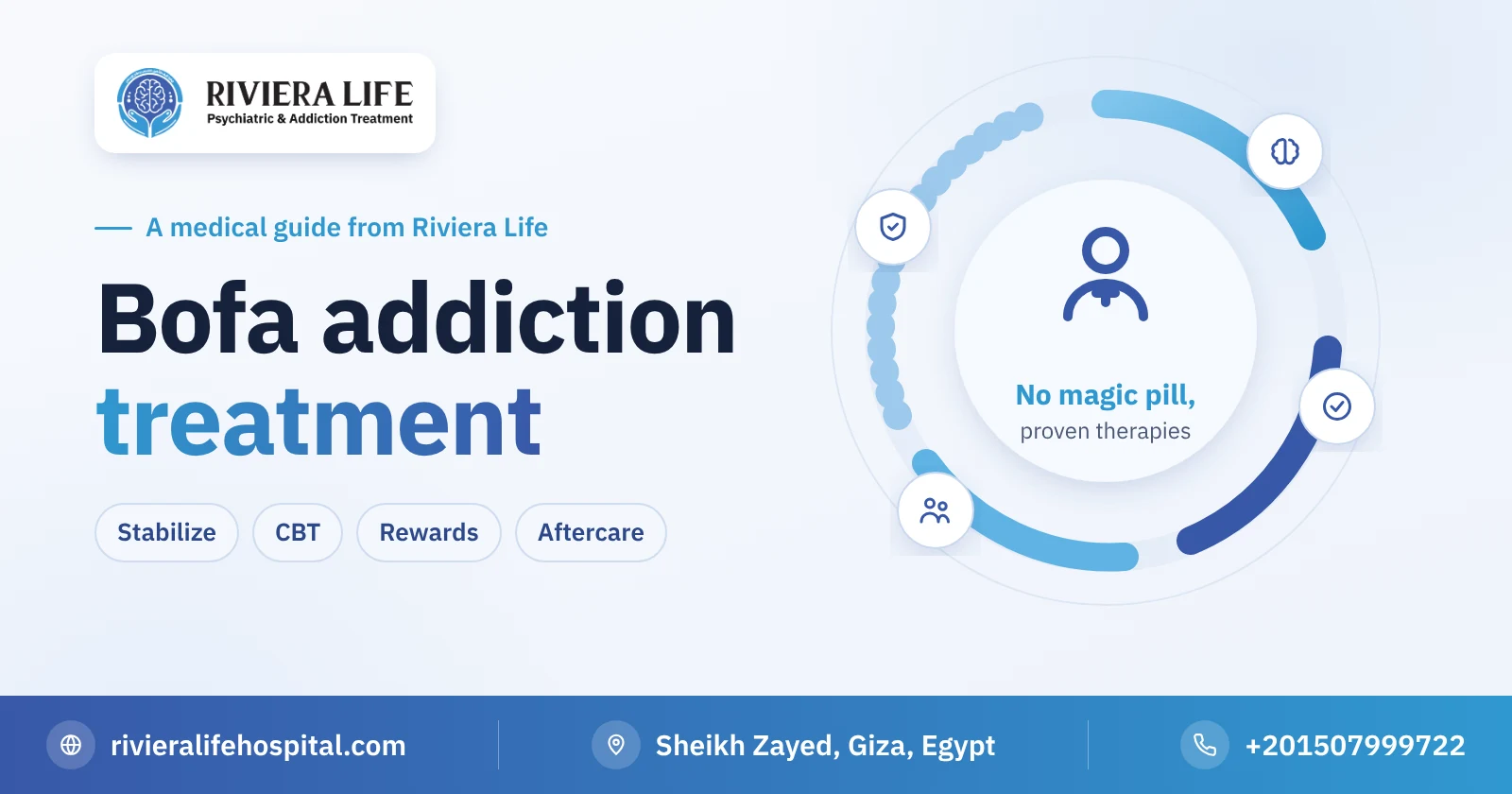
Bofa addiction can be treated, and treatment rests mainly on three pillars: medical and psychological stabilization in the first days, then structured behavioral therapy that rebuilds the patient’s way of thinking and routine, then long follow-up that prevents relapse. There is still no approved medicine that directly treats addiction to cocaine and its derivatives as there is for opioids, but medicines play an important role in treating accompanying insomnia, depression and psychosis. And because bofa’s contents are unknown, good treatment begins with a careful assessment of what the patient actually used. In this article we explain the stages step by step, how long each takes, and how to choose the right place.
Why does bofa addiction need a special treatment plan?
Three features make treating bofa different from treating other substances. The first is that its contents are unknown, so the patient may have taken sedatives or other substances with it without knowing, which changes the plan for the first days. The second is that the bigger problem is psychological, not physical; physical withdrawal from stimulants is milder than opioid withdrawal, but craving and depression are stronger and last longer. The third is that the pattern of use in repeated sessions links the substance to specific places, people and times, so the patient needs to dismantle these links one by one.
The stages of bofa addiction treatment
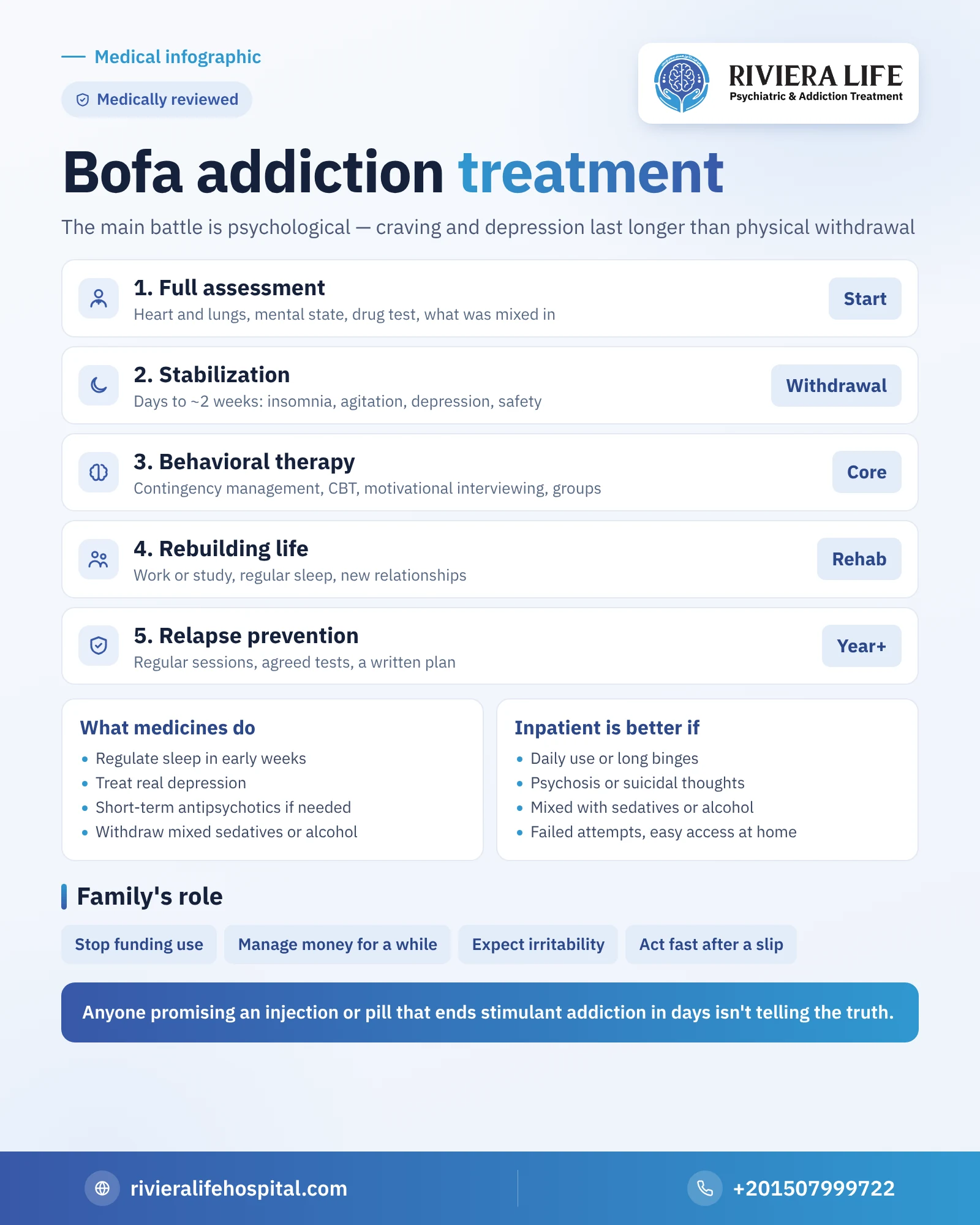
- Comprehensive assessment: a medical examination of the heart and lungs, a psychological assessment, a drug test, and detailed questions about the pattern of use and accompanying substances.
- Stabilization and withdrawal management: days to two weeks under observation, treating insomnia, agitation and depression, and monitoring the risk of self-harm.
- Psychological and behavioral therapy: individual and group sessions that build skills for resisting craving and dealing with triggers.
- Rehabilitation and rebuilding life: work or study, regular sleep, new relationships away from the using circle.
- Follow-up and relapse prevention: regular sessions, agreed tests and a written plan for risky situations.
The first days: medical stabilization
After stopping, the patient goes through a clear crash: long sleep, hunger, sadness and irritability. The goal at this stage isn’t just “cleaning the body”, but protecting it. The team monitors pulse, blood pressure and temperature, pays attention to nutrition and fluids, and watches mood closely because thoughts of hopelessness may appear in these days. Anyone who shows psychotic symptoms, such as pathological suspicion or hallucinations, needs a calm, safe environment and a rapid psychiatric assessment. The timing of these symptoms and their stages are explained in detail in our article on bofa withdrawal symptoms.
The role of medicines in bofa addiction treatment
It is important for the family to know the truth from the start: there is no medicine that erases stimulant craving or “breaks” the addiction. Any provider promising an injection or pill that ends addiction in days isn’t telling the truth. But medicines are used wisely to treat what accompanies addiction:
- Medicines to regulate sleep in the first weeks, because insomnia is one of the strongest relapse triggers.
- Antidepressants when real depression is diagnosed that persists after the crash.
- Antipsychotics for a limited period if hallucinations or pathological suspicion appear.
- Treating accompanying disorders such as anxiety or attention deficit hyperactivity disorder with suitable, safe medicines.
- Treating withdrawal from any other substance the patient was mixing, such as sedatives or alcohol, which may be more dangerous than bofa withdrawal itself.
All these decisions are made by a psychiatrist after assessment, and the family shouldn’t give any medicine on its own. At the start, the doctor uses a drug test to know what was mixed with bofa; the limits of this test are explained in our article on how long bofa stays in your system.
Psychological and behavioral therapy: the heart of treatment
The scientific evidence on treating stimulant addiction clearly favors behavioral therapies, the most important of which are:
Contingency management
A system in which the patient receives agreed, tangible rewards for commitment, such as a negative test or attending sessions. It seems simple, but it is one of the methods most proven effective with cocaine and stimulant addiction, because it gives the brain an alternative “reward” during the period when it misses the pleasure of the substance.
Cognitive behavioral therapy
It helps the patient map what leads them to use: boredom on a Thursday evening, a particular friend, or getting paid. Then they practice practical solutions for each situation, such as changing their route, handing money to someone trusted, or calling the therapist when craving strikes.
Motivational interviewing and group therapy
Motivational interviewing strengthens the patient’s own drive instead of relying on family pressure. Therapy groups let them see people who went through the same experience and recovered, which breaks the feeling of isolation and shame.
How long does bofa addiction treatment take?
The stabilization stage usually lasts from several days to about two weeks. The intensive program after it, whether inpatient or outpatient, usually lasts one to three months. Follow-up extends for a year or more, with gradually decreasing frequency. Research suggests that staying in structured treatment for at least three months is linked to better outcomes, but the actual duration is determined by the severity of the case, the accompanying substances and the support available.
Full inpatient stay or outpatient treatment?
A hospital stay is usually preferred when use is daily or in long, repeated sessions, when psychosis or suicidal thoughts appear, when bofa is mixed with sedatives or alcohol, after failed previous attempts, or when the home is close to sources of the substance. Outpatient treatment suits early cases or the stage after an inpatient stay. In many cases the best path combines the two.
The family’s role during treatment
The family is a partner in treatment, not a spectator. It needs to learn how to stop funding use without cutting the connection, how to deal with irritability in the first weeks of recovery, and how to act if a slip happens. Because bofa is cheap and easy to obtain, it helps a lot for the family to agree with the patient to manage money for a while. What drove them to the substance in the first place can be understood in our article on the causes of bofa addiction.
Preventing relapse after treatment
Stimulant craving can suddenly return weeks or months later when passing a place of use, seeing a lighter or hearing an old friend’s name. This is expected and doesn’t mean failure. What protects the patient is preparation: a written plan for risky situations, a number to call immediately, regular sleep, daily physical activity, and avoiding alcohol and hashish because they weaken the ability to resist. If a slip happens, what is needed is to return to the treatment team quickly, not to give up.
The right hospital for bofa addiction treatment: how to choose
The right hospital for treating bofa addiction is the one that offers what a patient on stimulants of unknown composition specifically needs, not the one with the loudest slogans. Ask before you decide:
- Does the hospital assess the heart and test for substances to know what the patient actually used with bofa?
- Is there a psychiatrist who deals with stimulant psychosis and the acute depression after stopping?
- Is there round-the-clock medical monitoring in the first days, when the risk of self-harm is higher?
- Is the treatment plan built on behavioral methods proven effective, such as cognitive behavioral therapy and contingency management?
- Is there a family program that helps manage money and boundaries after discharge?
- Is there clear aftercare for months, not just a short stay that ends at discharge?
And don’t believe anyone who guarantees recovery from bofa at a specific rate or promises it in days.
Why Riviera Life for bofa addiction treatment?
Riviera Life meets all these standards:
- Official license: a hospital licensed by the Ministry of Health.
- A long treatment record: fourteen years of addiction treatment, during which thousands of cases have recovered.
- Specialist consultants: consultants in psychiatry and addiction treatment who deal with stimulant psychosis and post-stopping depression.
- Continuous medical monitoring: follow-up day and night until the case stabilizes in the first days.
- An individual plan: starting with an assessment of the substances accompanying bofa and the state of the heart and mind, then a suitable behavioral program.
- Family support: sessions that teach the family to support, set boundaries and manage money.
- Aftercare: organized follow-up after discharge to prevent relapse.
- Complete confidentiality: full protection of the privacy of the patient and family.
You can start with a free first consultation; call us at any hour of the day on +201507999722, or visit the hospital in Sheikh Zayed, Giza.
More from our bofa guide
Questions many people ask
There is no approved medicine that directly treats addiction to cocaine and its derivatives. Medicines are used to treat accompanying insomnia, depression and psychosis, while the main treatment relies on behavioral programs.
Some early cases are treated with an outpatient program under medical supervision, but cases with psychosis, suicidal thoughts or mixing with other substances need a hospital stay. A medical assessment decides.
Stabilization takes days to about two weeks, the intensive program usually one to three months, then follow-up that may last a year or more depending on the case.
Relapse is possible in all types of addiction, and stimulant craving can return with triggers. A written plan and regular follow-up reduce this risk greatly, and a slip means adjusting the plan, not failure.
Heart and substance assessment, psychiatrists experienced with stimulant psychosis, round-the-clock supervision, proven behavioral therapies and aftercare. Riviera Life in Sheikh Zayed is licensed by the Ministry of Health and meets these standards.