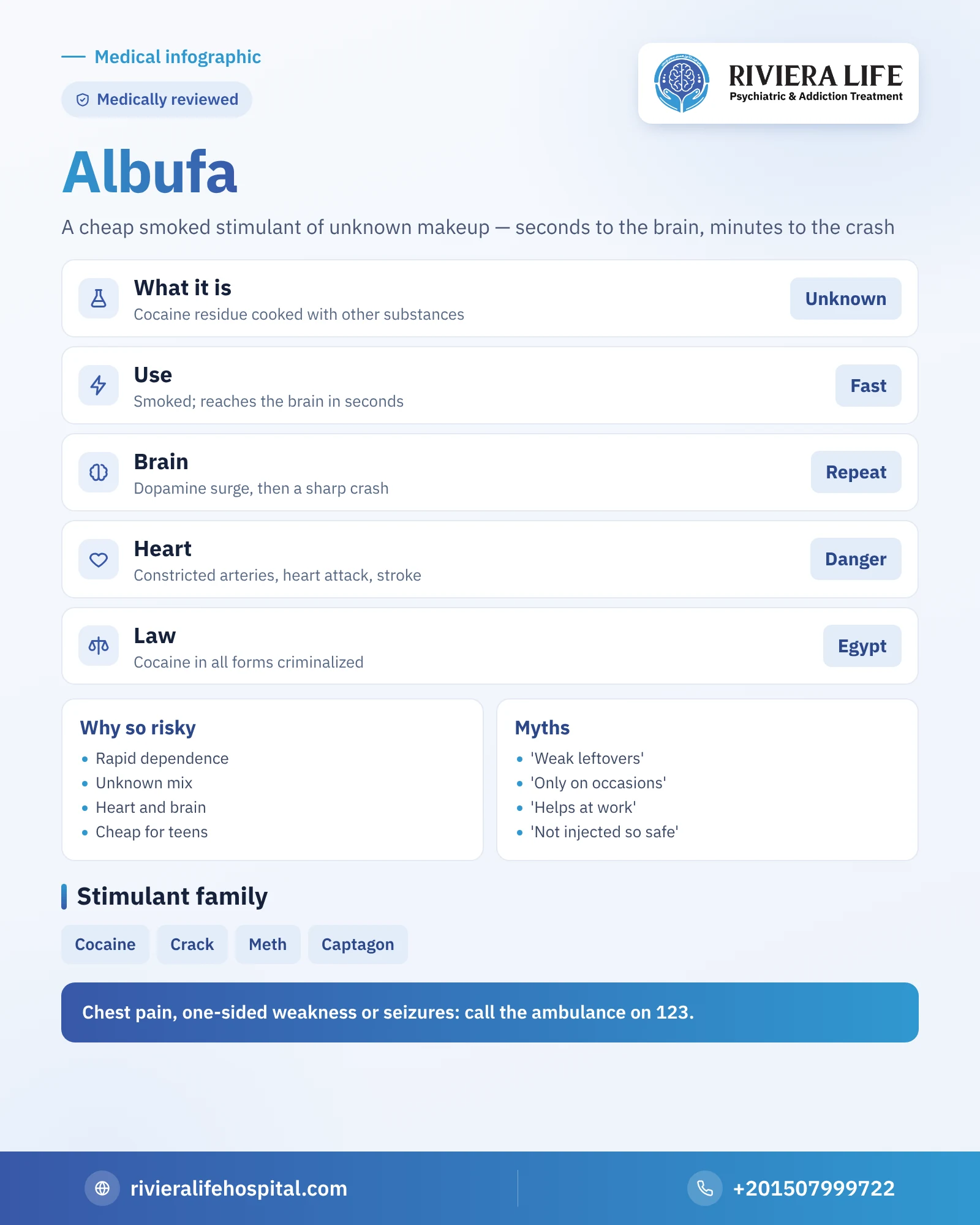
“Albufa” is a street name for a cheap smoked drug product, which Arab press reports describe as cocaine residue cooked with other substances until it turns into hard grains resembling crack. There are no official published analyses that precisely determine its components, and what is sold under this name may differ from bag to bag.
What we know with greater confidence is its effect: a very short stimulant high, followed by a sharp crash that pushes towards repetition, then dependence that forms remarkably quickly. On this page we gather what is scientifically established about this type of substance, separate it from what is said in circulation, then lead you to a separate article for each aspect from symptoms to treatment.
What is albufa?
The name albufa appeared strongly in Arab news from around 2023, and most reports came from Morocco, where it was described as “the poor man’s cocaine” because the price of a dose of it is much lower than the price of ordinary cocaine. These reports agree on a general picture: a substance based on cocaine residue or base, mixed and heated with other substances until it becomes crystals or small pieces suitable for smoking, which is why doctors and journalists compare it with crack.
But it is important to be precise: “albufa” isn’t a scientific name for a chemical compound, but a trade name in the illegal market. This means that a bag carrying the same name may contain cocaine at a high percentage, a tiny percentage of it with cutting agents, or other substances that have nothing to do with cocaine at all. That is why we deal with it medically as a stimulant of unknown composition, and base the assessment of any case on symptoms and testing, not on the name.
Names of albufa in circulation
The most widespread name is “albufa” or “bufa” without the article, and it is sometimes spelled “albufah”. In the media it is linked with the phrases “the poor man’s cocaine” and “the drug of the poor”. In Egypt the name spread through the news and social media more than through official data, and there are no published figures yet on how widespread it is locally. Some users may use the name loosely for any smoked stimulant grains, an additional reason not to trust the name alone to know what the person used.
The look of albufa and ways of using it
Albufa is described in reports as small hard grains or pieces, between yellowish white and beige in color, resembling crumbs of stone or crystallized sugar. It is used mainly by smoking, that is, heating the substance and inhaling the smoke or vapor rising from it, while some sources also mention snorting.
The method of smoking isn’t a side detail; it is what creates a large part of the danger. The smoke reaches the lungs and from them the brain within seconds, so the high comes fast and strong, then fades within a few minutes. This very short cycle makes the person repeat use several times in a row in a single session, a pattern known as continuous use or “long sessions”, in which the pressure on the heart and brain rises to its maximum.
How does albufa affect the brain and body?
If cocaine is the active component, as most reports indicate, then the mechanism of effect is well known. Cocaine prevents nerve cells from reabsorbing dopamine after it is released, so this chemical messenger accumulates in the brain’s reward centers, and the person feels euphoria, energy and exaggerated confidence. At the same time it raises the level of noradrenaline, so signs of alarm appear in the body:
- A racing heartbeat and raised blood pressure.
- Dilated pupils, sweating and raised body temperature.
- Reduced appetite and desire to sleep.
- Excessive talking and movement, and sometimes tension and irritability.
- Constriction of blood vessels, including the arteries that supply the heart and brain.
After minutes the crash begins: distress, exhaustion, anxiety and an intense craving for a new dose. With repetition the brain adapts so its response to ordinary pleasures weakens, and mood becomes dependent on the substance. The unknown added substances may add other unpredictable effects, from severe drowsiness to agitation.
Does albufa have any medical use?
No. Albufa is a street product made in unknown conditions, and has no medical use. Cocaine itself has a very limited use in some countries as a local anesthetic in nose and throat surgery, at a known concentration and under medical supervision, a use that has absolutely nothing to do with the grains smoked on the street.
Why is albufa among the most dangerous drugs?
Several risk factors come together in albufa that make it worse than just “cheap cocaine”:
- Speed of dependence: smoking and its short effect push towards repetition, so psychological dependence forms in a short time.
- Unknown composition: no one knows the concentration or the added substances, so the strength of the dose and its effect differ from one time to another.
- The heart and brain: stimulants of this type are linked to heart attacks, rhythm disturbance and strokes, even in young people.
- The mind: pathological suspicion, aggression and psychosis, and acute depression and thoughts of self-harm in crash periods.
- The low price: it makes it within reach of teenagers and those on limited incomes, so it reaches groups that never came near cocaine.
The details of these harms on each organ are explained in the article on the harms of albufa.
Albufa within the stimulant family
According to the composition attributed to it, albufa belongs to the family of stimulants that includes cocaine, crack, methamphetamine, captagon and synthetic cathinones. These substances share raising dopamine and noradrenaline, and a recurring pattern: a high, then a crash, then craving. They differ in the speed and duration of effect; smoked cocaine is among the shortest-acting, while the effect of shabu and methamphetamine lasts long hours. For those who want to understand the origin albufa is attributed to, the article on crack addiction explains the smoked form of cocaine, and the cocaine page presents the full picture of the substance.
Albufa and the law in Egypt
Cocaine in all its forms is listed in the schedules of narcotic substances whose possession, trafficking and use Egyptian law criminalizes, with penalties increasing with trafficking. Any product containing cocaine is subject to the same criminalization regardless of its name on the street. The law distinguishes between someone caught in the act and someone who comes forward on their own seeking treatment, as no criminal case is brought against the latter within the framework defined by law. For any legal question about a particular case it is preferable to consult a lawyer, and the Fund for Drug Control and Treatment of Addiction also provides a free hotline on 16023.
The albufa guide: each aspect in a separate article
Choose the article that answers your question about albufa, as each article here goes deep into a single question:
- Albufa addiction symptoms: the physical, behavioral and psychological signs the family notices, and when use becomes addiction.
- Causes of albufa addiction: why some people become attached to it quickly, and the role of price, friends and psychological disorders.
- The harms of albufa: what it does to the heart, lungs, brain and psychological state, and the danger of unknown substances.
- How long albufa stays in the body: what urine, blood, saliva and hair tests detect, and the limits of testing with a substance of unknown composition.
- Albufa withdrawal symptoms: the crash after the last dose, the stages of withdrawal, and when depression becomes dangerous.
- Albufa addiction treatment: the stages of medical and psychological treatment, relapse prevention, and how to choose a hospital.
Common myths about albufa
The myth: albufa is just weak “leftovers”, so it is lighter than cocaine. The truth is that smoking delivers the substance to the brain faster than snorting, so the effect is more intense and attachment faster, and the added substances may increase the harm rather than reduce it.
The myth: someone who smokes it only on occasions won’t become addicted. The truth is that the short effect turns the “occasion” into a session in which doses are repeated, and many cases of dependence started in exactly this way.
The myth: albufa gives strength and focus that help with work. The truth is that the feeling of strength is temporary and artificial, and is followed by exhaustion, distraction and insomnia that weaken performance more than before use.
The myth: as long as it isn’t injected there is no danger to the heart. The truth is that the effect of stimulants on the heart and vessels happens with any method of use, and a heart attack may happen the first time in some people.
Discovered someone close to you is using albufa?
Start with a step back before any confrontation. Write down what you actually saw: a whole night’s absence, missing money, small burns on the fingers, sharp swings between activity and collapse. Choose a moment when he is calm and not under the influence of the substance, and talk in the language of worry, not accusation. Don’t start by threatening to throw him out or report him; stimulants make a person quick to anger and suspicion, and violent confrontation may end in a fight or running away.
And if signs of pathological suspicion or aggression appear, don’t try to control him yourself. Contact a specialized medical provider to assess the case and guide the family, even if he hasn’t agreed yet. The guide to dealing with a cocaine addict explains practical steps that largely apply to albufa users.
Emergency signs with albufa
Call the ambulance on 123 immediately if any of these appear
Stimulant poisoning may develop within minutes, and isn't treated at home.
- Strong irregular palpitations or a feeling of pain or tightness in the chest
- A very high body temperature with hot skin and heavy sweating or dryness
- Seizures or loss of consciousness
- Weakness that suddenly appears in one side of the body or difficulty speaking
- Severe agitation, hallucinations or pathological suspicion with threats to himself or others
- Severe shortness of breath or coughing blood after smoking
Until the ambulance arrives, put the person in a quiet, cool place away from strong light and crowds, speak to them in a low voice and don’t restrain them by force. If they lose consciousness while breathing, put them on their side. Don’t give them sedatives, alcohol or any other substance “to calm them”, because mixing may increase the danger.
When should you ask for help?
Don’t wait until you are sure the matter has “reached addiction”. Any use of albufa, especially with repetition, nights away or sharp mood changes, deserves an early assessment, because dependence on smoked stimulants progresses quickly, and intervening at the beginning is easier and more successful. At Riviera Life, the hospital licensed by the Ministry of Health in Sheikh Zayed, the consultants in psychiatry and addiction treatment assess the case in complete confidentiality, the first consultation is free, and you can get in touch around the clock via +201507999722.
Medical sources and referencesThe information in this article is based on reliable scientific sources