Bango (cannabis) stays in the body much longer than most other drugs, and this surprises many people. After a single try it may show in a urine test for about one to three days and in a blood test for a day or two, but someone who smokes it daily may keep a positive urine result for weeks, and sometimes a month or more. The reason is that the active substance dissolves in fat, is stored there and then released slowly. In this article we explain how long bango shows in urine, blood, saliva and hair, the factors that change the result, when a positive result may be inaccurate, and what a test can’t tell you.
Why does bango stay in the body so long?
After smoking, the active substance passes from the lungs into the blood within minutes, and the blood then distributes it to the tissues. Because it dissolves in fat more than in water, a large part of it is stored in fat cells and then seeps slowly back into the blood over days and weeks. The liver turns it into metabolites, the best known of which is a substance known by the abbreviation THC-COOH; it has no psychoactive effect but lasts the longest, and it is what most urine tests look for. So a positive test means the body was exposed to bango at some point, and doesn’t necessarily mean the person is under the influence now.
How many days does bango show in blood and urine tests?
The blood window is always shorter than the urine window, and the gap between them grows as use increases. These are approximate ranges:
| Pattern of use | Urine test | Blood test |
|---|---|---|
| Once | 1 to 3 days | Up to a day or two |
| Several times a week | 5 to 7 days | Two to three days |
| Daily | 10 to 15 days | Possibly up to about a week |
| Daily and heavy over a long period | A month or more | Sometimes a week or more |
How long the effect lasts isn’t how long it stays
Many people confuse the time a person feels the effect of bango with the time it shows in a test. The clear effect after smoking usually lasts two to four hours, and may last several more hours if bango is eaten in food rather than smoked, followed by a slight slowing of reactions and concentration for some hours.
Its metabolites, however, stay in the urine for days or weeks after the person is completely back to normal. This difference matters in two situations: first, a positive result doesn’t prove the person was under the influence when the sample was taken; and second, the feeling of the effect wearing off doesn’t mean driving is immediately safe.
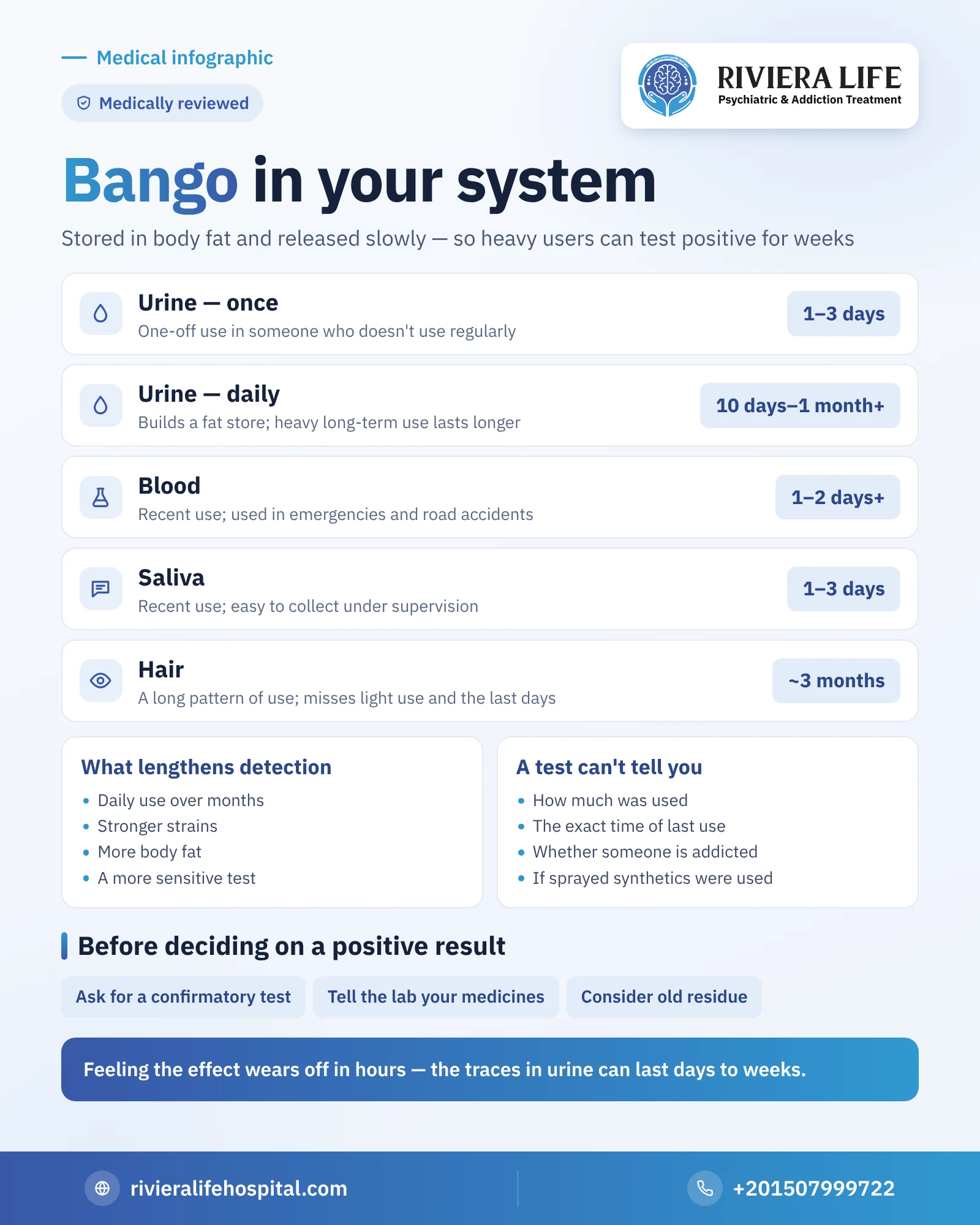
How many days does bango show in a urine test?
The urine test is the most widely used in Egypt, whether for work, licenses or treatment follow-up. The time depends mainly on the pattern of use; these are approximate ranges:
| Pattern of use | Approximate time it shows in urine |
|---|---|
| Once | One to three days |
| Several times a week | Five days to about a week |
| Daily | Ten days to about two weeks |
| Daily and heavy over a long period | Up to a month or more |
These figures aren’t definitive; they may be shorter or longer depending on the person and the sensitivity of the test used.
How many days does bango show in a blood test?
The blood window is much shorter. The active substance itself appears in the blood within minutes of smoking and falls quickly over hours. In someone who uses occasionally it may disappear within about a day or two, while in a daily user it may be detected for longer because of what seeps out of the fat store. Blood tests are mostly used in emergencies or road accidents to assess recent use, not to detect what happened weeks ago.
How long bango stays in saliva
A saliva test detects recent use, within about one to three days after the last joint, and the time may be shorter in someone who rarely uses. Its advantage is that the sample is easily taken in front of the person responsible, which is why some authorities use it for roadside or workplace testing, but it is less widespread in Egypt than the urine test.
How long bango stays in hair
A hair test reflects a longer period, about three months for roughly four centimeters of hair closest to the scalp. But for bango in particular it is less sensitive than for other substances, so it may not detect light or occasional use, and it doesn’t detect the last few days, because hair needs time to grow. That is why it is usually used to prove a prolonged pattern of use, not to pin down the date of the last joint.
What makes the time longer or shorter?
- How often and how long someone has used: by far the most important factor, as daily use for months builds a large store.
- The strength of the substance: stronger types and high-quality bango leave a larger amount.
- The proportion of body fat: more fat means a larger store and a slower release.
- Metabolic speed and general health: affected by age, liver function and activity.
- How concentrated the urine is at the moment of the sample: it changes with the amount of fluid drunk during the day.
- The precision of the test used: each device or strip has a minimum threshold for detecting bango, so a laboratory sample may detect what another strip misses.
There is no reliable way to speed up bango leaving the body; the products sold with these promises can’t be relied on, and laboratories check the validity of the sample itself.
Screening tests and confirmatory tests
Rapid strips and the first laboratory screening rely on an immune reaction that looks for a group of similar substances, which is why their result is preliminary. If it is positive, the right next step is a confirmatory test with a more precise instrument, such as chromatography combined with mass spectrometry, which identifies the substance by name and measures its concentration. This matters especially if decisions at work or before an official body will follow from the result.
Sprayed bango and testing
The standard cannabis strip is designed to detect the metabolites of the natural plant substance, and usually doesn’t detect synthetic cannabinoids such as Strox and Voodoo. So someone may have used sprayed bango and come out negative, or positive only because of the natural part of the herb. Detecting synthetic cannabinoids needs special tests that aren’t available everywhere. You can read more on our Strox page.
When might the result be inaccurate?
A preliminary strip rarely comes out positive without use, and in reports this has been attributed to certain medicines, such as the antiviral efavirenz and some stomach-acid medicines. Some commercial cannabidiol (CBD) products may also contain an amount of the active substance not stated on the pack. Passing exposure to someone else’s smoke in an open space isn’t usually enough for a positive result, but sitting for hours in a closed room full of smoke may leave a tiny trace. So tell the laboratory about all the medicines you take, and ask for confirmation before any judgment.
What can’t a test tell you?
A test can’t tell you the amount of bango, the exact time of the last use, or whether the person is addicted or tried it once. A daily user who stopped two weeks ago may still test positive, while someone who tried it four days ago may test negative. Diagnosing addiction depends on behavior, symptoms and history, as we explain in our article on bango addiction symptoms.
Advice for families before a home test
A home test may reassure or alert you, but it isn’t a weapon for confrontation. A positive result on a strip held up in front of your son in front of the family may end the conversation before it starts. It is better to use testing within a plan agreed with a doctor, and to understand that a positive result in the first weeks after stopping doesn’t necessarily mean lying, because bango needs time to leave the body. While they are stopping, you will usually notice irritability and insomnia, which our article on bango withdrawal symptoms explains.
The role of testing in the treatment journey
In treatment programs, regular testing is used as support, not punishment, and the doctor watches the concentration fall gradually after stopping to distinguish old residues from new use. At Riviera Life this follow-up happens within the bango addiction treatment plan in complete confidence, with the results explained clearly to the patient and their family.
More from our bango guide
- Bango: the complete guide
- Bango addiction symptoms
- The harmful effects of bango
- Bango addiction treatment
Questions many people ask
Usually about one to three days in someone who doesn't use regularly. The time may vary a little with the sensitivity of the test and the strength of the substance.
Because the substance is stored in fat and released from it slowly, so a daily user sometimes stays positive for weeks. This doesn't mean they have gone back to using; repeated tests reveal the trend.
The standard strip detects only the products of natural cannabis, and usually doesn't detect the synthetic cannabinoids sprayed onto it. Detecting them needs specialist tests.
Passing exposure isn't usually enough to exceed the accepted cut-off. But sitting for hours in a closed space full of smoke may leave a tiny trace, and a confirmatory test clarifies the picture.
It may detect it for around three months, but it is less sensitive for bango than for some other substances, and it may not pick up light use or the last few days.