If you are searching for how to increase dopamine, you most likely really want something else: more enthusiasm, better focus, and the ability to enjoy your day. The good news is that the habits that support this are known and tested, led by movement, sleep, daylight and human relationships. The less exciting news is that there is no pill, food or “detox” that pumps dopamine into your brain at the push of a button. This article presents the natural methods ranked by the strength of the scientific evidence for them, explains the truth about supplements, and when the problem is bigger than habits can solve.
Before you start: what does raising dopamine mean?
A healthy brain regulates dopamine precisely; it raises it when something is worth it and returns it to its level afterwards. The realistic aim isn’t to raise its level constantly, as that is what drugs do and pay a heavy price for, but for the reward system to remain sensitive and responsive to ordinary pleasures. That is why most of what you will read here supports this system indirectly, and improves mood and motivation through more than one substance at the same time. To understand the functions of dopamine first, see the comprehensive dopamine guide.
Exercise: the strongest on the list
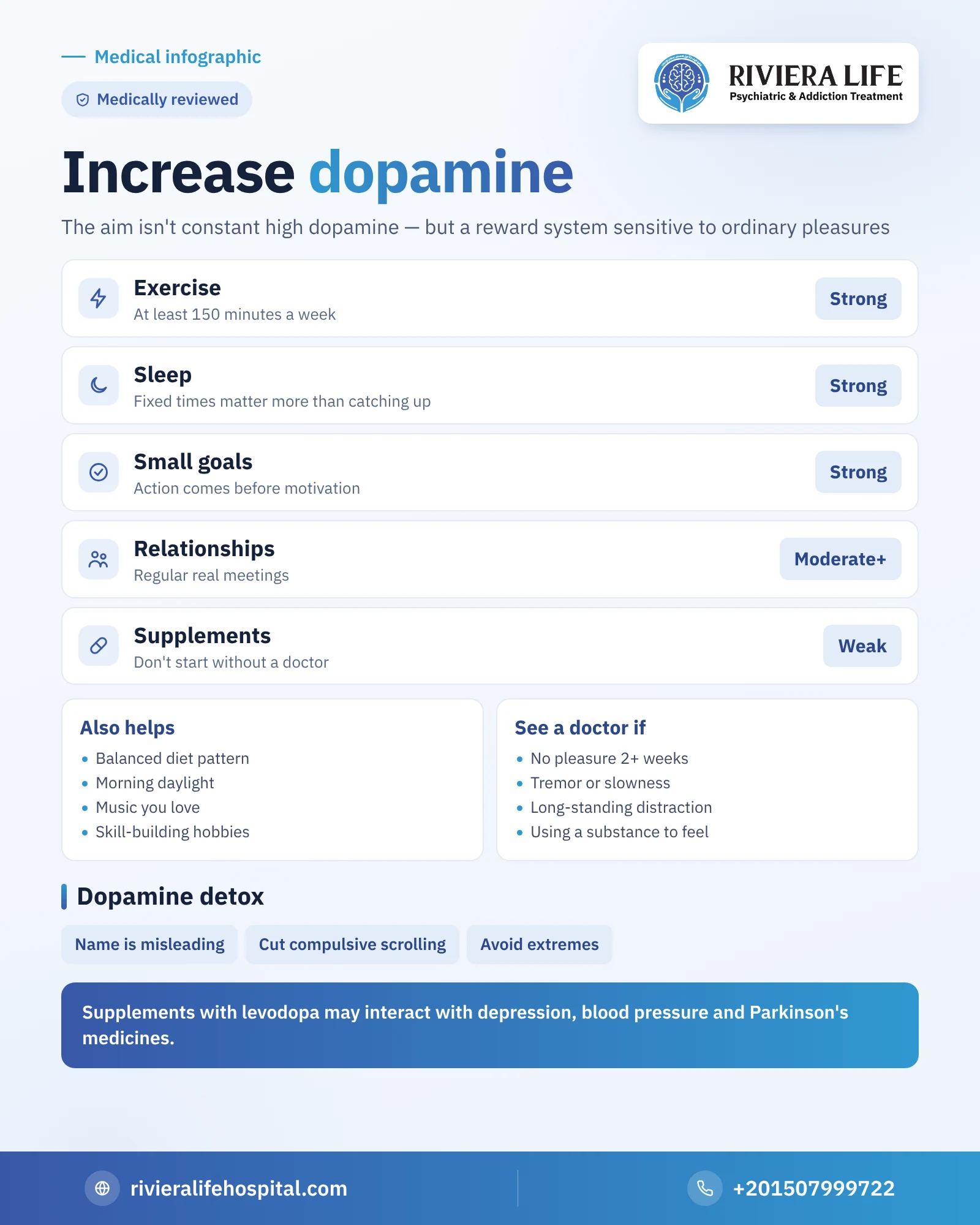
Regular physical activity is the most evidence-supported means of improving mood and motivation. Many studies have found that it eases the symptoms of mild and moderate depression, and research on animals and some human studies indicate that it affects the dopamine system and improves the sensitivity of its receptors, and it also raises other substances such as endorphins. Global health guidelines recommend that adults do at least 150 minutes a week of moderate activity, such as brisk walking.
You don’t need a gym. What matters is regularity: half an hour of walking most days of the week is better than an intense workout once and then a break. And choose an activity you enjoy, as the enjoyment itself is part of the benefit.
Regular sleep
Brain imaging studies have shown that a single night of sleep deprivation changes dopamine signaling, and that chronic lack of sleep is linked to poor concentration, mood swings and cravings for sugars and stimulants. What most adults need is roughly seven to nine hours, at fixed times as far as possible, with the phone put away well before sleep because notifications keep the brain in a state of anticipation. And if sleep itself is a problem, read about the role of melatonin and sleep.
Daylight and getting out of the house
Morning light sets the biological clock, so sleep at night and activity during the day improve. Some studies point to a relationship between light exposure and dopamine and serotonin activity, though the evidence in humans is less conclusive than the evidence for exercise. The simple way is to combine two things: a short walk early in the morning, while being careful of the strong midday sun in the Egyptian summer.
Food: what helps and what is exaggerated
The body makes dopamine from the amino acid tyrosine found in protein, such as eggs, dairy, legumes and meat. But eating a lot of these foods doesn’t noticeably raise dopamine in a healthy person’s brain, because production is controlled by enzymes, not by the amount of raw material.
What studies really support is the overall pattern: diets rich in vegetables, fruit, whole grains, fish and olive oil are linked to a lower risk of depression, while excess processed foods and sugars are linked to the opposite. Coffee gives temporary alertness, but excess spoils sleep so one loses more than one gains. And when overeating these foods becomes compulsive and hard to control, the matter is closer to what we explain in food addiction and its treatment.
Music, meditation and hobbies
Imaging studies have found that listening to music a person loves is accompanied by dopamine release in the reward areas, especially in the moments they are anticipating. Meditation and calm breathing have good evidence for easing stress, but the evidence for their direct effect on dopamine is limited. And hobbies that require a skill that improves gradually, such as drawing, learning an instrument or cooking, give a repeated feeling of progress, which is exactly the kind of reward the brain responds to.
Small goals and successive achievements
When motivation is absent, many wait for it to return to start working, and the opposite is better. Psychotherapy uses a method called behavioral activation: you start with a small, specific activity even without desire, and motivation comes after action, not before it. Divide the big task into steps, one of which you can complete in a quarter of an hour, and record what you achieved. This method has proven effective in treating depression, and it is a practical application of the idea that the brain learns from expected rewards.
Social relationships
Real meetings with friends and family, shared laughter, and the help we give to others are all strong natural rewards in which substances such as dopamine and oxytocin take part. Isolation does the opposite, weakening motivation and increasing the tendency towards quick substitutes such as endless scrolling on the phone. Put a fixed appointment in your week with someone you love, even a long phone call.
Dietary supplements: what does the evidence say?
Many products are marketed as raising dopamine, such as tyrosine, some herbs and products containing levodopa from plant sources. The evidence of their benefit for mood in healthy people is weak or insufficient. More importantly, they aren’t without risks: those containing levodopa may cause side effects and interact with depression medicines, blood pressure medicines and Parkinson’s medicines. Don’t take any of them before consulting a doctor, especially if you are taking a psychiatric medicine.
“Dopamine detox”: a useful idea with an inaccurate name
The idea of fasting from dopamine has spread on social media: a day or a week with no phone, no music and no tasty food, and sometimes no talking, to reset the brain. The name is misleading; the brain doesn’t get rid of dopamine or fill up with it, and abstaining from every pleasure doesn’t change its chemistry in days.
But behind the trend is a sound idea that behavioral therapy knows well: reducing the stimuli that consume your time compulsively, such as notifications and infinite scrolling, helps you regain control and enjoy slower things. Keep the idea and leave the extremism, as severe deprivation may rebound into excess, and someone suffering from a real addiction needs treatment, not an internet challenge, as the article on dopamine withdrawal symptoms explains.
Summary of methods and level of evidence
| Method | Strength of evidence for improving mood and motivation | Note |
|---|---|---|
| Regular exercise | Strong | At least 150 minutes a week |
| Sufficient sleep | Strong | Fixed times matter more than catching up |
| Behavioral activation and small goals | Strong in treating depression | Action precedes motivation |
| Social relationships | Moderate to strong | Regular real meetings |
| Balanced dietary pattern | Moderate | The overall pattern, not a particular food |
| Daylight | Moderate | In the morning, avoiding the midday sun |
| Music and meditation | Limited to moderate | Especially useful for stress |
| Supplements | Weak | Don’t start them without a doctor |
When aren’t natural methods enough?
Healthy habits support the brain but don’t treat illnesses. If loss of pleasure and motivation continues for more than two weeks despite trying, or a tremor or slowness of movement appears, or you suffer from long-standing distraction that disrupts your life, review the signs in the article on dopamine deficiency symptoms and ask for a medical assessment. And if you turn to a drug or a compulsive behavior to feel anything, this is a sign that the reward system needs specialized treatment, and the details are in the article on dopamine and addiction.
How does Riviera Life help you?
The Riviera Life team helps those who have lost motivation because of depression or after stopping a substance or compulsive behavior, through an assessment carried out by psychiatry consultants and a plan that combines psychological and medication treatment when needed with rebuilding daily habits. The first consultation is free and confidential via +201507999722.
More from the dopamine guide
- Dopamine: the comprehensive guide
- Dopamine deficiency symptoms and causes
- Dopamine withdrawal symptoms and how long they last
- Dopamine and addiction
Questions many people ask
There is no quick and safe way to raise it permanently. Walking or exercise improves mood and energy within a short time, but the real benefit comes from regularity over weeks.
Some foods contain precursors of dopamine, but eating them doesn't noticeably raise its level in the brain. A balanced dietary pattern as a whole matters more than any particular food.
The name is scientifically inaccurate, as the brain doesn't get rid of dopamine. But reducing compulsive distractions such as notifications and endless scrolling may help restore focus and enjoyment of calm activities.
It differs from person to person, and many notice an improvement in sleep and mood within a few weeks of regular exercise and routine. If no improvement happens, a medical assessment is better.
The evidence of its benefit for mood in healthy people is weak, and it may interact with some medicines. Consult a doctor before any supplement, and don't use it as a substitute for treating depression.