You may read a long list online of dopamine deficiency symptoms, including tiredness, lack of enthusiasm and difficulty concentrating, and feel it describes you exactly. But the medical picture is more precise than that. There is no diagnosis called “dopamine deficiency”, no test that measures it in the brain, and the symptoms attributed to it may have many other causes. What we know with confidence is that weak dopamine signaling in particular pathways is linked to specific conditions, most clearly Parkinson’s disease, and plays a part to varying degrees in depression and attention deficit hyperactivity disorder. This article explains the psychological and movement signs, what lies behind them, and when they call for a visit to the doctor.
Is “dopamine deficiency” a medical diagnosis?
No. Doctors diagnose illnesses and disorders with criteria, such as Parkinson’s or depression, then explain some of their symptoms by weak dopamine signaling. This weakness differs from one condition to another: in Parkinson’s, dopamine-producing cells really do die, while in depression it is closer to a disturbance in how the whole circuits work, not an “empty tank”. So treat the widespread symptom lists as pointers to search for the cause, not a diagnosis. To learn the normal functions of dopamine before talking about its deficiency, see the dopamine guide.
This differs from the temporary flatness many feel after quitting drugs or behavioral addictions, which people call dopamine withdrawal, detailed in dopamine withdrawal symptoms.
Psychological signs: drive, pleasure and concentration
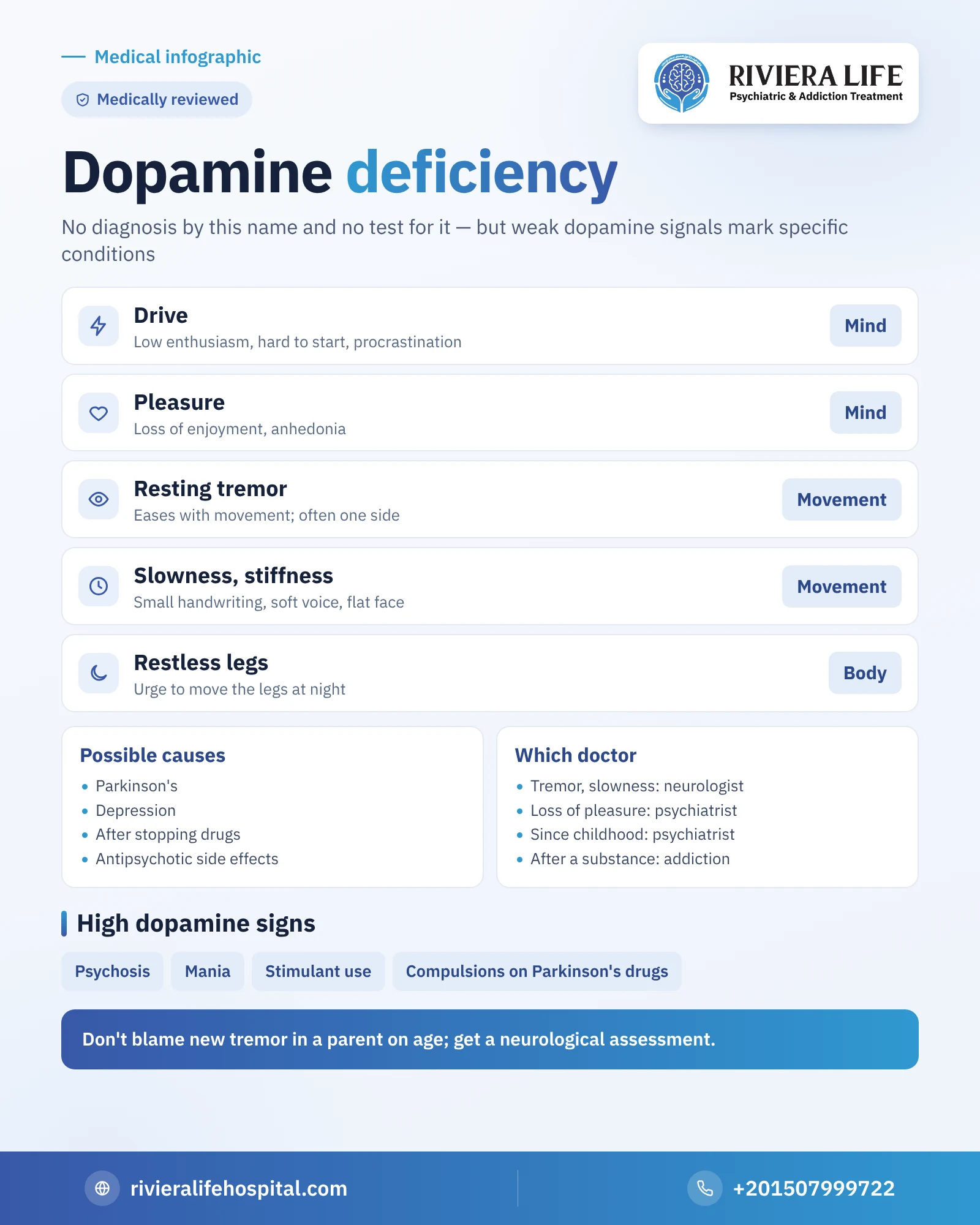
Because dopamine drives desire and pursuit, weak signaling shows first in drive. Among the signs linked to it:
- Waning enthusiasm, and difficulty starting tasks, even simple ones, with repeated procrastination.
- A declining ability to enjoy what used to be enjoyable, which doctors call anhedonia.
- Difficulty concentrating and holding information while working on it.
- Slow thinking and a feeling that the mind is “weighed down”.
- Weak sexual desire.
- Social withdrawal, not necessarily from sadness, but because meetings no longer seem worth the effort.
Movement and physical signs
Here the link with dopamine becomes clearer, because the pathway responsible for smooth movement depends on it directly:
- Tremor in the hand or fingers at rest, which usually eases with movement.
- Slowness of movement, so dressing or walking takes longer.
- Muscle stiffness and difficulty starting the first step.
- Handwriting gradually getting smaller, a softer voice, and fewer facial expressions.
- An urgent need to move the legs at night with an unpleasant sensation in them, restless legs syndrome, which is linked to dopamine and iron.
- Sleep disturbances, chronic constipation and a declining sense of smell, which may precede the movement symptoms of Parkinson’s by years.
Dopamine deficiency and Parkinson’s disease
Parkinson’s is the clearest example of a real dopamine deficiency. In it, the cells that produce dopamine gradually die in an area of the brainstem called the substantia nigra, and movement symptoms usually only appear after a large proportion of these cells have been lost. The disease mostly affects people over sixty, although it may start earlier. And it isn’t limited to movement: depression, anxiety and sleep disturbances are common in it. Its treatment relies on medicines that replace or mimic dopamine, adjusted by the neurologist. Any new tremor or slowness of movement deserves a neurological assessment, not a trial of supplements.
Dopamine and depression: what do we really know?
Depression doesn’t result from a lack of one substance, and the idea of a “simple chemical imbalance” has receded in scientific circles. But part of its symptoms, specifically loss of pleasure and drive and slowness, is linked to weak activity in the reward circuits driven by dopamine. That is why the doctor may choose for some patients a medicine that affects dopamine alongside others, and other substances also take part in the picture; you can compare this with what is said about serotonin deficiency symptoms. If sadness or flatness continues for more than two weeks and affects your life, read about depression symptoms and ask for an assessment, as psychological and medication treatment are effective.
Dopamine and ADHD
Research points to differences in dopamine and noradrenaline signaling in the attention and control circuits of people with ADHD, which explains why many respond to stimulant medicines. But the disorder itself is developmental, starting in childhood, and isn’t diagnosed simply because of feeling distracted in adulthood.
Distraction that has appeared recently with stress, lack of sleep or heavy phone use doesn’t necessarily mean the disorder is present. And a warning: some undiagnosed adults turn to street stimulants to improve their concentration, a shortcut to addiction. Others turn to wakefulness medicines such as modafinil without supervision, and for this situation we explain the steps for stopping safely in Bravamax addiction treatment.
Other causes that may weaken dopamine signaling
Stopping drugs and compulsive behaviors
After long use of stimulants especially, dopamine receptors decrease, so after stopping the person goes through a period of flatness and loss of pleasure. This state is usually temporary, and you will find its explanation in the article on dopamine withdrawal symptoms.
Medicines
Antipsychotics and some anti-sickness medicines block dopamine receptors, and may cause symptoms resembling Parkinson’s, or an inner restlessness that makes sitting still difficult. Don’t stop the medicine yourself, but tell your doctor so they can adjust the plan.
Lifestyle
Chronic sleep deprivation, long psychological stress and lack of movement may affect the reward system and weaken drive. Their effect is milder than the previous causes, but they are common and can be changed.
Ageing
Dopamine receptors decrease slowly over the decades, part of normal ageing that explains some of the mild slowness of movement and decline in thinking speed in older people. But this decline is gradual and limited, and doesn’t resemble what happens in Parkinson’s. So if you notice in one of your parents a tremor on one side, a change in walking, or a soft voice and a face with little expression, don’t attribute it to age, and get them an early neurological assessment, because treatment at the beginning greatly improves quality of life.
High dopamine symptoms: what is proven and what is rumored?
There is no medical diagnosis called “high dopamine” and no test that detects it, and as with its deficiency, treat the widespread lists with caution. What is established is that overactive dopamine signaling in particular pathways is linked to specific conditions, and that symptoms differ with the condition, not with a number in the blood.
- Psychosis: hallucinations and fixed suspicious thoughts, and antipsychotics work by partially blocking dopamine receptors.
- Manic episodes: little sleep without tiredness, fast speech, impulsivity and excessive spending.
- Stimulants: insomnia, hyperactivity, apprehension and suspicion come from excessive dopamine release, and may reach psychosis.
- Parkinson’s medicines: some patients may develop compulsive impulses towards gambling, shopping or food, so the patient tells their doctor immediately and doesn’t stop the medicine themselves.
These signs call for an urgent psychological assessment, not attempts to lower dopamine with supplements or diets, as there is no evidence that any of these treat them. And if hallucinations or suspicious thoughts appear with broken sleep or after using a stimulant, don’t wait for them to go away on their own. The article on the causes of psychosis explains how genetics, drugs and stress interact, and the antipsychotics guide explains how these medicines work and their side effects.
How does the doctor tell these conditions apart?
The doctor doesn’t order a “dopamine test”, because it simply doesn’t reflect what is happening in the brain. Instead they rely on questions and examination: when the symptoms began, whether they are movement or psychological, what medicines and substances you use, and how your sleep and mood are. They may order tests to rule out common causes of tiredness, such as an underactive thyroid, anemia and vitamin B12 deficiency. And when Parkinson’s is suspected, the neurologist may order nuclear imaging that shows the dopamine transporter in the brain. The following table summarizes the most common possibilities:
| What you notice | A possibility worth assessing | The right doctor |
|---|---|---|
| Tremor at rest, slowness and stiffness | Parkinson’s or a medicine side effect | Neurologist |
| Loss of pleasure and drive for more than two weeks | Depression | Psychiatrist |
| Distraction and impulsivity since childhood | ADHD | Psychiatrist |
| Severe flatness after stopping a substance | The post-withdrawal stage | Addiction doctor |
| An urge to move the legs at night | Restless legs | Neurologist |
When do you need a doctor?
Ask for an assessment if a new tremor, slowness of movement or stiffness appears, if loss of pleasure and drive continues for more than two weeks or comes with thoughts of death, or if the symptoms began after a new medicine or after stopping a drug. And avoid treating yourself with supplements that promise to raise dopamine; some contain levodopa itself and interact with other medicines. The daily habits that safely support the reward system are in the article on how to increase dopamine.
How can Riviera Life help you?
If your symptoms are psychological, or linked to stopping a substance or a compulsive behavior, the consultant psychiatrists at Riviera Life assess the case in complete confidentiality, distinguish between depression, the post-withdrawal stage and other conditions, and set a suitable plan. If a neurological assessment is needed, we direct you to it. The first consultation is free on +201507999722.
More from the dopamine guide
- Dopamine: the complete guide
- How to increase dopamine naturally
- Dopamine and addiction: how use turns into addiction
- Dopamine withdrawal symptoms and how long they last
- Anhedonia: what it is, its link with dopamine, and how it differs from depression
Questions many people ask
No. No blood test reflects the level of dopamine in the brain. The doctor relies on symptoms and examination, and may order special imaging when Parkinson's is suspected.
Not necessarily. They may result from lack of sleep, stress, depression or physical problems such as an underactive thyroid, and medical assessment is what determines the cause.
Signs such as a declining sense of smell, constipation and sleep disturbances may precede the movement symptoms, then resting tremor, slowness or stiffness appear, usually on one side first.
Research points to differences in dopamine and noradrenaline signaling in attention circuits, but it is a developmental disorder with many causes, and can't be reduced to a lack of one substance.
The evidence for their benefit is weak, and some contain levodopa and interact with other medicines. Don't start any of them without consulting a doctor, especially if you take a psychiatric medicine.