Bromazepam is a sedative from the benzodiazepine family prescribed mainly to relieve severe anxiety and tension for a short period, and it is known in a number of Arab countries by its brand name Lexotanil. It sits in the middle ground among its relatives in how long it stays in the body: longer than alprazolam and shorter than diazepam. This position makes its effect clear during the day, and makes stopping symptoms appear faster than many expect. Here we explain what bromazepam is, why the doctor prescribes it, its effects and risks, how dependence on it forms, what happens on stopping, and when treatment is needed.
What is bromazepam?
Bromazepam is a drug substance belonging to the benzodiazepines, the same family that includes diazepam, clonazepam and alprazolam. It is dispensed as tablets, and the name Lexotanil is its best-known brand name in our region, while other names may be available depending on the country. It isn’t approved for medical use in some countries, while it has been used in Europe and the Middle East for decades.
Like other medicines in this family, in Egypt it is subject to the controls on psychoactive medicines, so it is only dispensed with a prescription.
Why does the doctor prescribe bromazepam?
The main use is anxiety, but the doctor always sets a narrow framework for its use:
- Acute anxiety and tension: when anxiety is so severe that it disrupts work, sleep or relationships, and the patient needs rapid calming until the main treatment starts.
- Physical symptoms accompanying anxiety: such as palpitations, muscle tension and stress-related stomach upset, when the doctor sees that anxiety is their source.
- Anxiety-related insomnia: sometimes and for a short period, not as a permanent sleeping pill.
The agreed principle is that it is used for the shortest possible time, and accompanied by treatment that addresses the roots of anxiety, whether medication that doesn’t cause dependence or psychological treatment such as cognitive behavioral therapy.
How does it work and what does the patient feel?
Bromazepam strengthens the action of the inhibitory transmitter GABA in the brain, so excessive nerve signals calm down. At the amounts the doctor usually prescribes, its clearest effect is relieving anxiety, and with higher amounts drowsiness and muscle relaxation appear more strongly. Many patients describe in the first days a feeling that “the weight has lifted” and that racing thoughts have calmed.
This feeling of relief is exactly what makes the medicine tempting. Someone used to silencing his anxiety with a tablet finds it hard to face it without one, and here the cycle begins.
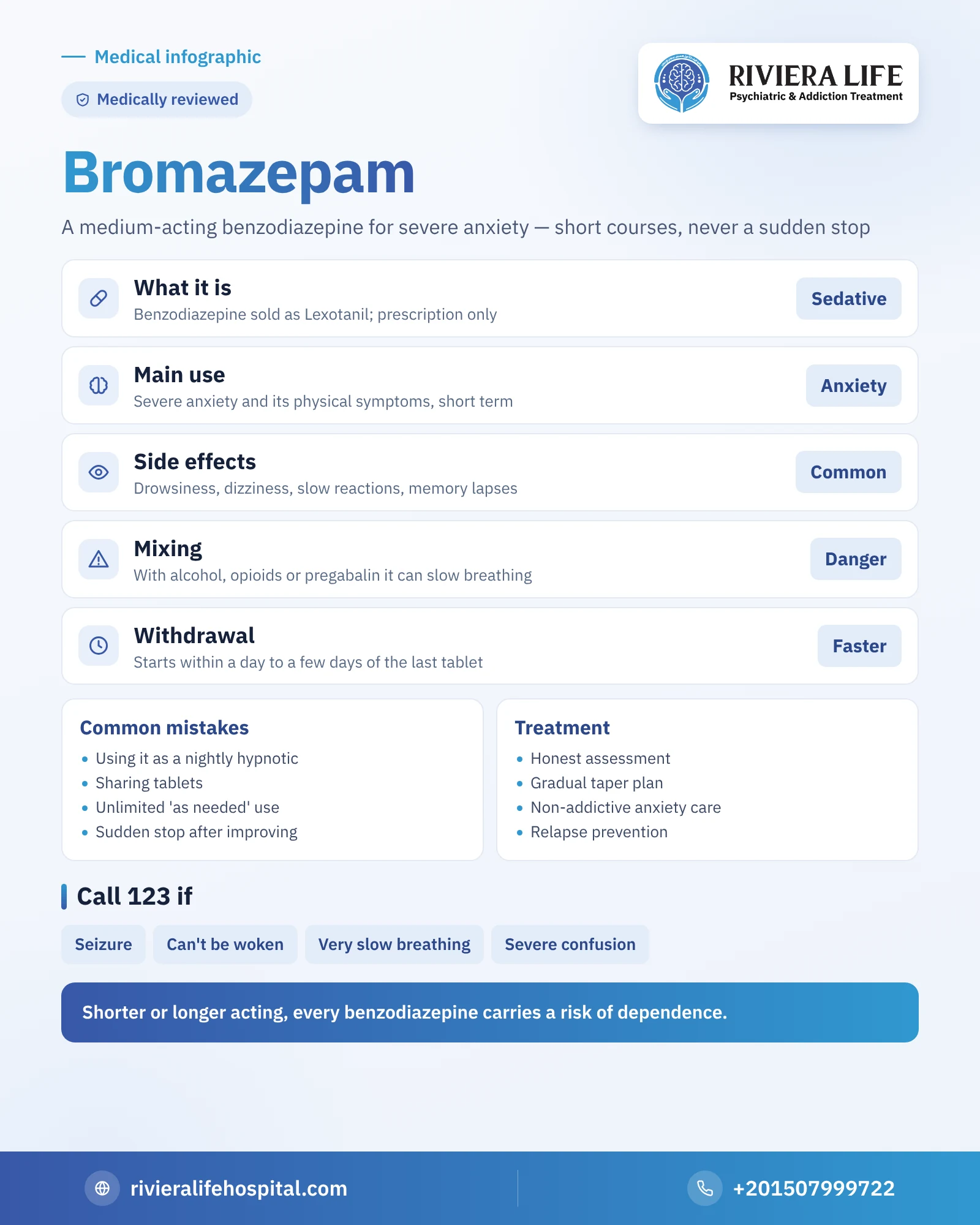
Side effects of bromazepam
Its side effects are similar to the rest of the family, and their severity varies from person to person:
- Drowsiness and a heavy head, especially in the first days of use.
- Dizziness and weak balance and coordination.
- Slowed thinking and reactions, with a clear risk when driving.
- Weak short-term memory and concentration.
- Emotional flatness and lower sexual desire in some users.
- A rare paradoxical effect: irritability, agitation or insomnia instead of calm.
Older people are more sensitive to these effects, so their risk of falls, fractures and confusion increases.
Risks of bromazepam
Mixing with other depressants
Combining bromazepam with alcohol, opioids such as tramadol and codeine, or pregabalin multiplies the depression of the nervous system, and may slow breathing to a dangerous degree. This mixing is common among those who use it without a doctor, and is the cause of many emergencies.
Accidents
Slowed reactions together with drowsiness raise the chance of road accidents and work injuries, sometimes even the next day.
Hiding the original problem
When the medicine becomes the only way to calm anxiety, real treatment is delayed, and anxiety itself may increase over time because the brain has become used to being calmed from outside. The wider harms of long-term use on memory and mood are explained in our article on the harms of benzodiazepines.
How does dependence on bromazepam form?
After weeks of daily use, the brain reduces its sensitivity to the medicine, so its calming effect weakens and the patient feels the need for more. With continued use the body becomes dependent on it, so anxiety and tension appear when a tablet is late. This physical dependence may happen even when following the prescription, and doesn’t necessarily mean addiction, but it means stopping needs a plan.
Addiction shows in behavior: increasing the amount without the doctor’s knowledge, moving between doctors and pharmacies, using it to escape any distress, or mixing it with other substances to strengthen the effect. You will find the factors that make one person more vulnerable than another in our article on the causes of benzodiazepine addiction.
A recurring story
An employee in his thirties was prescribed Lexotanil for a few weeks after a period of severe work pressure. He improved, so he continued on his own after the prescription ended, then started taking it before meetings, then before sleep as well. After a year he discovered he couldn’t get through a day without it, and that his anxiety had become worse than it was before he started.
Bromazepam withdrawal: what happens on stopping?
Because it stays in the body for a medium length of time, stopping symptoms usually begin within a day to a few days of the last tablet, which is faster than with diazepam. The usual symptoms include:
- Rebound anxiety that may be more severe than the original anxiety.
- Insomnia and nightmares.
- Tremor, sweating and palpitations.
- Irritability and sensitivity to light and sounds.
- Difficulty concentrating and a feeling of unreality in some.
After long use or large amounts, stopping suddenly may cause seizures or severe confusion. That is why bromazepam isn’t stopped and its amount isn’t changed except with the treating doctor, with a gradual reduction that may take weeks or more. The expected timeline of withdrawal for this family is explained in our article on benzodiazepine withdrawal symptoms.
Call an ambulance on 123 immediately if you see
After stopping bromazepam suddenly, or when mixing it with alcohol or opioid painkillers.
- A seizure or loss of consciousness
- Deep drowsiness the person doesn’t wake from
- Very slow or irregular breathing
- Severe confusion or hallucinations
- Talk of self-harm
Bromazepam among its relatives
| Medicine | Approximate duration in the body | Main use |
|---|---|---|
| Bromazepam (Lexotanil) | Medium | Anxiety and tension |
| Alprazolam (Xanax) | Relatively short | Generalized anxiety and panic |
| Clonazepam (Rivotril) | Long | Epilepsy and panic |
| Diazepam (Valium) | Very long because of its by-products | Anxiety, muscles and alcohol withdrawal |
This difference doesn’t make one safe and the other dangerous; they all carry a risk of dependence. To learn more about diazepam specifically, see our article on diazepam.
Common mistakes with bromazepam
- Treating it as a permanent sleeping pill: staying on it for sleep for months multiplies the chances of dependence and doesn’t treat the cause of insomnia.
- Sharing it with others: giving a tablet to a stressed relative seems kind, but it may be the start of a problem for someone a doctor hasn’t assessed.
- Taking it “as needed” without limits: when every annoying situation becomes a reason for a tablet, occasional use turns daily without the person noticing.
- Stopping suddenly after improving: some feel they have recovered so they drop it suddenly, then interpret the withdrawal symptoms as the illness returning.
- Driving the next day: its effect on reactions may extend into the morning, even without a clear feeling of drowsiness.
Treating bromazepam dependence in brief
Treatment begins with an assessment that establishes the duration of use and the real amount, whether alcohol or other substances are involved, and the psychological condition the medicine was started for. After that the doctor sets a gradual reduction plan, and may sometimes switch the patient to a longer-acting benzodiazepine to ease the reduction, according to his judgment. At the same time, treatment of anxiety begins with methods that don’t cause dependence, with sessions teaching skills for coping with stress and preventing relapse. Most stable cases are managed with outpatient follow-up, while mixing with alcohol or a history of seizures often needs a hospital stay. The full details are in our article on benzodiazepine addiction treatment.
How can Riviera Life help you?
At Riviera Life, licensed by the Ministry of Health, consultants in psychiatry and addiction treatment assess those dependent on bromazepam in complete confidentiality, and set a withdrawal plan suited to their condition, with round-the-clock medical supervision for those who need a stay, a family program and follow-up after discharge. The first consultation is free on +201507999722.
More from our benzodiazepines guide
- Benzodiazepines: the complete guide
- Diazepam
- Benzodiazepine withdrawal symptoms
- Benzodiazepine addiction treatment
Questions many people ask
Yes, Lexotanil is a brand name for bromazepam, which belongs to the benzodiazepine family of sedatives.
Its main use is relieving anxiety, and drowsiness is one of its effects; the doctor may prescribe it for anxiety-related insomnia for a short period only.
Because it stays in the body for a medium length of time, symptoms usually begin within a day to a few days of the last tablet, and include anxiety, insomnia and tremor.
Neither is classed as a safe substitute for the other; both cause dependence, and the main difference is how long they stay in the body.
This isn't advised after regular use; stopping is done with a gradual reduction plan set by the doctor to avoid severe withdrawal.