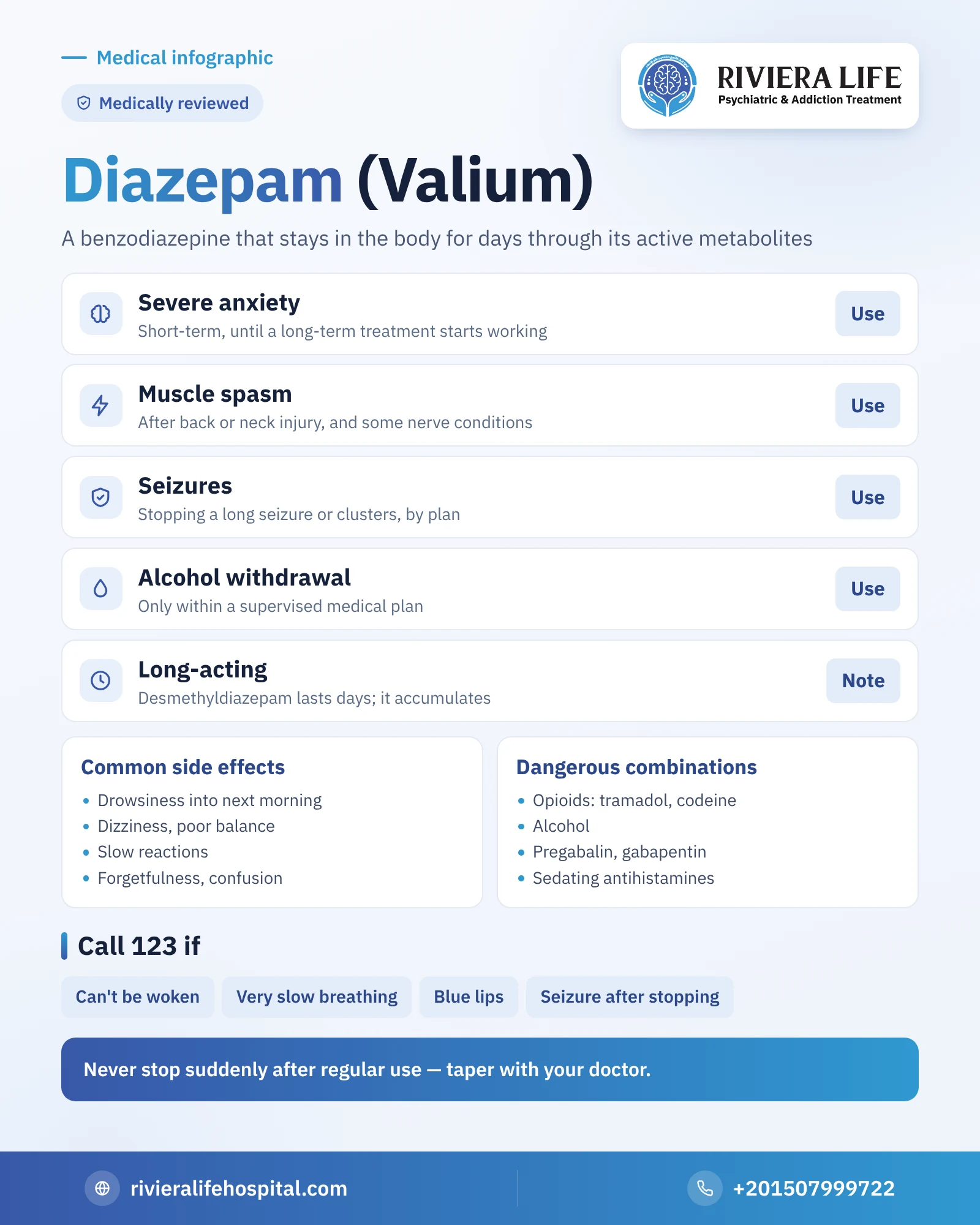
Diazepam is a sedative from the benzodiazepine family, known to most people by its best-known brand name, Valium, and doctors prescribe it for short-term severe anxiety, muscle spasms, some seizures, and alcohol withdrawal symptoms under medical supervision. What distinguishes it from its relatives is that it stays in the body for a long time, because the liver turns it into active substances that last for days. This property makes it useful in certain situations, but it makes its accumulation and its effect on memory and balance clearer with continued use. In this article we explain when it is used, how it works, its side effects, warnings and interactions, and why any change to it must stay in the doctor’s hands.
What is diazepam?
Diazepam is one of the oldest benzodiazepines in medical practice, and for decades the name “Valium” became synonymous with the word sedative. It is dispensed as tablets taken by mouth, and other forms such as injections are available in hospitals, and in some countries a form given rectally or nasally to stop repeated seizures. It belongs to the benzodiazepine family, which includes alprazolam, clonazepam and lorazepam, but it is almost the longest-lasting among them because of its active products.
In Egypt, diazepam is subject to controls on psychoactive medicines, so it is only dispensed on prescription, and trading or selling it without a prescription is a legal violation.
Medical uses of diazepam
The doctor prescribes diazepam for specific reasons, each with a clear duration and goal:
Severe anxiety
It is used to calm acute anxiety attacks for a short period, usually a few weeks, until a long-term treatment such as antidepressants or psychotherapy starts to work. It isn’t meant to become the permanent treatment for anxiety.
Muscle spasm and stiffness
It relaxes spasming muscles after back or neck injuries, eases the stiffness linked to some nerve and spinal cord diseases, and is sometimes used with physiotherapy.
Seizures
Diazepam has an emergency role in stopping a long seizure or successive seizures, and is usually given in hospital or by an emergency plan set by the neurologist. Daily prevention of epilepsy mostly relies on other medicines.
Alcohol withdrawal under supervision
When someone dependent on alcohol stops, the medical team may use diazepam to ease tremor and agitation and prevent seizures and delirium. This is a use carried out within a monitored medical plan, not at home by personal decision, and the details are in our article on alcohol withdrawal symptoms.
Doctors also use it before some medical procedures to calm the patient.
How does diazepam work in the brain?
In the brain there is a neurotransmitter called GABA whose job is to lower the activity of nerve cells. Diazepam binds to a special site on this transmitter’s receptors, making their response to it stronger. The result is calmer nerve signals: tension decreases, muscles relax, the threshold at which a seizure starts rises, and drowsiness comes.
After swallowing, its effect begins in a relatively short time, then the liver turns it into products, the most important being “desmethyldiazepam”, which stays active for longer than the original medicine. So some of the effect may continue into the next day, and it accumulates with daily use, especially in older people and those with liver disease. Details of how long it stays in the blood and urine are in our article on how long benzodiazepines stay in the body.
Common side effects
Most side effects are a natural extension of the sedative’s action, and are clearer at the start or in older people:
- Drowsiness and fatigue, which may last into the next morning.
- Dizziness and weakened balance and coordination of movements.
- Slowed reactions that make driving and operating machinery dangerous.
- Forgetting recent events and poor concentration.
- Confusion, especially in the elderly.
- Dry mouth and sometimes stomach upset.
- Reduced sexual desire in some patients.
The opposite may happen in a few people, with agitation, irritability or aggression appearing instead of calm. This is called a paradoxical effect, and calls for telling the doctor immediately.
Important warnings before using it
The doctor needs to know the patient’s full picture before prescribing diazepam, because some conditions make it more dangerous:
- Breathing diseases: such as sleep apnea and severe weakness of lung function, because the medicine suppresses breathing.
- Liver diseases: because the liver is what clears the medicine and its products, so it stays longer.
- Myasthenia gravis: because muscle relaxation may increase the weakness.
- Pregnancy and breastfeeding: it may reach the fetus and the infant, and here the doctor weighs the benefit against the risk.
- Older people: more exposed to falls, fractures and confusion.
- A history of addiction: anyone who has previously been dependent on alcohol or any substance is more likely to misuse it.
- Severe depression: needs close follow-up, as a sedative alone doesn’t treat it and may hide its worsening.
Drug interactions: when does diazepam become dangerous?
The most dangerous thing about diazepam isn’t the medicine alone, but what is combined with it. These are the main groups the doctor must know about:
| Substance | What may happen |
|---|---|
| Opioids, including tramadol, codeine and cough medicines | Severe suppression of breathing and deep drowsiness that may reach coma |
| Alcohol | Multiplied sedation, loss of balance and slowed breathing |
| Pregabalin and gabapentin | Increased drowsiness, dizziness and breathing risk |
| Sedating antihistamines and some sleeping medicines | Deeper sedation and confusion |
| Some antacids, antifungals and antiepileptics | May change how quickly the liver clears diazepam, increasing or decreasing its effect |
That is why the doctor and pharmacist must be told about every medicine, herb or supplement being taken, and no other sedative should be added without consultation.
Does diazepam cause dependence?
Yes. Daily use for weeks on end may produce tolerance, meaning the same effect needs a larger amount, then physical dependence that makes stopping suddenly difficult. This is possible even with full adherence to the prescription, which is why medical guidelines recommend the shortest possible duration.
Addiction, however, is a different behavioral stage: taking the medicine to get relaxation or a “high”, increasing it without the doctor’s knowledge, collecting it from more than one source, or mixing it with alcohol and opioids. You will find the signs of this stage that the family notices in our article on benzodiazepine addiction symptoms.
Why isn’t it stopped suddenly?
Diazepam’s long stay means withdrawal symptoms are sometimes delayed by days, so the person thinks they are over it and then a wave of anxiety, insomnia and tremor begins. After long regular use, stopping suddenly may lead to seizures, especially in someone who uses it for epilepsy or combines it with alcohol. The rule is clear: no change in the amount and no stopping except with a gradual reduction plan set by the treating doctor. What to expect during withdrawal is explained in our article on benzodiazepine withdrawal symptoms.
Diazepam compared with Xanax and Rivotril
All three are from the same family, but the timing differs. Alprazolam (Xanax) is relatively short-acting, so its user feels a clear dip between doses. Clonazepam (Rivotril) is long-acting and used more for epilepsy and panic. Diazepam, however, starts working quickly and then lasts thanks to its products, and has a clearer role in muscle relaxation and alcohol withdrawal. And lasting a long time isn’t an absolute advantage: it makes withdrawal smoother for some, but increases accumulation and drowsiness in the elderly. For the picture on the other two medicines: Xanax addiction and Rivotril addiction.
Tips for safe use under a doctor’s supervision
- Ask your doctor from day one about the expected length of treatment and the plan for stopping.
- Don’t drive until you know how the medicine affects you, and avoid it completely if you feel drowsy.
- Don’t drink alcohol, and don’t combine it with painkillers or sleeping pills without permission.
- Don’t give your tablets to anyone, and don’t take someone else’s, however similar the symptoms.
- Keep the medicine away from children, and somewhere teenagers in the home can’t reach.
- Tell the doctor if you feel you need it more, or that you can’t sleep without it.
Call an ambulance on 123 immediately if you see
Especially if diazepam was taken with alcohol, tramadol or any other opioid painkiller or sleeping pill.
- Deep drowsiness from which the person can’t be woken by calling or shaking
- Very slow or irregular breathing
- Blue lips or nails
- A seizure after stopping the medicine
- Severe confusion or hallucinations
When do you need specialist treatment?
If diazepam use has continued for months without review, the dose has become larger than the doctor prescribed, attempts to cut down have failed, or alcohol has come into the picture, the matter needs a specialist assessment. At Riviera Life we start with a confidential assessment that distinguishes between therapeutic dependence and addiction, then set a gradual withdrawal plan under round-the-clock medical supervision when needed, along with treating the anxiety or insomnia the medicine was started for. The details of the treatment stages and care for older people are in our article on Valium addiction treatment, and the first consultation is free on +201507999722.
More from our benzodiazepines guide
- Benzodiazepines: the complete guide
- Valium addiction treatment
- Bromazepam
- The harms of benzodiazepines
- The difference between Valium and Rivotril: use, duration, dependence and withdrawal
- Lorazepam (Ativan): uses, effects, dependence and withdrawal
- Librax: its ingredients, use for the colon and the risks of dependence
Questions many people ask
Yes, Valium is the best-known brand name for diazepam, and the same substance may be available under other brand names depending on the country.
Usually not; it is used for a short period to calm acute anxiety, while long-term treatment relies on antidepressants and psychotherapy.
It is advisable to avoid driving until the patient knows how the medicine affects them, because it slows reactions and its effect may extend into the next day.
Opioids such as tramadol and codeine, and alcohol, because they multiply the suppression of breathing and may cause coma.
It may cause tolerance and physical dependence with daily use for weeks, which is why the doctor prescribes it for the shortest possible time and stops it by gradual reduction.