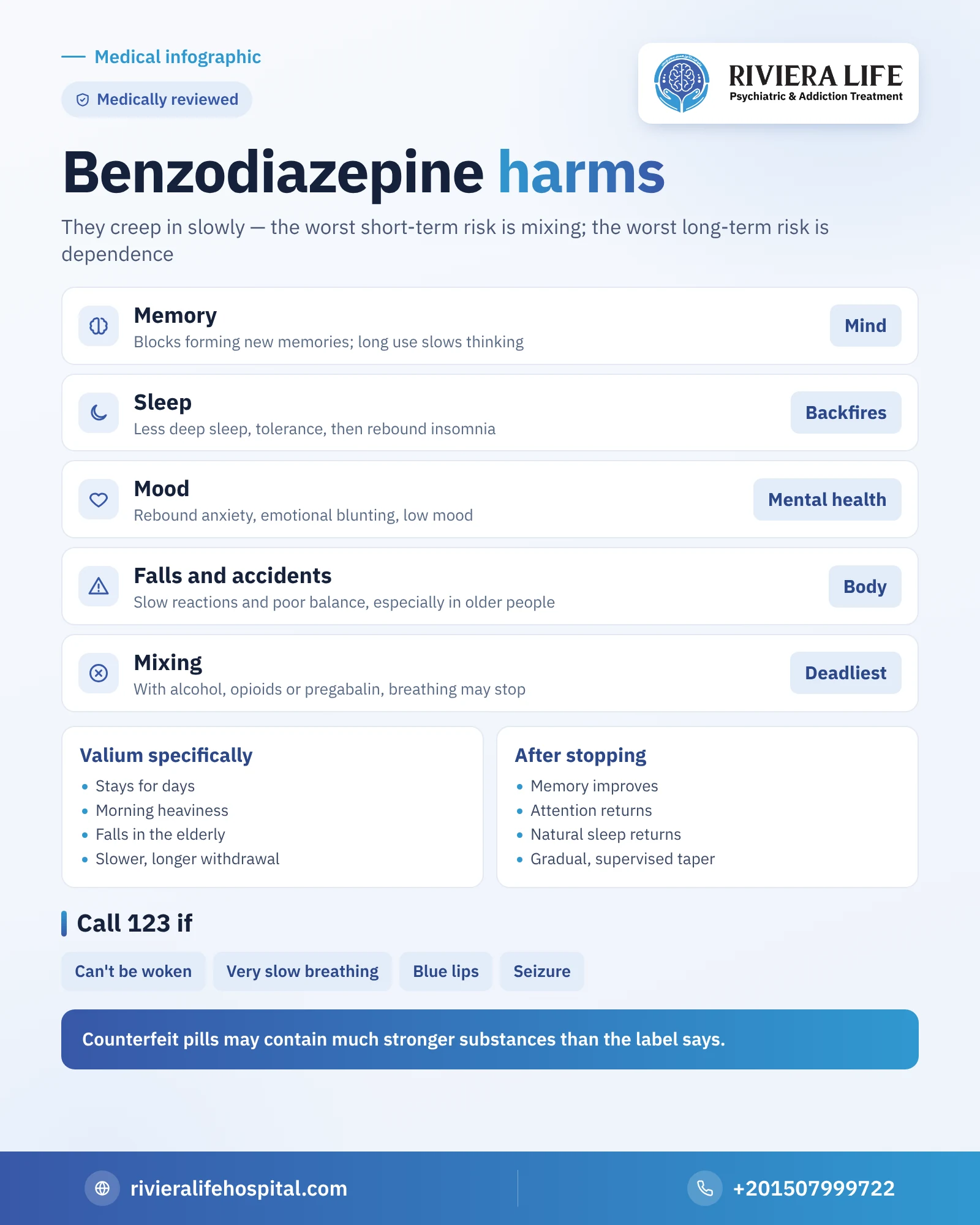
The harms of benzodiazepines don’t appear as a sudden collapse, but creep in slowly: weakening memory, slowing attention, a mood that loses its colors, and repeated falls and accidents. The most dangerous thing they do in the short term is slow breathing when mixed with alcohol, opioid painkillers or pregabalin, and the most dangerous thing they do in the long term is dependence, which makes stopping itself dangerous. These harms increase in older people, pregnant women and those who drive. In this article we review the effect of these medicines on the brain, body, mental health and daily life, and what improves after stopping them.
Short-term harms
Even the prescribed dose may cause unpleasant effects in the first days, which intensify with higher doses:
- Drowsiness and lethargy, which may extend into the next morning with long-acting types.
- Dizziness, unsteadiness and weak coordination of movement.
- Slow reactions and difficulty concentrating.
- Slurred speech and blurred vision with large amounts.
- Muscle weakness and a general feeling of slackness.
Their effect on memory and thinking
One of the best-known harms of these medicines is that they disrupt the forming of new memories while they are active. A person may have a whole conversation or do things and not remember them the next day, and this increases with high doses and mixing with alcohol. With long use, many complain of a general weakness in concentration, slowness in processing information and difficulty learning new things.
Some studies point to a link between long use in older people and an increased risk of dementia, but this relationship hasn’t been settled scientifically, and it can’t be stated with certainty that it is causal. What is certain is that a large part of the weakness in memory and concentration improves gradually after stopping.
Falls, fractures and road accidents
Because these medicines slow reactions and weaken balance, they raise the risk of falls, especially in older people when they get up at night to go to the bathroom. A hip fracture at this age isn’t a minor injury, but may change the person’s life completely. Driving under the influence of sedatives clearly raises the risk of accidents, and the problem is that the person often feels fine, while his reactions are slower than he thinks. The risk doubles if the sedative comes together with alcohol or another medicine that causes drowsiness.
Harms to mental health
The irony is that the medicine prescribed for anxiety may leave clear psychological harms with continued use:
- Rebound anxiety between doses that makes the person more tense than before the medicine.
- Emotional blunting, so he doesn’t feel joy or sadness to the normal degree.
- A depressed mood, and the condition of someone who already has depression may worsen.
- Paradoxical reactions in some people, such as agitation, aggression, loss of inhibition and impulsive behavior.
- The appearance of suicidal thoughts in a few patients, especially with accompanying depression, which calls for immediate contact with the doctor.
Sleep: a treatment that turns into a problem
Benzodiazepines help with falling asleep quickly at first, but they change its nature, reducing the stages of deep sleep and its actual quality. Over time their sleep-inducing effect declines because of tolerance, while dependence remains. And when the person tries to sleep without them, he faces rebound insomnia worse than before, so he becomes convinced he “can only sleep with the pill”. That is why these medicines aren’t advised as a long-term treatment for insomnia, and the more successful long-term alternative is cognitive behavioral therapy for insomnia.
Tolerance and dependence: a harm in itself
After weeks of daily use, the effect of the same dose decreases, so the person tends to increase it, and the brain adapts to the medicine’s presence until its absence becomes a source of danger. This dependence means that stopping suddenly may cause seizures or delirium, which makes benzodiazepines one of the few substances whose withdrawal may be life-threatening. You will find details in our article on benzodiazepine withdrawal symptoms.
Overdose and the danger of mixing
If benzodiazepines are taken alone, an overdose usually causes deep drowsiness and confusion, and is rarely fatal in healthy adults. But the picture changes completely when they are mixed with other substances that depress the nervous system. Alcohol, opioid painkillers such as tramadol, and pregabalin each slow breathing in their own way,
and combining them multiplies this effect until breathing may stop during sleep. This pattern specifically lies behind a large proportion of deaths linked to these medicines. To learn the danger signs with other substances and what to do until the ambulance arrives, see our drug overdose guide. The risk increases in older people and those with lung disease and sleep apnea.
Call an ambulance on 123 immediately if you see
Especially if the sedative was mixed with alcohol, a painkiller or pregabalin, and don't let him sleep alone.
- No response to being called, or great difficulty waking him
- Very slow or irregular breathing, or unusual snoring
- Blue lips or fingertips
- Severe confusion or a seizure
The harms of counterfeit and unknown pills
A large part of what circulates outside pharmacies in Egypt isn’t the medicine whose name it carries. A pill may be sold as Xanax or Rivotril while it is actually another substance, or the strength is much higher than written, or it contains a mixture of different sedatives. In some countries counterfeit pills have appeared containing very strong unlicensed sedatives or even synthetic opioids, which has noticeably increased cases of poisoning.
Someone who takes a pill of unknown origin can’t know how much he actually took, and the emergency doctor can’t know either. And crushing pills or taking several at once to strengthen the effect raises the dose reaching the brain in a short time, increasing the risk of deep drowsiness and slowed breathing, especially if alcohol or a painkiller came before.
Pregnancy and breastfeeding
Regular use of benzodiazepines in the last months of pregnancy may lead to the birth of a sluggish baby with weak muscles or withdrawal symptoms after birth, and amounts of them pass into breast milk. Even so, a pregnant woman shouldn’t stop the medicine suddenly on her own, because withdrawal harms her and the fetus. The right decision is a joint review by the gynecologist and psychiatrist to determine the safest plan.
Their effect on work and relationships
Away from organs and tests, these medicines leave a clear mark on daily life: declining work performance because of weak concentration and forgetfulness, missed appointments, and a family that feels the person is “there and not there” at the same time. With misuse other problems appear: increasing spending on pills, lying to hide the amount, tension in relationships, and legal risks when obtaining the medicine outside the medical framework. The family may notice these changes before the person himself admits them, and they are explained in our article on benzodiazepine addiction symptoms.
Do the harms of benzodiazepines go away after stopping?
The reassuring news is that most of the harms can improve. Memory and concentration improve gradually over weeks to months, many regain their balance and sharpness of attention, and natural sleep returns after a period of disturbance. But improvement needs patience, because some symptoms may remain as intermittent waves for a while after stopping. The road to this passes through gradual reduction under supervision, not sudden cutting off, which our article on benzodiazepine addiction treatment explains. At Riviera Life, psychiatry consultants follow this stage step by step, treating the anxiety and insomnia that appear during it.
The harms of Valium specifically: why is it different from others?
Valium (diazepam) is one of the long-acting types, and this changes the shape of its harm. It and a substance produced from it stay in the body for days, so the amount accumulates with daily use and drowsiness and mental slowness appear the next morning, even if the pill was taken in the evening. The patient may not link the heaviness in his head during the day with the previous night’s pill, so he treats it with a cup of coffee or an extra pill.
The most feared harms are:
- Falls and fractures in older people, because the medicine weakens balance and its effect lasts long.
- Weak concentration and short-term memory, and the effect of this on driving and work.
- Multiplied slowing of breathing when combined with alcohol or painkillers.
- Physical dependence, which may appear after weeks of regular use.
It is common for Valium to be prescribed originally for muscle spasm or anxiety, then continue for months without review, so medical use turns into dependence without anyone noticing. Because of its long action, its withdrawal is slower and less intense at first than the short-acting types, but it lasts longer, and it isn’t stopped suddenly. The full introduction to the medicine and its medical uses is in our article on diazepam (Valium), and the steps of safe reduction in Valium addiction treatment.
More from our benzodiazepines guide
- Benzodiazepines: the complete guide
- Causes of benzodiazepine addiction
- How long benzodiazepines stay in the body
- Benzodiazepine addiction treatment
- Bromazepam (Lexotanil): uses, side effects, dependence and withdrawal
- Rohypnol pills (flunitrazepam): memory loss, the danger of alcohol and how to protect yourself
- Librax: its ingredients, use for the colon and the risks of dependence
- Lorazepam (Ativan): uses, side effects, dependence and withdrawal
Questions many people ask
Yes, they may disrupt the forming of memories while they are active, and with long use they weaken concentration and speed of thinking. Most of this improves gradually after stopping.
Alone it is rarely fatal in healthy adults, but mixing them with alcohol, opioids or pregabalin may stop breathing, and this is the greatest danger.
They may cause emotional blunting and a depressed mood with long use, and may worsen the condition of someone who already has depression, which is why they need regular psychiatric follow-up.
Because they stay in their bodies longer and weaken balance and attention, so the risk of falls, fractures and mental confusion rises.
The doctor decides according to the case, as regular use near delivery may affect the newborn, but stopping suddenly is also dangerous. Don't change the medicine without a medical review.