The causes of marijuana addiction can’t be reduced to one cause; three parties meet in them: a substance that has become stronger than ever before, a person with a particular susceptibility because of their age, genetics or psychological state, and an environment that eases access to it and portrays it as something ordinary. The more factors from these parties come together, the higher the likelihood that use turns into dependence. This article explains each factor separately, why some people fall into addiction while others stop after trying, and what protects children before the problem begins.
Why do some users become addicted and others stop?
Many try marijuana once or twice then leave it without effort, while others find themselves a year later unable to sleep without it. The difference doesn’t go back to “willpower” as some imagine, but to a group of factors that interact together. The matter can be likened to a scale: on one side risk factors, on the other protective factors, and addiction happens when the first clearly outweighs and use continues long enough. To understand the stages a person goes through on this road, see the article on marijuana addiction.
Causes related to the substance itself
The substance young people use today differs greatly from its old image:
- Higher concentration: the average THC in seized samples in the United States has become several times higher than it was in the nineties, and the stronger dose speeds up tolerance and dependence.
- Declining cannabidiol: in many strains the proportion of this compound, which may ease some psychological effects of THC, has decreased.
- Concentrates and vaping devices: deliver large amounts quickly, and can be used dozens of times a day without a smell.
- Repetition: daily use is the strongest predictor of addiction, stronger than the amount on a single occasion.
Age at start: the strongest factor
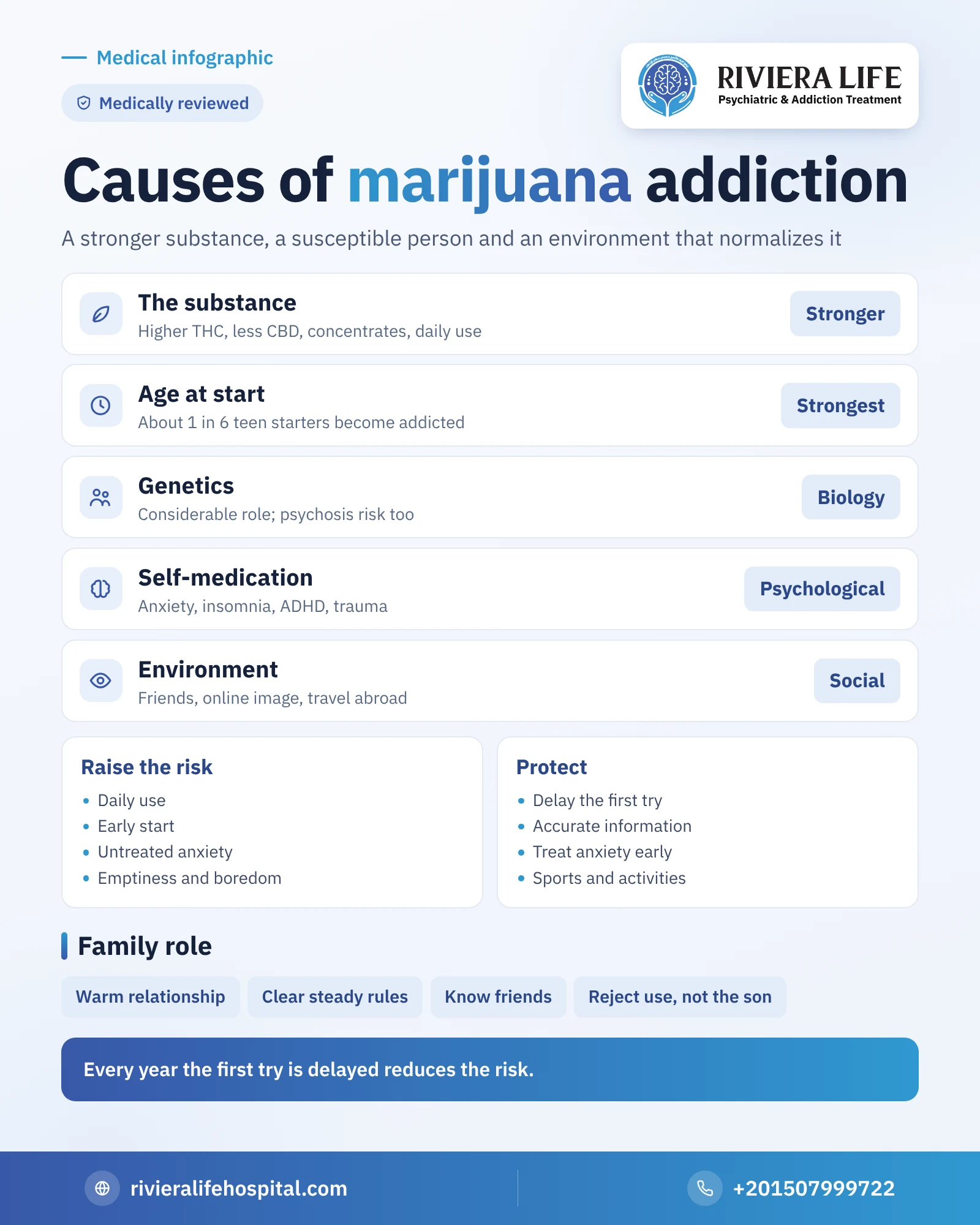
The brain doesn’t complete its development until about the mid-twenties, and the areas responsible for controlling impulsivity and decision-making are the last to be completed. The internal cannabinoid system itself takes part in guiding this development. That is why introducing THC at this stage leaves a deeper effect. Estimates from the US National Institute on Drug Abuse indicate that those who start in adolescence are clearly more susceptible to addiction than adults, with the likelihood of addiction approaching one in six users in this group. Every year the start is delayed reduces the risk.
Genetics and family predisposition
Twin and family studies indicate that genetic factors explain a considerable part of the difference between people in susceptibility to cannabis addiction, and that this susceptibility overlaps with a predisposition to addiction to other substances. Having a father or brother suffering from addiction doesn’t mean the son will inevitably become addicted, but it is an additional reason for caution and early prevention. A genetic predisposition to schizophrenia and psychosis is also linked to a particular risk; these people are more likely to have marijuana reveal psychotic symptoms in them.
Anxiety, depression and attention deficit disorder
Many users didn’t start looking for a high, but for calm. The young man suffering from social anxiety finds that the joint makes talking easier, someone with chronic insomnia finds in it a way to sleep, and someone with ADHD feels with it that their mind has “calmed down”. This is what doctors call self-medication. The problem is that the relief is temporary, and regular use may increase anxiety and depression in the long term, so the person returns to it more, and the circle closes. That is why the doctor always looks for these disorders in the first assessment.
Trauma and chronic pressures
Exposure to harsh experiences in childhood, a sudden loss, or prolonged pressures in study, work or home raises the likelihood of turning to any substance that numbs feeling. Research indicates a clear link between traumatic experiences and higher rates of substance use disorders in general. Imagine a young man who lost his father suddenly in his final year of secondary school, and found no space to grieve amid the pressure of exams; the first joint may be just an escape from a long night, but it quickly turns into his only way of sleeping. Here stopping marijuana isn’t enough; the original wound must be treated with specialized psychological sessions.
Boredom, emptiness and lifestyle
A factor that seems simple but is strongly present in the stories of many users: long hours without purpose, staying up in front of screens, and the absence of any activity that gives a sense of achievement. In this emptiness marijuana becomes an “activity” in itself, and a daily ritual that fills the evening. This repeats often in long summer holidays, after graduation and before getting a job, and in periods of unemployment. That is why the treatment program cares about building an organized, full day as much as it cares about stopping the substance.
Friends and the social environment
Teenagers and young people are strongly influenced by the group. If marijuana is a fixed part of meetings with friends, refusing becomes socially costly, and use becomes a means of belonging. The risk is increased by easy access through social apps, the availability of money without supervision, and spending long times without organized activity.
The image of marijuana on the internet
A whole generation grows up on clips showing brightly lit cannabis shops in foreign cities, celebrities talking about it without embarrassment, and pages promoting “cannabis treatment” for everything from anxiety to epilepsy. This image lowers the sense of risk, and a lower sense of risk is among the strongest indicators of increased use among teenagers in survey studies. What these clips leave out is that legalization in those countries is a regulatory decision that doesn’t mean safety, and that medicines derived from cannabis are something completely different from the joint. We discuss this difference in detail on the marijuana page.
Travel and study abroad
A familiar story recurs in addiction clinics: a young man who travelled to study or work in a country where marijuana is sold openly, tried it without fear of punishment, then returned to Egypt having come to need it. Being away from home, loneliness and study pressure come together there with easy access, and when he returns he finds the law is different but the need remains, so he looks for it in the illicit market with all its adulteration and mixing.
The family’s role: risk and protection
The family may be a risk factor or a protective factor. Constant disputes, supervision that is either completely absent or completely suffocating, and the parents’ own leniency with substances raise the risk. On the other hand, children are protected by a warm relationship in which they talk freely, clear steady rules, the parents knowing their children’s friends and where they go, and a frank message that the family rejects use without rejecting the son.
Can it be prevented before it starts?
- Delaying the first experiment as much as possible, as every year makes a difference.
- Talking with children with accurate information, not exaggerated frightening that makes parents lose their credibility.
- Treating anxiety, depression and attention disorder early with a doctor.
- Filling time with sports and social activities that give belonging and enjoyment.
- Following small changes early, helped by the article on marijuana addiction symptoms.
When the causes come together: when do you seek help?
If you find in your son or in yourself several factors from this list along with repeated use, don’t wait for big problems to appear. Early assessment determines whether use is still at a stage that can be stopped with a simple intervention, or whether it needs a full program. At Riviera Life the team works on the causes themselves, not on the substance alone, treating anxiety, insomnia and trauma alongside the use, as the article on marijuana addiction treatment explains.
More from the marijuana guide
- Marijuana: the complete guide
- Marijuana addiction and how it develops
- The harms of marijuana
- Marijuana addiction treatment
Questions many people ask
There is no single cause, but daily use and starting in adolescence are among the strongest factors, and the risk increases with untreated anxiety or depression.
Genetics plays a considerable role in susceptibility to addiction, but it doesn't determine fate on its own. Environment, age and method of use share in the outcome.
Because it gives temporary calm, but regular use may increase anxiety later and delay its real treatment, so the person enters a closed circle.
Results differ between countries and are still under study, but a lower sense of risk linked to its legal image is associated with greater readiness to try it among teenagers.
With a close relationship and calm dialogue with accurate information, steady rules, knowing his friends and activities, and treating any anxiety or attention disorder early.