Marijuana addiction treatment rests mainly on behavioral psychotherapy, supported by medication treatment for withdrawal symptoms and accompanying disorders, then extended follow-up that prevents relapse. There is so far no globally approved medicine that treats cannabis addiction itself, which is why the quality of treatment is determined by the team’s experience with proven psychological methods, not just providing a bed. This article explains the stages of the treatment plan in order, when residence is necessary, what determines the chances of recovery, and how to choose the right hospital.
Does marijuana addiction need specialist treatment?
Many believe that leaving marijuana is a matter of decision, and that the absence of dangerous withdrawal means the matter doesn’t deserve a doctor. In reality a large proportion of those who try to stop alone return within weeks, not because of acute physical pain, but because of insomnia, irritability, anxiety and the absence of an alternative. Specialist treatment offers what willpower alone doesn’t: a diagnosis of what lies behind the use, practical tools for dealing with craving, and a support network for the patient and family. The need for it increases with daily use, mixing with other substances, or the appearance of psychological symptoms.
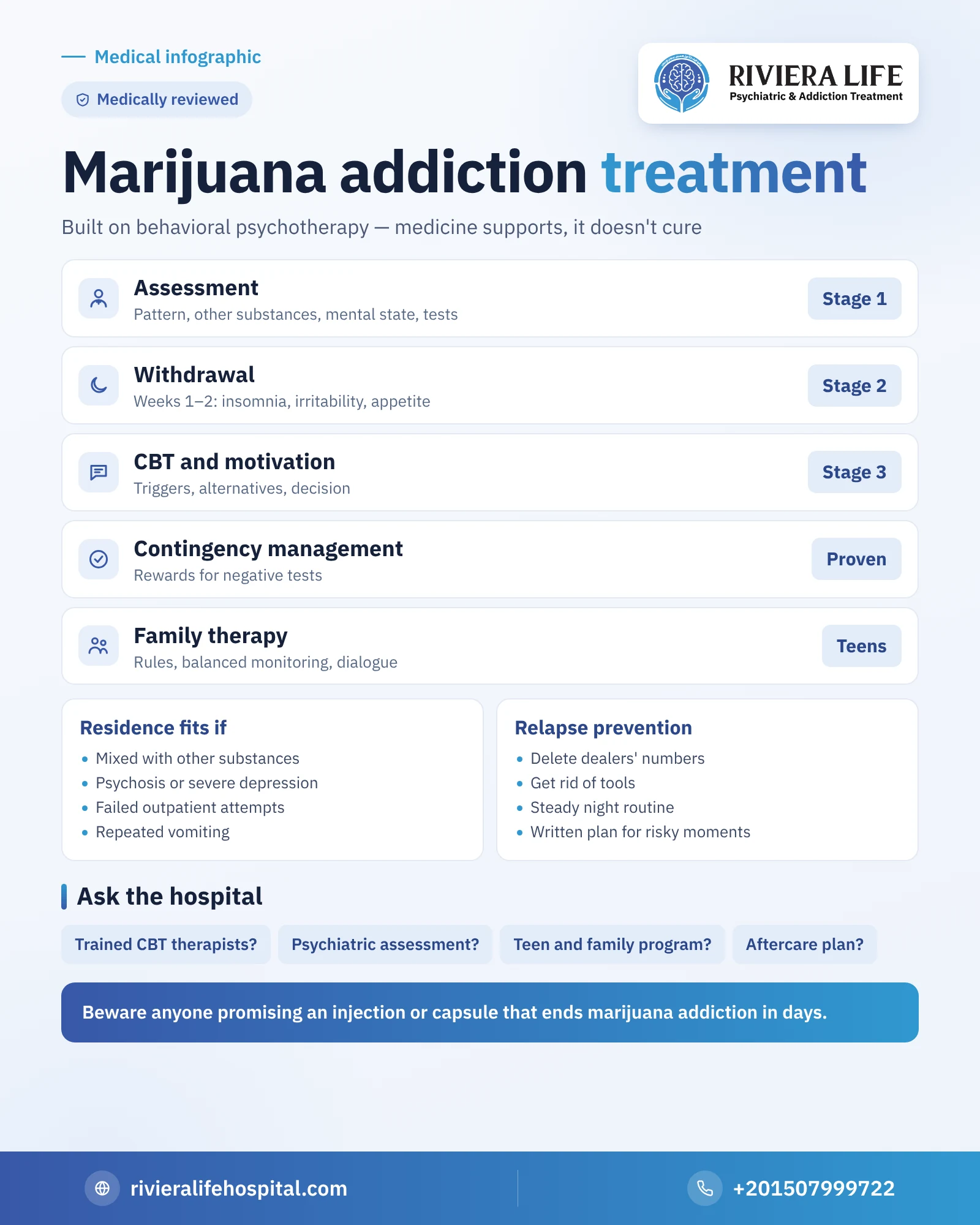
The first stage: comprehensive assessment
Treatment begins with an assessment session carried out by a psychiatrist specializing in addiction, including:
- The history of use: when it started, how many times a day, and which form is used, whether flowers, concentrates, vaping devices or edibles.
- Other accompanying substances such as alcohol, tramadol and pregabalin, because they change the order of the plan.
- Examining the psychological state to look for anxiety, depression, psychosis or attention deficit disorder.
- Tests to confirm the substances used and to distinguish between marijuana and synthetic cannabinoids.
- A physical examination including the heart and digestive system, especially for those with repeated vomiting.
The assessment produces a classification of the severity of the disorder, and a recommendation for the place and duration of treatment.
The second stage: getting through withdrawal
Marijuana withdrawal isn’t usually life-threatening, but it is troublesome enough to make home attempts fail. It is concentrated in the first and second weeks, and consists of insomnia, disturbing dreams, irritability, loss of appetite and anxiety. The doctor deals with each symptom with what suits it, treating sleep disturbance, anxiety and nausea with medicines determined according to the case, while organizing sleep, food and physical activity. The article on marijuana withdrawal symptoms details what happens on each day of this stage.
The third stage: proven psychotherapies
This is the heart of marijuana addiction treatment, and what research supports most:
Cognitive behavioral therapy
In it the patient learns to recognize the situations and thoughts that precede craving, such as boredom after work or anxiety before sleep, and to build alternative reactions. They train in refusing offers and facing friends who still use.
Motivational therapy
Relatively short sessions that help the hesitant patient settle their position, by weighing what they gain from marijuana against what they lose, without preaching or pressure. It is especially useful for someone who comes to treatment under family pressure.
Contingency management
The patient receives tangible incentives in return for consecutive negative tests, a method that has proven effective in lengthening periods of abstinence, especially in the first weeks.
Family therapy
With teenagers and young people specifically, involving the family is an essential part, as it learns to set clear rules, balanced monitoring and a style of dialogue that reduces clashes.
Is there a medicine to treat marijuana addiction?
There is so far no medicine approved by the major drug agencies to treat cannabis use disorder directly, although a number of medicines are under study. That is why any advertisement for an “injection” or “capsule” that ends marijuana addiction within days should be met with caution. What medicine actually offers is treatment of accompanying symptoms: sleep, anxiety and depression, and this alone makes a big difference in the patient’s ability to continue.
Treating co-occurring mental disorders
Many marijuana patients started using to calm undiagnosed anxiety, insomnia or sadness. If use stops and the original problem remains, the patient returns to what they know. That is why the team treats depression, anxiety and attention deficit disorder in parallel. Someone who has shown psychotic symptoms needs careful psychiatric follow-up, and may need residence. To understand these motives see the article on the causes of marijuana addiction.
Residence or outpatient follow-up?
| Inpatient residence is suitable when | Outpatient follow-up is suitable when |
|---|---|
| Marijuana is mixed with alcohol, sedatives or stimulants | Dependence is on marijuana alone |
| There are psychotic symptoms, severe depression or thoughts of harm | The psychological state is stable |
| Previous outpatient attempts have failed | It is a first treatment attempt |
| The home environment is full of triggers | The family is supportive and cooperative |
| There is repeated vomiting and dehydration | The patient can commit to sessions and tests |
Duration of treatment and chances of recovery
The intensive stage usually extends from weeks to a few months according to severity, followed by follow-up that may continue a year or more. There is no single “cure rate” that can honestly be stated, as results differ greatly according to the patient’s age, duration of use, presence of mental disorders and degree of commitment. What research confirms is that whoever completes psychotherapy and continues follow-up achieves much better results than someone who settles for the first weeks, and that relapse, if it happens, doesn’t mean failure but the need to adjust the plan.
Preventing relapse after treatment
The first months after stopping are the most sensitive. It helps the patient in them to delete the numbers of those they used to buy from, get rid of all tools, and build a fixed night routine because insomnia is among the strongest reasons for returning. It is important to anticipate the difficult moments in advance: travel to a country where it is sold openly, a night with old friends, or exam pressure, and to have a written plan for each. Periodic follow-up sessions and random tests agreed with them give them and their family a sense of security.
The family’s role during treatment
The family is a partner, not a watcher. It needs to stop arguing about “the benefits of cannabis” and focus on tangible behavior, reward progress even if small, and keep clear limits on money and going out. It benefits from sessions of its own in which it learns how to deal with relapse without collapsing.
The right hospital for marijuana addiction treatment: how to choose
The right hospital for marijuana addiction treatment is one that offers what a marijuana patient specifically needs: specialized behavioral psychotherapy that doesn’t settle for isolation, accurate diagnosis of accompanying anxiety, depression and psychosis, and experience with young people, teenagers and their families. Ask before you decide:
- Does the place offer cognitive behavioral and motivational therapy by trained therapists, or does it settle for residence?
- Does it carry out a psychiatric assessment that uncovers cannabis-linked psychosis, depression and anxiety?
- Does it have tests that distinguish marijuana from synthetic cannabinoids and accompanying substances?
- Does it have a program suited to teenagers that really involves the family?
- Does it deal medically with cases of repeated vomiting and dehydration if present?
- Is there a clear follow-up plan after discharge to prevent relapse?
And beware of any party that promises you a guaranteed cure rate or ending addiction within a few days.
How Riviera Life meets these standards in marijuana addiction treatment
At Riviera Life the previous criteria are applied as follows:
- A licensed body: Riviera Life operates under a license from the Ministry of Health in psychiatry and addiction.
- Fourteen years in the field: years of addiction treatment that have resulted in the recovery of thousands of cases.
- Specialist consultants: consultants in psychiatry and addiction treatment diagnose the anxiety, depression and psychosis behind the use.
- Structured psychotherapy: a behavioral and motivational program targeting craving and the habits linked to marijuana.
- Night and day follow-up: a medical team present 24 hours during the marijuana withdrawal stage, treating insomnia, vomiting and anxiety attacks.
- Complete confidentiality: the privacy of the patient and family is protected, which matters especially to young people and students.
- Care for the family and after discharge: a program that involves the family, and aftercare that protects recovery.
Begin the journey of recovery from marijuana with a free first consultation; we answer your call at any time on +201507999722, and our address is Sheikh Zayed, Giza.
More from the marijuana guide
- Marijuana: the complete guide
- Marijuana addiction and how it develops
- Marijuana withdrawal symptoms and their stages
- Causes of marijuana addiction
Questions many people ask
The intensive stage usually extends from weeks to a few months according to severity and accompanying substances, then follow-up continues for months to protect recovery.
There is so far no approved medicine that directly treats cannabis use disorder, but the doctor treats accompanying insomnia, anxiety and depression, which makes it easier to commit to psychotherapy.
In mild cases regular outpatient follow-up with the doctor and therapist can be relied on. Cases mixed with other substances or accompanied by severe psychological symptoms need residence.
Choose one licensed by the Ministry of Health with consultants in psychiatry and addiction and an integrated psychological and family program. Riviera Life in Sheikh Zayed meets these criteria with fourteen years of experience.
No, relapse is possible in chronic illnesses including addiction. What matters most is returning quickly to follow-up and reviewing the triggers that preceded it to adjust the plan.