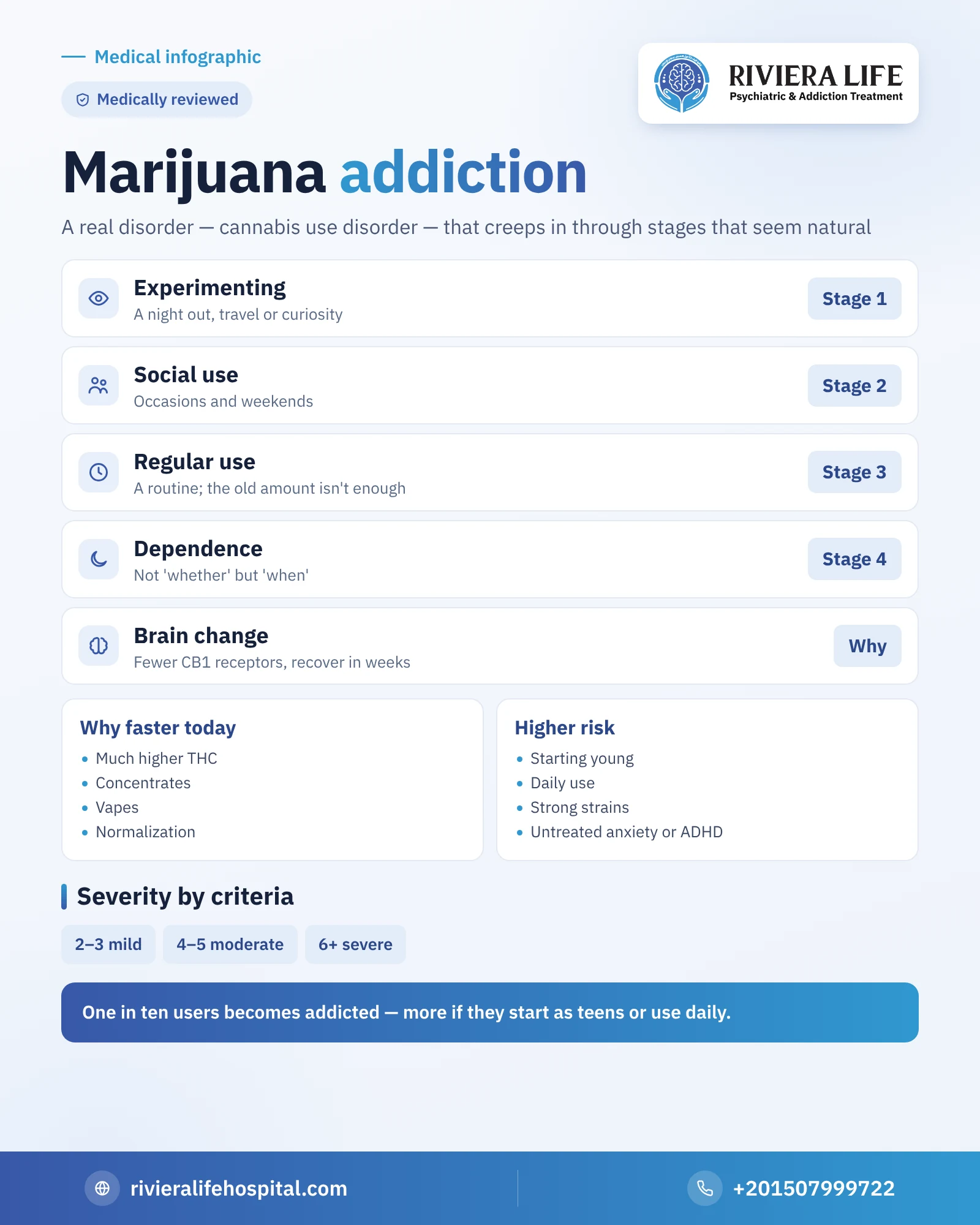
Marijuana addiction is a real condition that doctors call “cannabis use disorder”, diagnosed when a person loses the ability to control their use despite the problems it causes. This doesn’t happen overnight; it creeps in through successive stages that are hard for the person to notice, because each stage seems a natural extension of the one before. This article explains how dependence on marijuana forms step by step, what changes in the brain during it, why it is faster today than two decades ago, and when treatment becomes a necessity.
Does marijuana really cause addiction?
Yes. This isn’t a point of view but a settled medical fact; the Diagnostic and Statistical Manual of Mental Disorders recognizes cannabis use disorder, and also recognizes a withdrawal syndrome specific to it. US research bodies estimate that about one in ten users becomes addicted, and that the rate rises a lot for those who start in adolescence and those who use daily. The confusion arises because marijuana dependence doesn’t look dramatic like heroin dependence: no severe tremor and no fatal overdose. It is a “quiet” addiction that slowly eats away ambition, memory and relationships, which is why acknowledging it is delayed for years.
From experimenting to dependence: four stages
Not every user passes through all the stages, but those who reach addiction have usually crossed them in this order.
Stage one: experimenting
It usually starts at a night out with friends, while travelling to a country where it is sold openly, or out of curiosity after a clip online. The first effect may be pleasant or unpleasant, and in itself says nothing about the future.
Stage two: social use
The experience repeats at occasions and weekends. The person feels completely in control, and that marijuana is just part of the atmosphere of the gathering. Here the first link forms in the brain between the substance and relaxation, laughter and belonging to the group.
Stage three: regular use
Marijuana moves from occasions to ordinary weekdays, then to a fixed routine: a joint before sleep, after work, or when upset. The person notices the old amount is no longer enough, and starts looking for stronger types or a vaporizer that can be used anywhere.
Stage four: dependence
The daily question becomes not “will I use?” but “when?”. Sleep doesn’t come without it, irritability appears if it is late, and attempts to stop end after days. At this stage the diagnosis of the disorder is met even if the person still appears to work and study.
What changes in the brain with daily use?
THC acts on receptors called type 1 cannabinoid receptors, which are part of a natural system that regulates mood, sleep, appetite and memory. When the person floods them daily with an external substance, the brain defends its balance by reducing the number of these receptors and weakening their response. This adaptation explains three things together: tolerance, meaning the need for a larger amount; withdrawal, meaning distress when the substance is absent; and loss of pleasure in ordinary activities. The good news is that studies suggest these receptors start returning to normal within weeks of stopping, which makes recovery clearly possible.
At the same time, the brain’s habit circuits learn to link the substance with specific situations: a certain place, particular people, a feeling of boredom, or even a song that was played at using sessions. These links are what suddenly ignite craving months after stopping, which is why getting the substance out of the body isn’t enough; the patient needs to learn how to recognize these triggers and gradually undo their link.
When is use called a medical addiction?
Doctors rely on a list of eleven criteria, assessed over twelve months. They include:
- Using marijuana in larger amounts than planned, or for longer than intended.
- A persistent wish to cut down, with repeated failure.
- Spending a large part of one’s time obtaining marijuana or recovering from its effects.
- A strong, urgent craving to use.
- Falling short in study, work or household responsibilities.
- Continuing despite clear problems in relationships or mental health.
- Tolerance and withdrawal symptoms.
Two or three criteria mean a mild disorder, four or five a moderate disorder, and six or more a severe disorder. What the family notices from the outside differs slightly, and we have gathered it in the article on marijuana addiction symptoms.
Why does addiction form faster today?
Today’s user isn’t dealing with the same substance a previous generation knew. Four changes speed up the road to dependence:
- Concentration: the average THC in seized samples in the United States and Europe has risen several times over about three decades.
- Concentrates: oils and waxes containing amounts far above the flowers, so tolerance jumps quickly.
- Vaporizers: almost odorless and can be used dozens of times a day without anyone noticing.
- Normalization: images of legalization abroad and talk of medical cannabis lower the sense of danger, so seeking help is delayed.
Physical dependence and psychological dependence
Some users think the absence of severe physical symptoms means they aren’t addicted. But marijuana dependence combines both sides. The physical side appears in insomnia, loss of appetite, sweating and abdominal pain after stopping. The psychological side is the deeper one: the feeling that life is unbearable without it, and using it as the only way to deal with anxiety, sadness or boredom. This side is what makes stopping difficult even after the physical symptoms have gone. The details of what happens after the last joint are in the article on marijuana withdrawal symptoms.
Who is most likely to reach addiction?
The likelihood increases with starting at a young age, daily use, using strong types, untreated anxiety, depression or attention deficit disorder, and a family history of addiction. We explained each of these factors and how it interacts with the others in the article on the causes of marijuana addiction.
When marijuana combines with other substances
Use in Egypt is rarely limited to one substance. Some young people combine marijuana with alcohol, use it to soften the effect of stimulants, or move between it and tramadol and pregabalin when it is scarce. This mixing makes dependence more complex, changes the withdrawal and treatment plan, and raises the chance of ending up with synthetic cannabinoids when they are sold as marijuana. That is why the doctor asks in the first assessment about everything the person uses, not just the main substance.
Is it possible to stop without help?
Some people succeed in stopping alone, especially in the early stages. But someone who has reached daily use and tried to stop more than once without success benefits a lot from a structured program. Cognitive behavioral therapy and motivational therapy are among the methods best proven effective with this type specifically, and they address the motives that bring the person back to the substance. Accompanying psychiatric disorders need separate diagnosis and treatment, otherwise the patient returns to marijuana as self-treatment. The full stages of the plan are in the article on marijuana addiction treatment.
How can Riviera Life help you?
At Riviera Life the road starts with a confidential meeting with a consultant in psychiatry and addiction treatment, who determines which stage the patient is at, whether they need admission or outpatient follow-up, and what feeds their use, such as anxiety, insomnia or stress. The first consultation is free, and you can get in touch around the clock. For the full picture of the substance itself, see the marijuana page.
More from the marijuana guide
- Marijuana: the complete guide
- Marijuana addiction symptoms
- The harms of marijuana on memory and the heart
- Marijuana addiction treatment
- Hash vs marijuana: source, concentration, effect and which is more dangerous
Questions many people ask
There is no fixed period; it depends on frequency, strength, age of starting and mental state. But daily use for several months is often linked to the appearance of tolerance and withdrawal symptoms.
Not necessarily; diagnosis depends on loss of control and resulting problems, not just use. But repeated use remains a step that may lead to regular use and then dependence.
Not every user moves on to other substances, and the relationship is debated scientifically. But starting early and mixing with dealing networks raise the likelihood of trying more dangerous substances.
Research suggests cannabinoid receptors start to recover within weeks of stopping, while habits of thinking and craving need longer and behavioral therapy.
Many cases are treated with outpatient follow-up, but admission is advised when mixing with other substances, with psychosis or severe depression, or when previous attempts have failed.