The short answer
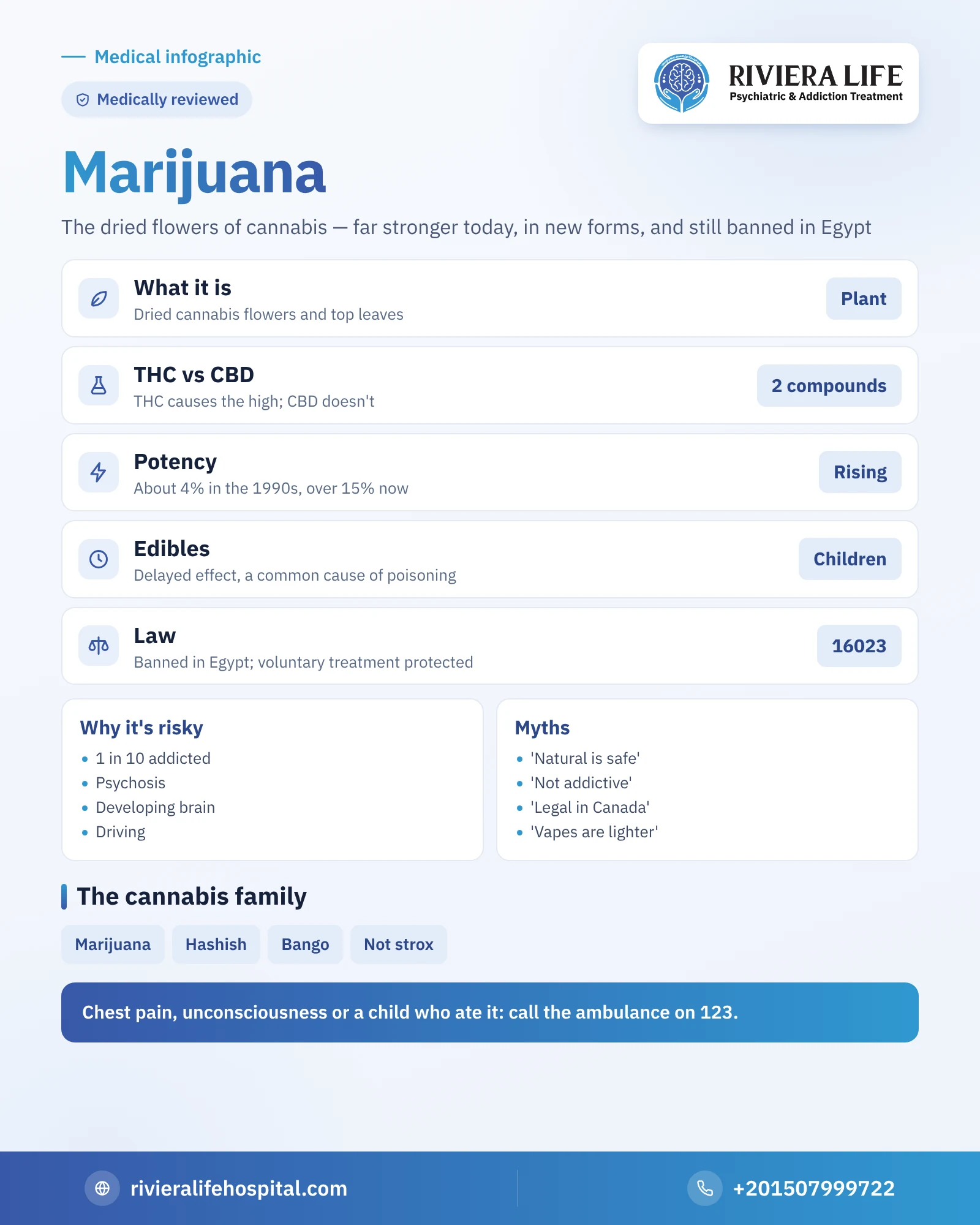
Marijuana is the dried flowers and upper leaves of the cannabis plant, and contains the substance tetrahydrocannabinol (THC), which is responsible for the high and for the risk of dependence, alongside cannabidiol (CBD), which doesn’t cause euphoria. And yes, it is a drug: cannabis in all its forms, from marijuana to hashish and bango, is listed among the banned substances in Egypt’s anti-narcotics law. The concentration of the active substance in it has risen greatly compared with past decades, and there is no approved medical use for smoking it in Egypt.
- Active substanceTHC
- Is it a drug?Yes, and banned in Egypt
- Closest formsHashish and bango
Marijuana is the dried flowers and upper leaves of the cannabis plant, and contains the substance tetrahydrocannabinol (THC), which is responsible for its effect on the mind. A contradictory image surrounds it today: countries that sell it in licensed shops, advertisements for “cannabis therapy”, and clips that portray it as a natural substance without consequences. On the other hand, addiction clinics are crowded with young people who have lost control over it, and emergency departments with cases of repeated vomiting, panic attacks and psychosis. This page puts the full picture before you in calm scientific language, then leads you to a separate article for each question, from symptoms and withdrawal to testing and treatment.
Some spell its name “marjuana” or “mariuana”.
What is marijuana?
The cannabis plant belongs to a plant family that includes many species and strains, the best known being Cannabis indica and Cannabis sativa. The active substances are concentrated in the tiny resinous hairs that cover the female flowers, which is why the dried “buds” are the strongest parts of the plant. The plant contains more than a hundred compounds from a group called cannabinoids, the most important being two:
- Tetrahydrocannabinol (THC): the substance that causes the high and changes perception, and is responsible for the risk of dependence.
- Cannabidiol (CBD): doesn’t cause a high, is being studied in a number of medical uses, and one of its forms is an approved medicine for rare cases of epilepsy.
The word “marijuana” itself is of Spanish origin and spread worldwide through the Americas, while in Arabic the scientific name is “qinnab” (cannabis), and the popular name differs according to the part used and the method of preparation.
Names of marijuana circulating in Egypt
On the Egyptian street the word “marijuana” is usually used to refer to higher-quality dried buds, to distinguish them from bango, which usually means the cheaper mix of leaves and stems. Among young people, words of English origin such as “weed” and “grass” are widespread, and sometimes the names of imported strains, used as a brand to show off strength. These names guarantee nothing; what is sold as imported marijuana may be a local plant, or may be herbs sprayed with synthetic cannabinoids of the strox type, which are completely different and more dangerous substances.
Forms of marijuana and ways of using it
Marijuana no longer means only a rolled cigarette. Markets abroad have produced new forms, some of which have reached Egypt through travel and the internet:
- Dried buds: smoked rolled, in a pipe or a water device, and the effect begins within minutes.
- Vaporizers and e-cigarettes: cartridges containing a concentrated oil, with no clear smell, so they are easy to hide.
- Cannabis-infused edibles: sweets, chocolate and drinks, whose effect is delayed by roughly half an hour to two hours and lasts hours longer.
- Concentrates: waxes, oils and crystals in which the proportion of active substance may exceed half their weight.
The delay in the effect of edibles in particular is a frequent cause of poisoning; the person thinks the first piece didn’t work so they eat another, then the whole effect arrives at once. They are also the most dangerous form for children, because they look exactly like ordinary sweets.
What does marijuana do in the brain and body?
The body has a natural system called the endocannabinoid system, which takes part in regulating memory, mood, appetite, sleep and the sensation of pain. THC acts on the same receptors this system uses, most of which are in the hippocampus, responsible for forming memories, the cerebellum, responsible for balance, and the frontal cortex, which manages attention and decision-making. That is why things that seem far apart come together in a single effect:
- Relaxation, laughter and a change in the perception of time, colors and sounds.
- Weakness in short-term memory and difficulty following a conversation.
- Slow reactions and disturbed balance and judgment, which is what makes driving under its influence dangerous.
- A racing heartbeat, red eyes, dry mouth and increased appetite.
- In some people, especially with strong doses: acute anxiety, panic attacks, suspicion and sometimes hallucinations.
With daily use the brain reduces the number of these receptors and their sensitivity, so the person needs a larger amount, and feels tense and sleepless when they stop. This is the first seed of dependence, and the article on marijuana addiction explains how it turns step by step into a full disorder.
The potency of marijuana today: why isn’t it what it used to be?
Many parents compare what their children use with what they heard about in their youth, and the comparison is misleading. According to US health authorities’ monitoring of seized cannabis samples, the average THC concentration rose from roughly 4% in the mid-1990s to more than 15% in recent years, while concentrates reach several times that. At the same time, in many strains the proportion of cannabidiol has fallen, the compound believed to soften some of the psychological effects. The result is a stronger substance that causes tolerance faster, and a clearer link with psychotic episodes and cyclic vomiting syndrome, conditions that were rare in the past.
Medical cannabis: what is established and what is exaggerated?
There are real medicines derived from cannabis or synthesized along its lines, approved in some countries for specific uses: a preparation of pure cannabidiol for two rare types of childhood epilepsy, preparations of synthetic THC to ease the nausea that accompanies chemotherapy and improve appetite in cases of wasting, and a spray used in some countries for the muscle stiffness that accompanies multiple sclerosis. These are medicines with a known concentration and calculated doses, dispensed to particular patients under a doctor’s supervision.
As for what is promoted on the internet, that marijuana treats anxiety, depression and insomnia, the evidence for it is weak or conflicting, and regular use may even increase anxiety and depression in the long term. There is no approved medical use for smoking marijuana in Egypt. The existence of a cannabis medicine doesn’t make the cigarette in circulation on the street a treatment, just as the presence of morphine in hospitals doesn’t make heroin a medicine.
Why is marijuana dangerous despite its light reputation?
Marijuana rarely kills by overdose the way opioids do, and this very fact is what is exploited to portray it as a safe substance. But the danger comes from other directions:
- Addiction: estimates from the US National Institute on Drug Abuse indicate that about one in ten users becomes addicted, and the proportion rises to about one in six for those who start in adolescence.
- Mental health: daily use of strong types is linked to a higher risk of psychosis, especially for those with a family predisposition.
- The developing brain: starting use before the brain finishes developing in the mid-twenties is linked to problems with attention, learning and memory.
- The heart: a faster pulse and a higher burden on the heart may be dangerous for someone with heart disease.
- Accidents: driving under the influence doubles the risk of accidents, and the risk multiplies further with alcohol.
The details of these harms, system by system, are in the article on the harms of marijuana.
Marijuana within the cannabis family
Marijuana, hashish and bango are three products from the same plant, differing in the part used and the method of preparation, and therefore in concentration. Hashish is the pressed resin extracted from the hairs, and you will find it detailed on the hashish page. Bango in Egyptian usage is the less concentrated dried leaves and stems, and it has its own page in bango. Synthetic cannabinoids such as strox are different chemicals sprayed onto herbs, much stronger and more linked to seizures and death, and they have nothing to do with the plant except that they act on the same receptors.
Legalization abroad and the law in Egypt
Young people often hear that marijuana “has become legal around the world”, and the truth is more complicated. Uruguay and then Canada permitted it for adults under a regulated commercial system, numerous US states have allowed it even though it remains banned at the federal level, some European countries have eased restrictions to varying degrees, while other countries have reversed earlier liberalization steps after problems appeared. In most of these countries the motive wasn’t that the substance is safe, but an attempt to move the market from gangs to state control, and the results of these experiments are still a matter of scientific debate today.
In Egypt the situation is completely different. Cannabis in all its forms, from marijuana to hashish and bango, is listed among the banned narcotic substances in the anti-narcotics law, its possession, cultivation and trafficking are punished, and buying it from a country that permits it changes nothing on entering Egypt. On the other hand, no criminal case is brought against a user who comes forward of their own accord for treatment, and the Fund for Drug Control and Treatment of Addiction provides a free, confidential hotline on 16023. For any specific legal case, consulting a specialized lawyer remains the most accurate course.
The marijuana guide: each aspect in a separate article
If you have questions about marijuana, you will find a full answer to each of them in a separate article below:
- Marijuana addiction: how use turns from an experiment into a disorder, and the stages of this shift.
- Marijuana addiction symptoms: the physical and behavioral signs the family notices at home.
- Causes of marijuana addiction: why some people fall into it and not others, and the risk factors.
- The harms of marijuana: its effect on memory, the heart, the lungs and mental health.
- Marijuana withdrawal symptoms: the timeline after stopping and how to get through it safely.
- How long marijuana stays in the body: the period urine, blood, saliva and hair tests detect it.
- Marijuana addiction treatment: the stages of treatment, proven psychological therapies and how to choose a hospital.
- Hydro addiction: what it is, its signs, harms and effective treatment methods
- Cannabidiol addiction treatment: is the problem CBD or THC? And the road to recovery
Common myths about marijuana
The myth: as long as it is a natural plant, it is safe. The truth: many toxins are natural, and what matters most is the concentration of the active substance, which today is much higher than it was decades ago.
The myth: marijuana doesn’t cause addiction. The truth: cannabis use disorder is a recognized medical diagnosis, and it has documented withdrawal symptoms such as insomnia, irritability and loss of appetite.
The myth: as long as it is legal in Canada, it is beneficial. The truth: alcohol and tobacco are legal in most of the world, and legality is a regulatory decision, not a certificate of safety.
The myth: e-cigarettes and edibles are lighter than smoking. The truth: they may spare the lungs part of the smoke, but counterfeit vaping cartridges have been linked to acute lung injuries, and edibles are among the most common causes of poisoning because of their delayed effect.
Discovered your son is using marijuana? Start here
Many families discover the matter from a smell clinging to clothes, a small vaporizer that looks like a phone memory stick, or strangely wrapped sweets. The first step is not to let the confrontation turn into a trial. Children at this age carry ready-made arguments from the internet about “legalization” and “cannabis therapy”, and entering an argument about them wastes the opportunity.
It is more useful to talk about what you have noticed yourself: falling grades, staying up late, or withdrawing from the family, and to ask with real curiosity about how much and how often he uses. After that, a specialized assessment helps determine whether the matter is a passing experiment or the beginning of dependence, a distinction that is hard for the family alone. The list of marijuana addiction symptoms helps you organize your observations before the meeting.
When is marijuana an emergency?
A marijuana overdose doesn’t usually depress breathing, but acute poisoning with it, especially from edibles and concentrates, may need urgent intervention, and children who eat it by mistake are more prone to severe complications.
Call the ambulance on 123 immediately if any of these appear
These signs after using marijuana or a product thought to contain it can't wait, and tell the paramedics what was taken.
- Pain or pressure in the chest, or a very fast pulse that doesn’t calm down
- Fainting, loss of consciousness or difficulty waking the person
- Hallucinations or detachment from reality with aggressive behavior or a danger to themselves
- Repeated vomiting that doesn’t stop, with inability to drink fluids
- Seizures, which are more likely with synthetic cannabinoids
- A child who has eaten sweets or a drink containing cannabis
Until help arrives, stay with the person in a quiet, dimly lit place, talk to them in a low voice, and if they are unconscious and breathing, put them on their side. Don’t give them stimulants or medicines to wake them, and keep the packet if there is one, because it helps the doctors.
When should you ask for help?
If use has become daily, or the person has come to need marijuana to sleep or calm down, or their attempts to stop have failed, or suspicion or repeated vomiting have appeared, this is the time for a specialized assessment, not a time to wait. At Riviera Life, the hospital licensed by the Ministry of Health in Sheikh Zayed, the consultants in psychiatry and addiction treatment assess the case in complete confidentiality, and the first consultation is free. You will find the stages of the treatment plan in detail in the article on marijuana addiction treatment.
Medical sources and referencesThe information in this article is based on reliable scientific sources
1NIDA — Cannabis (marijuana): research and information pagenida.nih.gov2NIDA — Research report on marijuananida.nih.gov3WHO — Cannabis: Department of Mental Health and Substance Use pagewho.int4StatPearls — Cannabis (marijuana) overviewncbi.nlm.nih.gov5SAMHSA — The risks of marijuana and cannabidiol, and help resourcessamhsa.gov