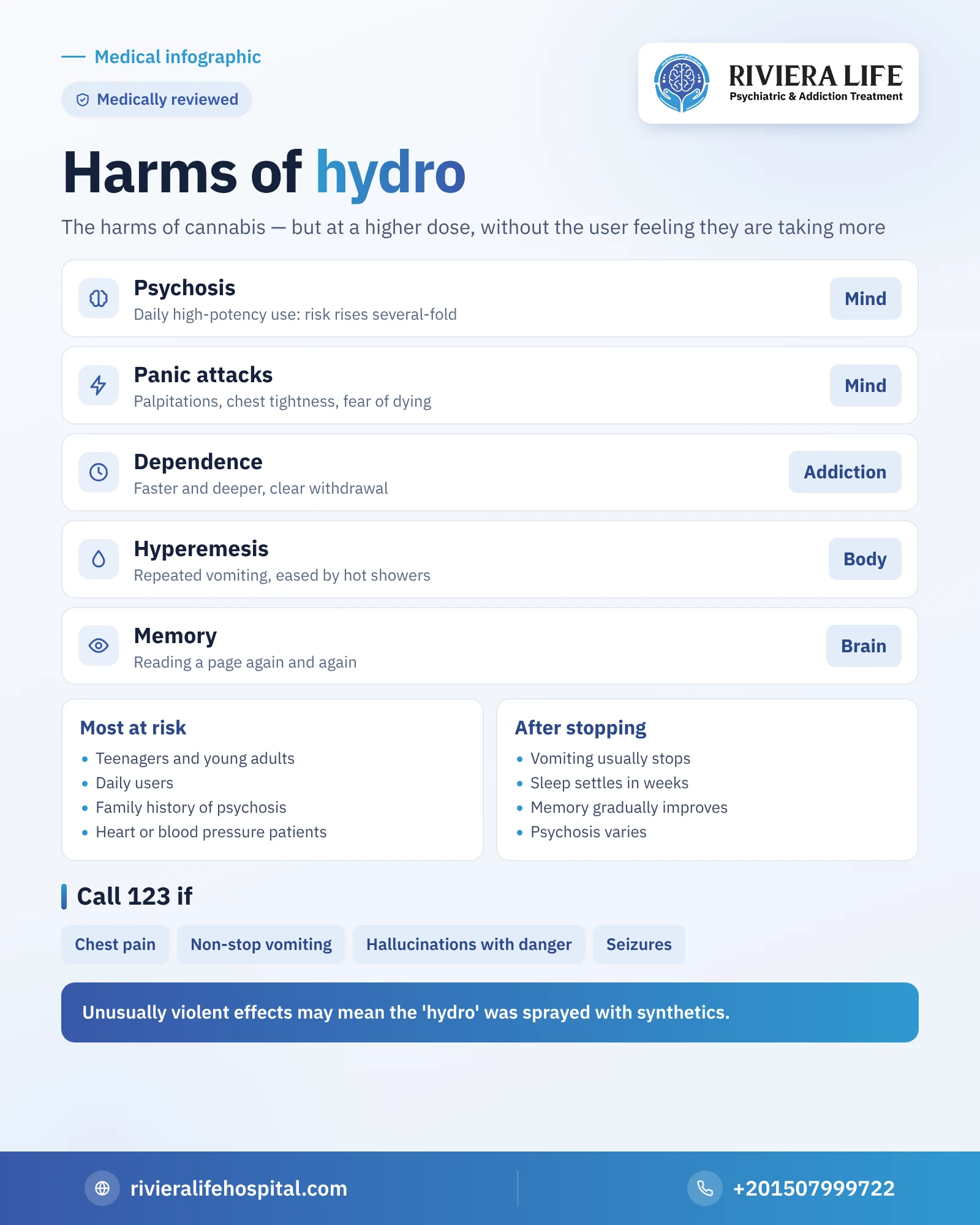
The harms of hydro are the harms of cannabis itself, but at a higher dose. Hydro is marijuana grown with techniques that raise the proportion of THC, the substance responsible for the psychological effect, and the higher this proportion, the greater the risk of psychosis and panic attacks, the faster dependence comes, and problems such as repeated cannabis vomiting and weak memory appear, especially in teenagers and young people. This doesn’t mean everyone who smokes hydro will suffer these harms, but it means high potency changes the calculation. In this article we explain how potency raises each risk separately, who is most vulnerable, and what improves after stopping.
Why do the harms of hydro differ from traditional hash?
Many of the harmful effects of cannabis follow the dose rule: the more THC in one go, and the more often it is used, the greater the likelihood and severity of harm. Hydro raises the dose without the user feeling they are “taking more”, because the joint itself has become stronger. And with tolerance they need a larger amount of this strong type to get the same feeling. This is where the problem lies: what parents or the user knew about “light hash” no longer applies. The article on the harms of marijuana explains the general picture of cannabis harm, while here we focus on what high potency adds.
What has changed in the plant?
Cannabis contains hundreds of compounds, the most important being THC, which causes the high, and cannabidiol (CBD), which doesn’t cause a high and is thought to possibly soften some of THC’s psychological effects. Hydroponic cultivation and genetic selection indoors raise THC strongly, usually at the expense of CBD. The result is a stronger, less balanced plant. International data indicate that the average THC concentration in seized cannabis has risen clearly over recent decades, and hydro is one of the most prominent forms of this rise.
Psychosis: the clearest danger
The relationship between cannabis and psychosis is one of the most researched. Studies show that daily use of high-potency cannabis is linked to a several-fold higher risk of psychosis compared with non-users, and that the risk is lower with weaker types and occasional use. Psychosis may appear as an acute episode after use: suspicion, a feeling of being watched, and hearing voices. In those with a genetic predisposition or a family history of schizophrenia or bipolar disorder, hydro may reveal a chronic illness or bring forward its onset. You will find a detailed explanation of this disorder on the psychosis page.
Anxiety and panic attacks
Low doses of THC may calm some people, but high doses do the opposite in many: palpitations, chest tightness, and a feeling of losing control or imminent death. Some young people reach the emergency department thinking they are having a heart attack, then it turns out to be a panic attack after a hydro joint. With repetition, anxiety may become a constant state even on days without use, so the person enters a cycle: they smoke to calm down, and their anxiety increases when the effect wears off.
Heavy use is also linked to depression and loss of motivation: the young person loses interest in study, sport and old friends, and spends the day between the joint, sleep and the phone. Researchers don’t always know which comes first; a depressed person may turn to cannabis, and cannabis may deepen depression, but the cycle between the two recurs often in clinics.
Dependence: faster and deeper
High potency means the brain adapts faster. Research indicates that users of high-concentration cannabis are more prone to symptoms of cannabis use disorder, and more severely: increasing the amount, failed attempts to cut down, and constant preoccupation with the substance. On stopping, clear withdrawal symptoms appear: insomnia and disturbing dreams, irritability, loss of appetite and anxiety. The details of how use turns into addiction and its signs are in the article on hydro addiction.
Cannabinoid hyperemesis syndrome
Paradoxically, a substance some think of as anti-nausea may cause severe repeated vomiting bouts in chronic users. The syndrome is characterized by nausea, vomiting and abdominal pain recurring as bouts, and the sufferer usually notices that a hot shower temporarily eases the symptoms. It is linked to long-term daily use, and reports of it are increasing with the spread of high-potency types. It may cause severe dehydration and salt imbalance needing hospital treatment, and its real treatment is stopping cannabis.
Memory, concentration and learning
THC affects the brain areas responsible for short-term memory and attention. With hydro this effect is clearer during use and for hours after, and with daily use weak concentration and slow thinking may last days. The student notices they read the page several times without remembering it, and the employee notices repeated mistakes and forgetting appointments. Many of these effects improve after weeks of stopping, but improvement may be slower in those who started young.
Teenagers and young people: the most vulnerable group
The brain keeps developing until about the mid-twenties, and the body’s natural cannabinoid system takes part in this development. That is why starting use in adolescence, especially with strong types, is linked to a higher risk of addiction and psychosis and declining school performance. A teenager who tries hydro first starts from a dose a previous generation reached after years. If you are a worried parent, start by understanding the motives for starting in the article on the causes of marijuana addiction.
The heart and lungs
THC raises the heart rate immediately after use, and may change blood pressure. In healthy young people this usually passes without a problem, but it is a real burden on those with heart disease or high blood pressure, and it has been linked in reports to cardiac events. As for smoking itself, it exposes the lungs to smoke and irritants, so chronic cough, phlegm and bouts of bronchitis appear, and these effects increase in those who mix hydro with tobacco.
Driving and accidents
Hydro slows reaction and weakens judgment of distances and the ability to attend to more than one thing at a time. With high potency this effect lasts longer and is more intense. And mixing it with alcohol or sedative pills multiplies the risk. Driving after use isn’t a matter of “I know my limits”; the affected person is the last to judge their ability accurately.
When the hydro is adulterated
Hydro’s high price tempts some sellers to adulterate it or spray it with synthetic cannabinoids to make it seem stronger. Here the nature of the danger changes completely: seizures, severe agitation, and heart and kidney problems, effects not usually linked to natural cannabis. If symptoms more violent than usual appear after a “hydro” joint, the cause may be a completely different substance.
Do the harms of hydro go away after stopping?
The good news is that many harms improve: cannabis vomiting usually disappears on stopping, sleep settles within weeks, memory and concentration gradually improve, and cough decreases. Psychosis differs: some episodes disappear with stopping and treatment, and some reveal a disorder that needs long treatment. The most important factor in recovery is stopping early and specialist follow-up, not just cutting down. You will find the steps of treatment in the article on marijuana addiction treatment.
When do you need urgent help?
Call an ambulance on 123 immediately if you see
After using hydro, these signs need urgent medical assessment.
- Chest pain or severe palpitations that don’t settle
- Continuous vomiting with dizziness or signs of dehydration
- Hallucinations or intense suspicion with dangerous behavior
- Seizures or loss of consciousness
- Talk of self-harm
If thoughts of self-harm appear, don’t leave the person alone, and call the mental health hotline 16328. At Riviera Life our psychiatry and addiction doctors assess cases of high-potency cannabis use, with a plan that takes psychological symptoms and withdrawal into account, in complete confidentiality.
More from the marijuana guide
- Marijuana: the complete guide
- Hydro addiction
- How long hydro stays in the body
- The harms of marijuana
- Hydro vs bango: cultivation, potency, effect and dependence risk
Questions many people ask
The active substance is the same, but its higher concentration in hydro raises the risk of psychosis, anxiety and dependence, especially with daily use.
Repeated use of high-potency cannabis is linked to a higher risk of psychosis, and may bring forward the onset of schizophrenia in those predisposed. Not every user is affected, but the risk is real.
Long-term daily cannabis use may cause cannabinoid hyperemesis syndrome, repeated bouts of nausea and vomiting that usually improve on stopping use.
Concentration and memory usually improve within weeks to months of stopping, and improvement may be slower in those who started using at a young age.
It raises the heart rate after use, which is a burden on those with heart disease or high blood pressure, and it has been linked in reports to cardiac events.