Marijuana addiction symptoms don’t appear in a single shocking scene, but in small daily details that accumulate: red eyes after coming back from outside, staying up until dawn then sleeping until the afternoon, a sudden craving for sweets, and indifference towards things the person used to love. Each sign alone may have an innocent explanation, but their coming together and persisting for weeks is what deserves attention. This article puts before the family the physical, behavioral and psychological signs that can be noticed at home, distinguishes the signs of passing use from those of dependence, and clarifies when the symptoms become an emergency.
Many people spell its name in different ways in Arabic, and the signs we present are the same whatever the spelling.
Signs of use in the first hours
These signs appear minutes after smoking and last about two to four hours, and much longer with edibles:
- Clear redness in the whites of the eyes, heavy eyelids and a vacant look.
- Laughing for no understandable reason, or unusual calm and slow speech.
- Sudden, intense hunger, especially for sweets and fast food.
- Forgetting what was said minutes ago and repeating the same questions.
- A pungent smell like burnt grass on clothes, hair or in the car.
- Dry mouth and drinking a lot of water.
With vaping devices and edibles the smell may be completely absent, which is why the family shouldn’t rely on it alone.
Physical signs with continued use over weeks and months
- A disturbed body clock: staying up long then heavy sleep that extends into the day.
- A change in weight, gaining from night eating or losing on sudden stopping.
- Recurring cough and morning phlegm in those who smoke it.
- Constant fatigue and sluggishness even after long hours of sleep.
- Recurring bouts of nausea and vomiting, with a strange urge to take hot showers for long periods because that eases them.
The last sign specifically may point to cannabinoid hyperemesis syndrome, a condition that affects some long-term users and needs a medical assessment because it may cause severe dehydration. We explain its mechanism and complications in our article on the harms of marijuana.
Behavioral signs at home
Behavior usually changes before the body does, and the change starts slowly until the family gets used to it without noticing. A mother may say, for example, that her son “has become calm”, then discover months later that the calm was isolation. Among what families notice most:
- Keeping the bedroom door closed for long periods and opening windows in winter, or heavy use of air fresheners and incense.
- Going out repeatedly at late hours for short periods without a clear explanation.
- New friends no one knows, and distancing from old friends.
- Asking for increasing amounts of money for changing reasons, or small things disappearing from the home.
- Sharp irritability when asked where he has been or about his phone.
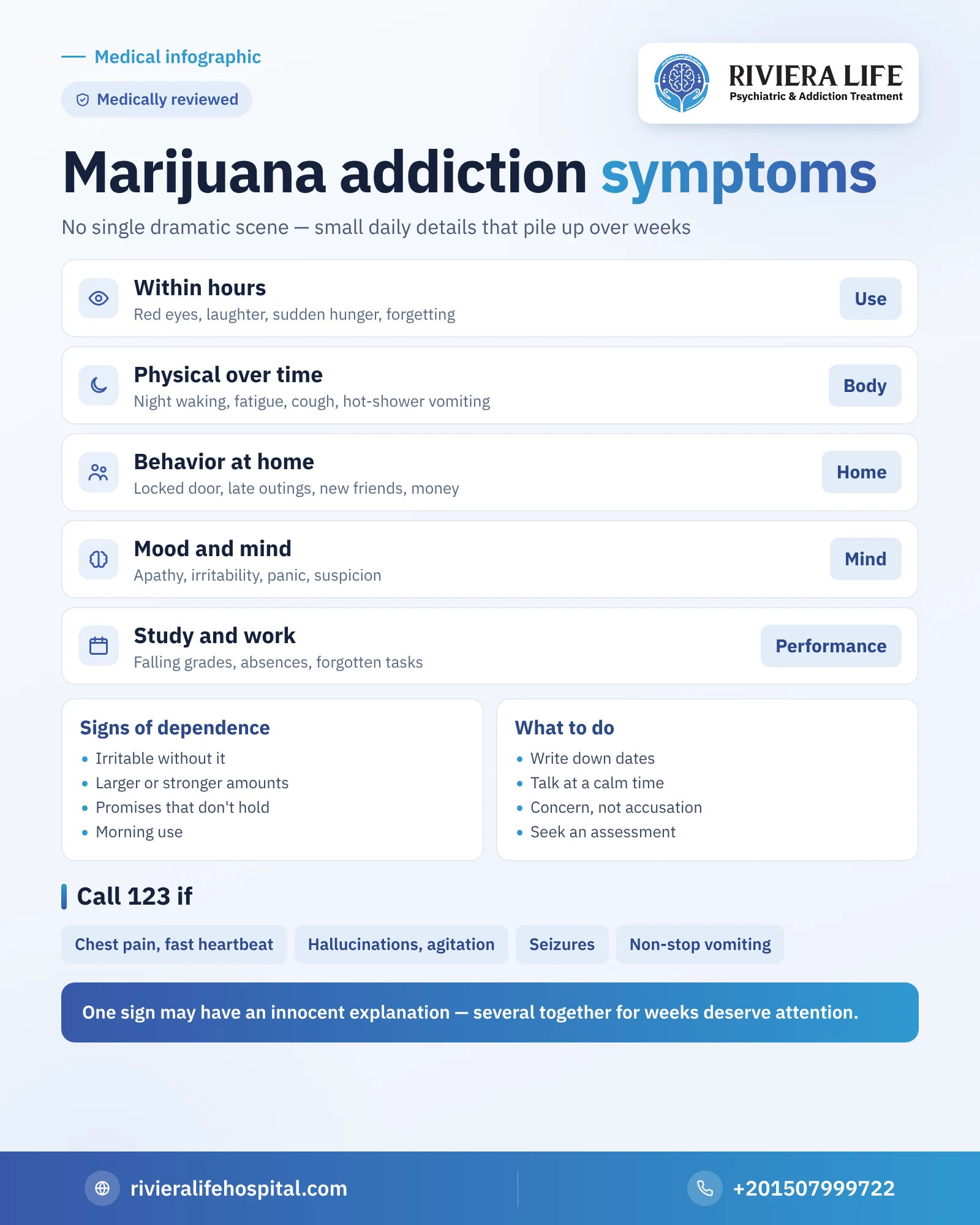
Psychological and mood signs
What worries families most is a change in the personality itself. The young man who was enthusiastic becomes indifferent, postpones everything and answers any plan with “it doesn’t matter”. This chronic indifference towards goals is among the pictures most linked to heavy marijuana use. Alongside it you may notice:
- Mood swings between excessive calm and sharp irritability, especially when the substance is late.
- Anxiety or panic attacks that weren’t known in him before.
- Suspicion of others, such as believing people are watching him or talking about him.
- Difficulty concentrating and finishing any long conversation.
If the suspicions develop into fixed, illogical ideas, or he hears voices others don’t hear, this isn’t a “passing effect” but a sign that needs a psychiatrist as soon as possible.
Signs at school and work
Short-term memory and attention are the first to be affected, which is why the results show quickly in performance, and the teacher or manager may notice them before the family: falling grades, repeated absence or lateness, forgetting appointments and assignments, and losing interest in projects he had been planning. At work they may appear as repeated mistakes, slowness in getting things done, or clashes with colleagues.
These signs are more telling if they appear suddenly in someone whose performance was stable. It helps for the family to contact the school or university calmly to find out when the decline started, as the date helps the doctor estimate the duration of use. Some students justify the decline by the difficulty of the curriculum or unfair teachers, a justification that may sometimes be true, but deserves review if it comes with the other signs.
Items you may find in the room or bag
The presence of any of these things doesn’t prove use on its own, but it calls for a calm conversation. Don’t make finding them a loud moment of confrontation in front of siblings; keep what you found and wait for the right time to talk:
- Thin rolling papers, a small round grinder, or a small pipe.
- A vaping device that looks like a USB stick or a pen, with small oil cartridges.
- Sweet or chocolate packages with unfamiliar foreign wrappers or no label.
- Remains of dried green herb or seeds in pockets or the car.
- Eye drops in unjustified quantities.
Signs specific to teenagers
It is sometimes hard to distinguish the normal swings of adolescence from signs of use. What tips the balance towards the latter is the changes coming together and their intensity: a complete change in the circle of friends with academic decline, staying up late, isolation and secrecy about the phone at the same time. Teenagers specifically are more prone to addiction than adults, because the brain at this age is more sensitive to THC, which we explain in our article on causes of marijuana addiction.
When do the signs shift from use to addiction?
Not everyone who has used marijuana is an addict. The signs that point to dependence are:
- Irritability, insomnia and loss of appetite when he can’t find it for a day or two.
- Increasing the amount or moving to stronger types and concentrates.
- Repeated promises to stop that don’t last more than days.
- Using in the morning or before study and work.
- Continuing despite clear problems with the family, study or the law.
What happens after stopping in detail, day by day, you will find in our article on marijuana withdrawal symptoms.
Symptoms that may be confused with others
Some of these signs are shared with depression, attention deficit disorder and sleep disorders, and the person may have one of them and use marijuana to ease it. The reverse is also possible. And what is sold as marijuana may be herbs sprayed with synthetic cannabinoids, and here the picture differs greatly: severe agitation, seizures and a dangerously fast heart, signs that don’t resemble marijuana and need urgent intervention. That is why testing and medical assessment help identify the substance precisely instead of guessing.
When are the symptoms an emergency?
Call an ambulance on 123 immediately if you see
Some symptoms after use go beyond the usual effect and need urgent assessment in the emergency department.
- Chest pain or a very fast heartbeat with dizziness
- Hallucinations, severe agitation or talk of harming himself or others
- Seizures or loss of consciousness
- Continuous vomiting that doesn’t allow drinking water
What do you do after noticing these signs?
Write down what you noticed with dates instead of relying on a general impression, and choose a calm time to talk away from a moment of anger or discovery. Start with concern, not accusation: “I’ve noticed you’re not sleeping well and your grades have dropped, and I’m worried”. Avoid daily searching and threats, as they teach hiding, not stopping. After that a specialist assessment helps, even if the person doesn’t agree at first, as the family itself needs guidance. At Riviera Life the family can start with a free and completely confidential consultation, after which the next step is decided. You will find the stages of treatment in our article on marijuana addiction treatment.
More from our marijuana guide
- Marijuana: the complete guide
- Marijuana addiction and how it develops
- Marijuana withdrawal symptoms
- How long marijuana stays in the body
Questions many people ask
Watch for several signs coming together for weeks, such as red eyes, sudden hunger, staying up late, isolation and declining studies. One sign isn't enough, and a medical assessment is what settles the matter.
No, allergies, staying up late and screen strain also cause redness. Redness becomes more telling if it recurs with changes in behavior, sleep and appetite.
It may be a sign of cannabinoid hyperemesis syndrome, as hot water temporarily eases the nausea. This condition needs a medical assessment and usually improves by stopping use.
Yes, especially with strong types and heavy use. If the suspicions persist after the effect wears off or are accompanied by hallucinations, the person should be seen by a psychiatrist.
They usually improve within weeks to months of stopping, and behavioral therapy and regulating sleep and activity help restore motivation faster.