Why does a young man go back to a paper that caused him a night of terror, even though the substance leaves no dependence in his body forcing him to return? This question is the key to understanding the causes of paper drug addiction. The motive here isn’t escaping withdrawal pains as with opioids, but a mixture of curiosity, promises of “a different experience”, pressure from friends and parties, psychological problems the person is trying to escape, and misleading information that presents the substance as safe or even beneficial. This article explains how use turns from an experiment into a repeated pattern, who is most at risk, and what protects children.
Does the paper drug cause addiction at all?
LSD usually doesn’t cause physical dependence or daily compulsive craving, and the body gains rapid tolerance that makes repeating it on consecutive days almost without effect. But psychiatry recognizes another pattern it calls hallucinogen use disorder, which appears when the person continues using despite clear harm to them. In other words, the addiction here is basically behavioral and psychological: attachment to the ritual of the party, the company and the feeling the experience gives, more than attachment to the substance itself. That is why knowing the substance isn’t enough to understand the problem; the person who uses it must be understood.
From the first try to repetition
Many users go through a similar path. The story starts with a paper at a party or a trip with friends, usually out of curiosity. If the first experience is enjoyable or “amazing”, the person starts waiting for the next occasion, then looks for it themselves. Over time the occasions grow further apart or closer depending on tolerance and circumstances, but life itself starts revolving around these experiences: new friends, money spent, and online content that feeds the idea. At this stage hash, alcohol and ecstasy usually enter the picture, so it turns into multiple use whose parts are hard to separate.
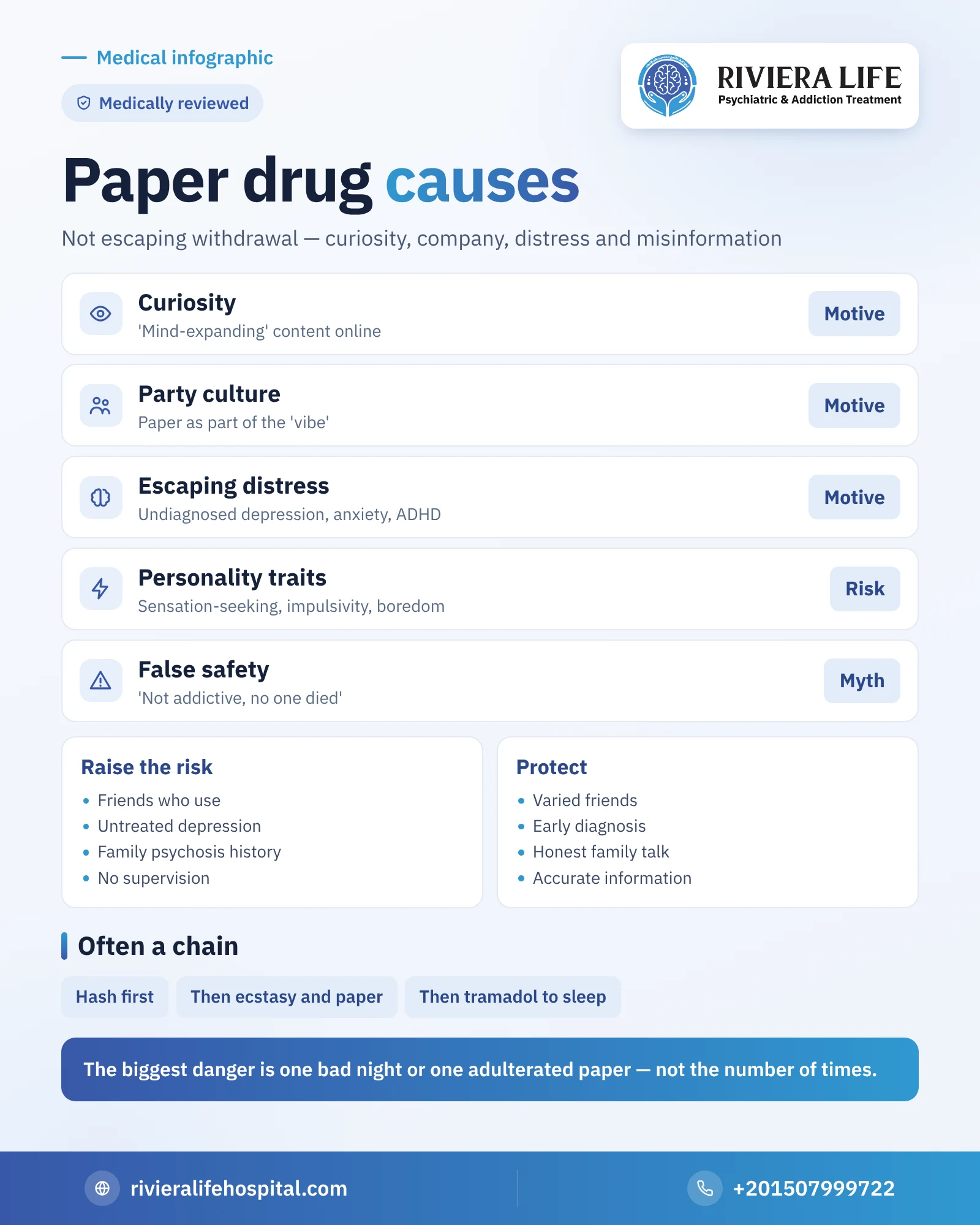
Curiosity and the illusion of “expanding consciousness”
Content spreads on social media presenting hallucinogens as a path to self-discovery, “opening the mind” or getting past depression, sometimes drawing on real news about experimental research on similar substances. The young person reading this content doesn’t notice that the research is done with pure substances under medical supervision with patients who have undergone careful screening, while what reaches him is a paper of unknown content. This confusion between science and personal experience is one of the strongest motives among educated people and university students in particular.
Party culture and friends
Paper is linked in many minds with electronic music parties, desert trips and long nights. In this environment the paper is presented as a natural part of the “vibe”, and someone who refuses is seen as scared or conventional. Peer pressure here needs no direct words; it is enough for the young person to see all his friends doing the same thing. And the more his social circle narrows to these friends, the more stopping means losing all his company, which is what makes recovery hard.
Escaping psychological pressures
Some users look in paper for a way out of depression, anxiety or a feeling of emptiness that hasn’t yet been diagnosed. Doctors note that a not insignificant proportion of those who repeat use have accompanying psychological disorders, such as depression, anxiety disorders and attention-deficit/hyperactivity disorder, or a history of trauma and hard experiences. The problem is that hallucinogens may worsen these disorders instead of easing them, especially when the experience goes badly. That is why treating the accompanying disorder is an essential part of the plan for paper drug addiction treatment.
Personality traits that increase the risk
There is no particular “addictive personality”, but some traits raise the likelihood of trying and repeating: love of adventure and constant sensation-seeking, impulsivity and difficulty postponing desire, quick boredom with routine, and rebellion against authority. These traits aren’t faults in themselves, but they need safe outlets such as sport, travel and creative activities, otherwise they look for dangerous outlets.
Easy access through the internet
The form of paper itself helps it spread: it is small and light, odorless, and easy to hide in a wallet, between the pages of a book or inside an envelope. Messaging apps and online groups have made access to sellers easier, away from the family’s eyes. This very ease is what makes adulteration widespread, so the person gets a substance whose name they don’t know, and which may be one of the synthetic substances we explain on the paper drug page.
Misleading information about safety
Phrases such as “paper doesn’t cause addiction” and “no one has died from LSD” seem reassuring, and contain part of the truth, but they hide the full picture: accidents during hallucination, psychosis, persistent perceptual disturbance, and poisoning by substitute substances. The more the idea of safety takes hold, the less hesitation about the first try, and the less caution on later occasions. You will find these harms arranged by their near and far range in the article on the harms of the paper drug on body and mind.
Genetic and family factors
Heredity plays a role in vulnerability to addiction in general, so having a first-degree relative with addiction raises the risk. But heredity with paper carries an important extra aspect: someone with a family history of schizophrenia or bipolar disorder is more likely to have the substance reveal a psychotic episode in them that may last. The family environment itself also has an effect, as constant disagreements, lack of supervision and tolerance of adults’ use are all factors that raise the likelihood.
Why are teenagers and young people more at risk?
The brain continues to develop until about the mid-twenties, and the last to mature are the areas responsible for planning, judging consequences and controlling impulses. At the same time, the desire to experiment and to belong to the group is at its peak. This timing makes the teenager more inclined to try and less able to judge the danger. The signs that may appear on him are explained in the article on paper drug addiction symptoms.
When paper is a link in a chain
A young person rarely reaches paper without having tried anything before it. In most of the stories we hear, hash comes first, then the circle widens to include ecstasy and paper at parties, then tramadol, pregabalin or alcohol appears to calm the “comedown” after a long night without sleep. Each substance here opens the door to the next: the party needs energy, energy ends in insomnia, and insomnia needs a sedative. That is why it isn’t enough to ask why he tried paper, but why he needed all these substances together, and what he is trying to fill with them.
Risk factors and protective factors
| Factors that raise the risk | Factors that protect against it |
|---|---|
| Friends who use and consider it normal | A varied circle of friends and activities away from late nights |
| Untreated depression or anxiety | Early diagnosis and available psychotherapy |
| A family history of addiction or psychotic disorders | A family that knows its history and talks about it frankly |
| Misleading information from the internet | Accurate knowledge the young person gets from a source he trusts |
| Lack of supervision and money without oversight | A close relationship with parents and clear limits |
How do you protect your children?
A general warning isn’t enough, as young people read online what contradicts it. It is more effective to talk with accurate information: that the paper may carry a substance other than the one he thinks, and that the real danger is in one bad night, not in the number of times. Ask about his friends and parties with interest, not interrogation, and pay attention to any change in his sleep and mood.
Also help him find what fills his time and gives him a sense of achievement and belonging, such as a team sport, a summer job or a hobby he masters, as a young person who finds his place in real life has less need to look for it in a paper. And if there is a history of psychological disorder in your family, tell him clearly, as this is information that concerns and protects him. And if psychological effects appear after an experience, go back to the article on paper drug withdrawal symptoms to know when a doctor is needed.
More from the paper drug guide
- The paper drug: the complete guide
- Paper drug addiction symptoms
- Paper drug addiction treatment
- How long the paper drug stays in the body
Questions many people ask
Because the attachment is psychological and behavioral: to the ritual of parties, the company and the feeling the experience gives. With a psychological disorder or pressure from friends, use turns into a repeated pattern that is hard to break.
Depression or anxiety may push some young people to look for a way out in hallucinogens, but these substances may worsen the condition instead of treating it. Treating the accompanying disorder is an essential part of prevention and treatment.
Teenagers and young people, those with a family history of schizophrenia or bipolar disorder, and those who mix paper with hash or other substances.
No. Research is done with pure substances of known amount under medical supervision with carefully selected patients, while street paper is of unknown content and may carry more toxic substances.
Talk with accurate information, not general warnings, ask about his life with interest, not interrogation, explain that the biggest danger is in an adulterated paper or a bad night, then leave the door open for him to come back to you.