A mother tested her son at home after finding small colored paper squares in his wallet. Every panel came back negative, and she was reassured. What she didn’t know is that the strip she used doesn’t look for paper at all. This is the most important fact about how long paper stays in the body: the routine tests common in Egypt don’t detect LSD or the synthetic substances sold in its place, and detecting them needs a specialized test requested by name.
Even with that test, the window stays short: LSD usually shows in urine for roughly one to four days, and in blood for hours. In this article we explain why, what each type of test can detect, and when a result is misleading.
What happens to the substance inside the body?
The membranes lining the mouth absorb the substance from the paper, and it reaches the blood and brain within a short time. The active amount in a paper is very small, measured in thousandths of a milligram, and this alone makes its concentration in body fluids so low that very sensitive equipment is needed to detect it. The liver then converts most of the LSD into inactive by-products, the best known being a substance known by the abbreviation 2-oxo-3-hydroxy-LSD, which then leaves in the urine. The half-life of LSD in the blood is estimated at roughly three to four hours, meaning half the amount disappears from the blood within that time.
Why doesn’t paper show in a normal test?
Rapid test strips and the usual laboratory panels look for a specific group of substances, most notably hashish, opioids, tramadol, amphetamines and benzodiazepines. LSD isn’t part of this group in most routine strips and panels, because its low concentration needs a different technique. The NBOMe group and similar substances aren’t detected by routine tests either, and they aren’t chemically similar enough to amphetamines to give a positive result in that panel. That is why a negative result on a normal test doesn’t rule out paper use.
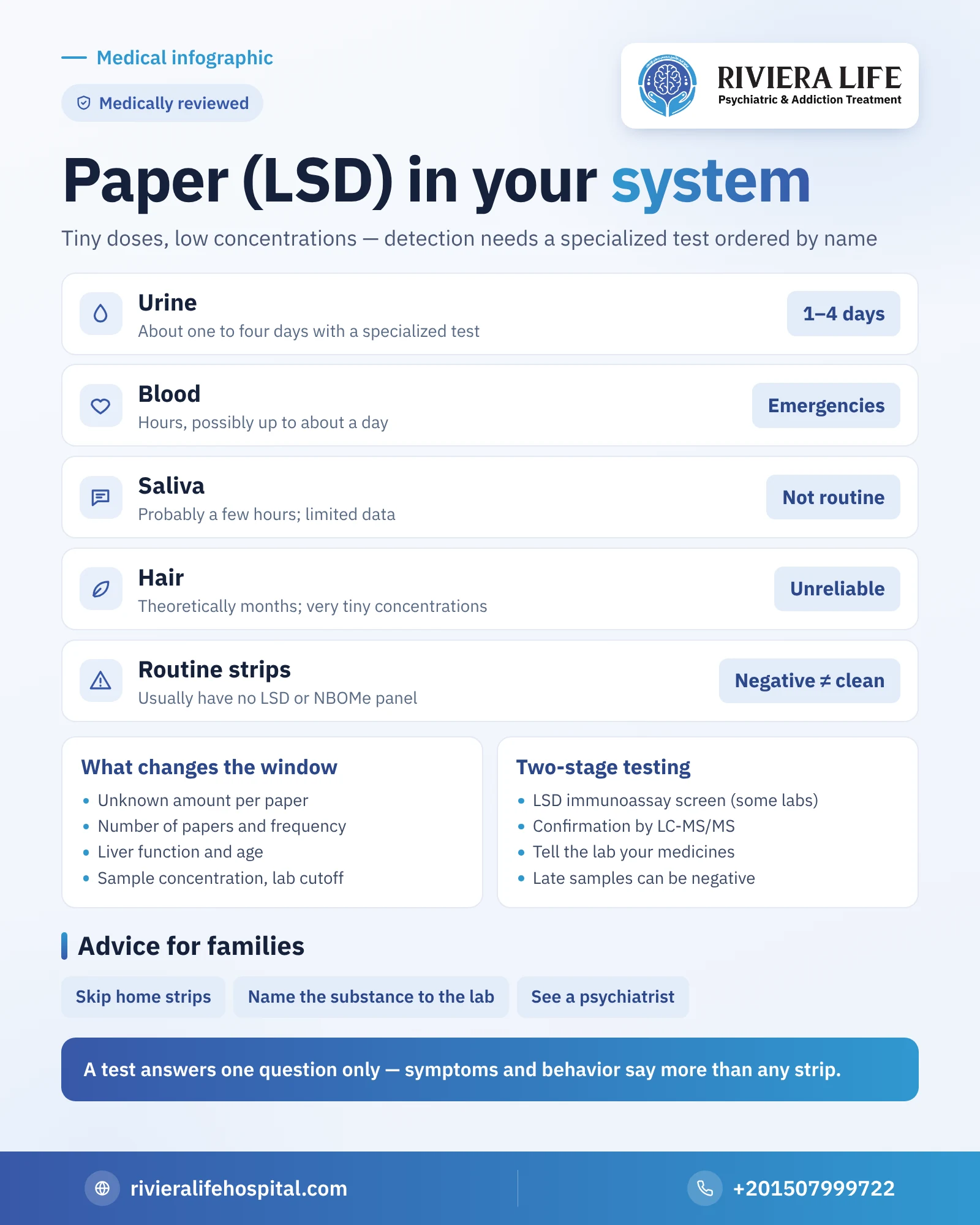
How long paper shows in each type of test
The following figures are approximate, apply to LSD when a specialized test is used, and vary from one laboratory to another:
| Type of test | Approximate time | Note |
|---|---|---|
| Urine | Roughly one to four days | The by-products stay longer than the substance itself |
| Blood | Hours, possibly up to about a day | Mostly used in emergencies |
| Saliva | Probably a few hours | Limited data, not used routinely |
| Hair | Theoretically possible for months | Very tiny concentrations, and few labs do it |
The urine test
The most suitable for detecting paper if the specialized test is requested by name. The original substance usually shows within roughly the first day, while the converted by-product remains in higher concentration and for longer, extending the detection window to a few days.
The blood test
Its window is short, and it is mainly useful in emergencies, when someone arrives agitated or poisoned and the doctors need to know what they took. But its result may be delayed, so treatment starts based on the symptoms, not on waiting for the test.
The saliva test
Research on it for LSD is limited, it isn’t relied on in everyday practice, and its window most likely doesn’t exceed hours.
The hair test
Hair can theoretically keep a trace of the substance for months, but the amount deposited in it from a single paper is extremely small, and may not reach the detection limit even in advanced laboratories. That is why it isn’t considered a reliable way to prove or disprove paper use.
What about substitutes such as NBOMe?
If the paper contains a synthetic substance, the information available on how long it stays is far less than for LSD. These substances are also active in very tiny amounts, so their concentration in blood and urine is low, and detecting them needs advanced equipment and a laboratory that knows what it is looking for. In poisoning cases, doctors focus on treating the symptoms immediately, then samples are sent for specialized testing if possible.
Why does the time differ from person to person?
- The actual amount in the paper, which is usually unknown and varies between papers.
- The number of papers in one night and the gap between occasions.
- Liver efficiency, since it is the main organ that converts the substance.
- Age and general health.
- Fluid intake and urine concentration when the sample is taken.
- The sensitivity of the equipment used, the detection limit the laboratory applies, and how the sample is stored.
The screening test and the confirmatory test
Some laboratories have a screening immunoassay specific to LSD as part of extended panels. Its positive result needs confirmation using liquid chromatography coupled with mass spectrometry, which identifies the substance by name, measures its concentration and distinguishes it from its by-products. The same equipment is the only realistic way to detect new synthetic substances.
When is the result inaccurate?
The LSD screening immunoassay can sometimes react with medicines that have nothing to do with drugs, including some psychiatric medicines and others, giving a false positive. That is why the laboratory should be told every medicine the person takes, and no screening result should be judged before confirmation. In the other direction, the result may come back negative despite use if the sample was taken late or the concentration is below the detection limit.
Does the effect wearing off mean the substance has gone?
The two aren’t precisely linked. The effect usually lasts eight to twelve hours, while by-products may show in urine for days after that. Conversely, the substance may leave the body completely while some people keep psychological or visual effects for weeks, which have nothing to do with the substance being in the blood, as we explain in our article on paper withdrawal symptoms.
What can’t the test tell you?
A test answers one question: is the substance present in the sample above a certain threshold? But it doesn’t determine how many times the person used, whether use has become a disorder, or whether they have psychological symptoms that need treatment. Behavior and symptoms are more truthful on these questions than any strip, and you’ll find them in detail in our article on paper addiction symptoms.
Advice for families before a home test
Don’t rely on home strips when it comes to paper, as they most likely don’t include it. If testing is necessary, ask a trusted laboratory, name the suspected substance, and know that its result is, at best, part of the picture. More important than the test is that your son sees a psychiatrist if any unusual symptoms appear. You can learn more about the substance itself on our page about paper (LSD).
Testing in emergencies: what actually helps?
When a young person arrives at the emergency department agitated or with a high temperature after a party, doctors don’t wait for a paper test result before starting treatment. Specialized tests may take days, while the decision is made in minutes based on vital signs and symptoms. What helps here are general tests: kidney function, muscle enzymes, salts and an ECG, as well as routine strips that detect whatever was mixed with the paper, such as hashish, sedatives or stimulants. That is why the most important thing the family can give the medical team isn’t a test, but honest information about what the person took and when, even if it is only a suspicion.
How can Riviera Life help you?
At Riviera Life we don’t treat a test as a final verdict, but as part of a broader assessment carried out by consultants in psychiatry and addiction treatment in complete confidentiality. If the case needs a specialized test, we direct you to it and explain its result, then set a plan that fits what we actually find.
More from our paper (LSD) guide
- Paper (LSD): the complete guide
- Paper addiction symptoms
- Paper withdrawal symptoms
- Paper addiction treatment
Questions many people ask
With a specialized test, LSD or its by-products usually show in urine for roughly one to four days. A routine test usually won't detect it, whatever the timing.
Most home strips have no panel for LSD or for synthetic substances such as NBOMe, so a negative result from them can't be relied on.
Theoretically possible, but the amount deposited in hair is very small and may not reach the detection limit, so a hair test isn't a reliable way to prove paper use.
Yes. The screening test may react with some medicines, so any positive result needs confirmation with advanced lab equipment, and the lab should be told which medicines are being taken.
Because the psychological and visual effects some people have after stopping don't depend on the substance being in the blood, but on changes in how the brain works that need assessment and follow-up.