A small paper square the size of a fingernail, printed with a colored design resembling a postage stamp, placed on the tongue, after which perception changes for long hours. This is what young people in Egypt mean when they say “the paper drug”.
The paper itself does nothing; it is merely a means of carrying a very powerful hallucinogenic substance, originally “LSD”, but what is sold today under this name may be another synthetic substance much more dangerous than it, and there is no way to know that by eye. On this page we explain what the paper drug is, what it does to the brain and body, and why most of its risks lie in the first hours, then link you to detailed articles on each of its aspects.
What is the paper drug?
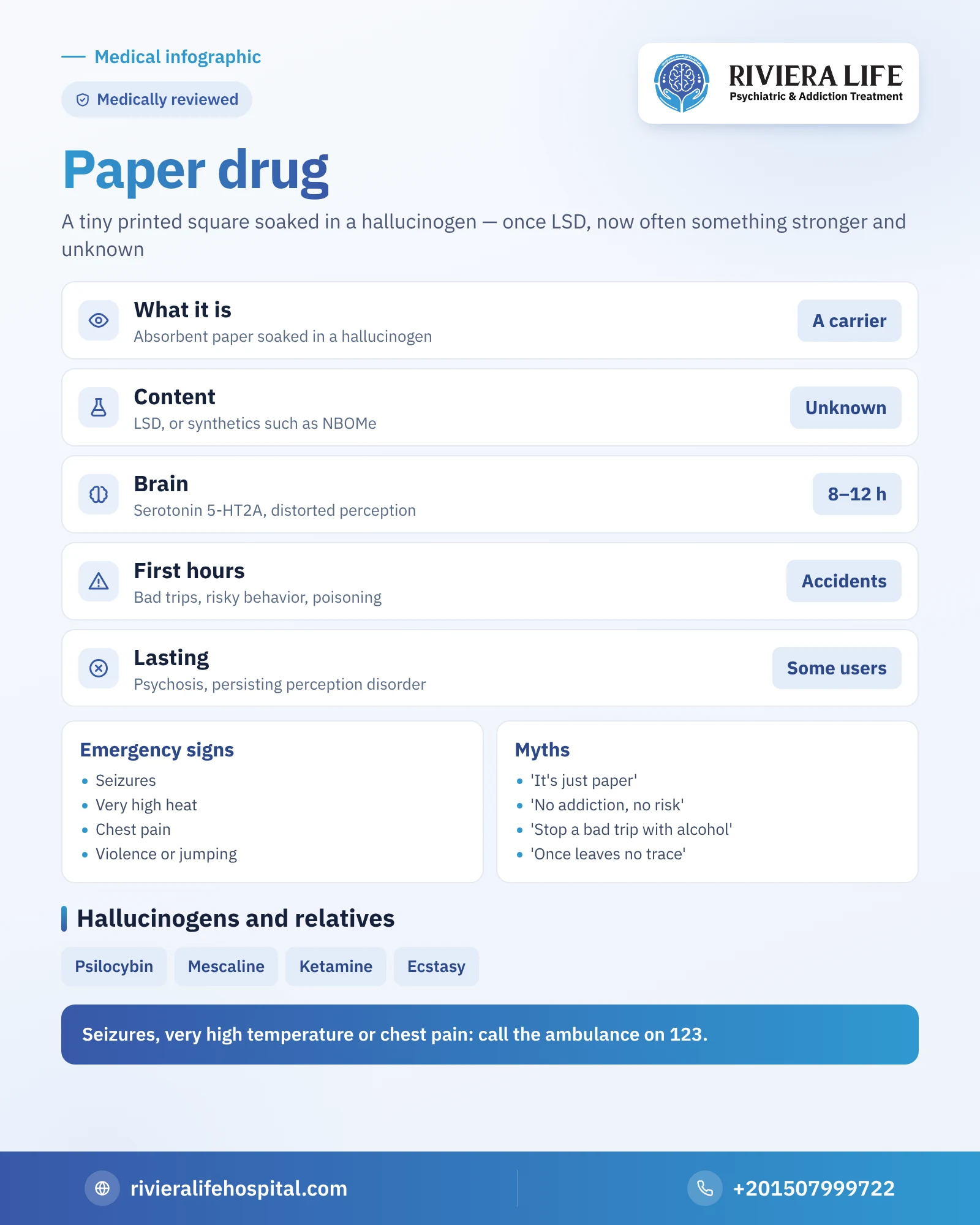
The paper drug isn’t a single substance, but a way of delivery. A thin absorbent paper is soaked in a liquid containing a hallucinogenic substance, then dried and cut into small squares separated by perforation lines, and a design or logo that distinguishes the “batch” is printed on its face. Because the active substance works in very tiny, invisible amounts, it is enough for the paper to absorb it without its appearance changing.
Historically this paper was linked to lysergic acid diethylamide, known worldwide as “LSD”, a substance discovered in a Swiss pharmaceutical lab in the 1930s whose hallucinogenic properties became known in the 1940s.
But European monitoring reports and analyses of seizures in more than one country indicate that part of the papers in circulation no longer contain LSD at all, but rather modern synthetic hallucinogens, the best known being a group known as “NBOMe”, or other substances from the phenethylamine family. There are no precise published data on the proportion of each substance in the Egyptian market, which is why in this guide we treat “paper” as a package of unknown content until testing proves otherwise.
Names of the paper drug circulating in Egypt
What is heard most on the Egyptian street is “el-wara'” or “el-wara’a” (paper), and sometimes “the stamp” or “the stamps” because of the resemblance to postage stamps, and some young people use the word “acid”, taken from the English name for LSD, or make do with the letters themselves. The papers may be named after the design printed on them, so people say such-and-such paper. None of these names indicates the real substance inside the paper, as the name describes the shape, not the content. Attention should be paid to the fact that some dealers apply the name “paper” to papers soaked in substances from the synthetic cannabinoid family, a completely different substance explained on the spice page.
Forms of the paper drug and ways of using it
The best-known form is small paper squares, but the substance itself may appear in other forms:
- Perforated square papers bearing cartoon or geometric designs or logos, the form that gave the drug its name.
- A clear liquid in small dropper bottles.
- Very small tablets or thin transparent pieces resembling gelatin.
- Sugar cubes or sweets onto which the liquid has been dropped.
The paper is usually taken by placing it on or under the tongue until the substance is absorbed through the membranes, then the effect begins after about half an hour to an hour in the case of LSD, and usually lasts from eight to twelve hours, and residual effects may remain afterwards. The synthetic hallucinogens sold in its place differ in their onset, duration and strength, and this difference alone is the cause of many accidents: a person waits for an effect they know, and gets another, stronger or longer effect, or takes a second paper thinking the first “didn’t work”.
What does the paper drug do in the brain and body?
LSD works mainly on serotonin receptors in the brain, especially the type known as “5-HT2A”, a type widespread in the cerebral cortex, which is responsible for regulating perception, thinking and linking the senses together. When these receptors are strongly activated, the usual filtering of what reaches consciousness is disrupted, so many changes appear at the same time:
- Distortion of colors, shapes and the sense of distance, and apparent movement of stationary objects.
- Mixing of the senses, as when a person feels they “see” sound.
- A strange slowing or speeding up of the sense of time.
- Sharp swings in emotion between euphoria and fear within minutes.
- A feeling of detachment from the body or from reality.
In the body the pupils dilate, the pulse, blood pressure and temperature rise slightly, sweating, nausea, tremor and loss of appetite appear, and sleep is usually absent for a whole night. The “NBOMe” group activates the same receptors much more strongly, and affects the blood vessels and heart more severely, which is why it is linked to serious poisoning cases not usually known with LSD.
Does the paper drug have any medical use?
There is today no approved medicine containing LSD, and it isn’t dispensed on any prescription in Egypt. It is true that global research has returned in recent years to studying some hallucinogenic substances in treating resistant depression and anxiety, but it takes place within controlled clinical trials: a pure substance of known amount, a patient who has undergone careful psychological screening, and a therapeutic team that accompanies them throughout the session and follows them up afterwards.
None of these conditions is available in a paper of unknown origin bought from a friend or through an app, and what happens at parties has nothing to do with what is studied in labs. As for “NBOMe”, no therapeutic benefit at all is known for it.
The harms of the paper drug and why it is dangerous
Many young people hear that LSD “doesn’t cause addiction and doesn’t kill”, so they think the paper drug is safe. The truth is that its danger comes from directions different from other drugs, and is no less than theirs.
Harms of the first hours
- The bad trip: an episode of terror, intense suspicion or a feeling of dying or going mad that may last for hours.
- Risky behavior: jumping from a high place, running into the road, driving, or harming oneself and others because of a wrong interpretation of what the person sees.
- Poisoning with substitute substances: “NBOMe” in particular has been linked to seizures, a severe rise in temperature, a dangerous racing of the heart, muscle breakdown and kidney failure, and deaths have been recorded after a single paper.
Psychological harms that may last
- The appearance or triggering of psychosis in those who are predisposed, such as a family history of schizophrenia or bipolar disorder.
- Hallucinogen persisting perception disorder, the continuation of visual distortions such as halos and movement trails for weeks, months or longer, or a sudden return of fragments of the experience.
- Anxiety, depression and a feeling that the world is unreal after repeated bad experiences.
Harms to daily life
Repeated use gradually draws a person into a world of parties, late nights and mixing with hashish, alcohol and ecstasy, so studies and work decline, and family and legal problems increase. The substance itself doesn’t need a large amount to do harm, as the problem usually lies in the first adulterated paper or in the worst night, not in the number of times.
You will find the short- and long-term harms in detail in the article on the harms of the paper drug.
The paper drug within the hallucinogen family
LSD belongs to what doctors call classic hallucinogens or perception-altering substances, along with psilocybin-containing mushrooms, mescaline and “DMT”. They all share acting on the same serotonin receptors, and the fact that the body acquires rapid tolerance to them within a few days of repetition, then the tolerance fades after stopping.
Dissociative substances such as ketamine differ from them, separating sensation from consciousness through another mechanism, as does ecstasy, which combines stimulation and emotional closeness more than hallucination. These substances often come together on the same night out, which multiplies the danger and makes it harder for the doctor to know what happened.
The paper drug and the law in Egypt
LSD is listed in the schedules of narcotic substances in Egypt’s anti-narcotics law, and possessing, using or trafficking it are crimes punishable by law, with the penalty becoming harsher the more they are linked to trafficking. The Egyptian authorities are also expanding the addition of new synthetic substances to the schedules, so it isn’t right to believe that a substance you haven’t heard the name of is “not banned”.
On the other hand, the law allows someone who comes forward on their own seeking treatment to be treated without a criminal case being brought against them, and specialized hospitals are committed to the confidentiality of their patients’ data. For any legal question concerning a specific case it is preferable to consult a lawyer, and the Fund for Drug Control and Treatment of Addiction also provides a free, confidential hotline on 16023.
The paper drug guide: each aspect in a separate article
We have dedicated a separate article to each question that preoccupies families and users, answering it in detail:
Paper drug addiction symptoms
What the family notices during the effect and afterwards, the items that may reveal use, and when the matter turns into a disorder that needs treatment.
Paper drug withdrawal symptoms
Why it causes hardly any physical withdrawal, and the psychological and perceptual effects that may continue after stopping, including flashbacks.
Paper drug addiction treatment
The stages of treatment from dealing with emergencies to psychiatric assessment, behavioral therapy and relapse prevention, and how to choose a hospital.
Causes of paper drug addiction
Curiosity, the illusion of “expanding consciousness”, parties and psychiatric disorders, and why some young people fall into repeated use despite the absence of physical addiction.
How long the paper drug stays in the body
Why routine tests don’t detect it, and how long it shows in urine, blood and hair with specialized tests.
Common myths about the paper drug
The myth: paper is “natural” because it is just a piece of paper. The truth is that the paper has nothing to do with the effect; it is a carrier for a chemical made in a lab, which may be a substance the user has never heard of before.
The myth: as long as LSD doesn’t cause physical addiction, there is no danger from it. The truth is that most serious harms have nothing to do with addiction at all: an accident during a bad trip, psychosis, or poisoning with a substitute substance.
The myth: a bad trip can be “stopped” by taking another substance or alcohol. The truth is that mixing substances increases the confusion and adds new risks, and what actually calms the situation is a safe, quiet place and medical supervision when needed.
The myth: a single experience leaves no trace. The truth is that most people who try it once don’t develop lasting problems, but a small proportion develop psychosis or persisting perception disorder after a few times, and it is impossible to predict in advance who will be among them.
Discovered your son is using the paper drug? Start here
If you find small colored paper squares in your son’s wallet or among his books, don’t start by shouting or searching every day. Keep what you found without trying it or touching it with your tongue, and note when he goes out and when he comes back and who he stays out with, and whether his sleep, mood or talk about reality has changed.
Then talk to him at a time when he is sober, ask him calmly what he knows about these papers, and tell him what specifically worries you: that the paper may contain a substance other than the one he thinks. And if any unusual psychological sign appears on him after use, such as suspicion, hearing voices or feeling that the world isn’t real, this is the time for a medical assessment, not for waiting. You will find the detailed list of signs in the article on paper drug addiction symptoms.
When is a paper drug case an emergency?
Call the ambulance on 123 immediately if any of these appear
Especially if the paper is of unknown origin, as it may contain a substance more toxic than LSD.
- Seizures or loss of consciousness
- A very high body temperature with heavy sweating, or dryness and exhaustion
- Very fast palpitations or chest pain
- Severe agitation, violence, or an attempt to jump or self-harm
- Suspicion and hallucinations that continue after the expected duration of the effect has ended
Until the ambulance arrives, stay with the person in a quiet, dimly lit place, away from windows, balconies and sharp tools, and talk to them in a steady voice with short sentences reassuring them that what they feel will pass. Don’t restrain them by force except to stop them from direct danger, and don’t give them any substance or medicine of your own. If they lose consciousness while breathing, put them on their side, and tell the paramedics everything you know about what they took, even if it is only a suspicion.
When should you ask for help?
The matter doesn’t need to reach “addiction” in the common sense to deserve a visit to a doctor. Repeated use at parties, mixing with other substances, or any psychological effect continuing after the experience are all sufficient reasons for an early assessment. At Riviera Life, the consultants in psychiatry and addiction treatment assess the case in complete confidentiality, and determine whether it needs outpatient follow-up or a short admission, involving the family in the plan from the start.
Medical sources and referencesThe information in this article is based on reliable scientific sources
1EUDA — LSD drug profile (soaked papers, methods of use and duration)euda.europa.eu2EUDA — Risk assessment report on 25I-NBOMeeuda.europa.eu3StatPearls — LSD toxicity: mechanism, symptoms and managementncbi.nlm.nih.gov4NIDA — Psychedelic and dissociative drugsnida.nih.gov5WHO — Psychoactive substanceswho.int