Paper drug addiction treatment isn’t like treating heroin or tramadol, and it doesn’t start with a week of detox. LSD doesn’t leave a physical dependence that needs weaning, and the real problem lies elsewhere: a repeated pattern of use tied to parties and friends, mixing with other substances, and psychological effects that may remain after the experience, such as anxiety, psychosis and visual distortions.
So successful treatment rests on three pillars: safely handling any acute condition, a careful psychiatric assessment that uncovers what lies behind the use, then a behavioral program and follow-up that prevent a return. In this article we explain the stages, the role of medicines and their limits, the expected duration, and how to choose the right hospital.
Who needs treatment for the paper drug?
Not everyone who has tried a paper once needs a full treatment program, but specialist treatment becomes necessary in clear cases:
- Repeated use despite bad experiences or previous psychological symptoms.
- Psychosis, suspicion or hallucinations that continued after the effect ended.
- Recurring visual distortions or flashbacks that disrupt daily life.
- Mixing the paper with hashish, alcohol, ecstasy or sedatives.
- Depression, anxiety or suicidal thoughts.
- A clear decline in study, work or relationships.
And if you aren’t sure there is any use at all, start with our article on paper drug addiction symptoms.
Stages of paper drug addiction treatment
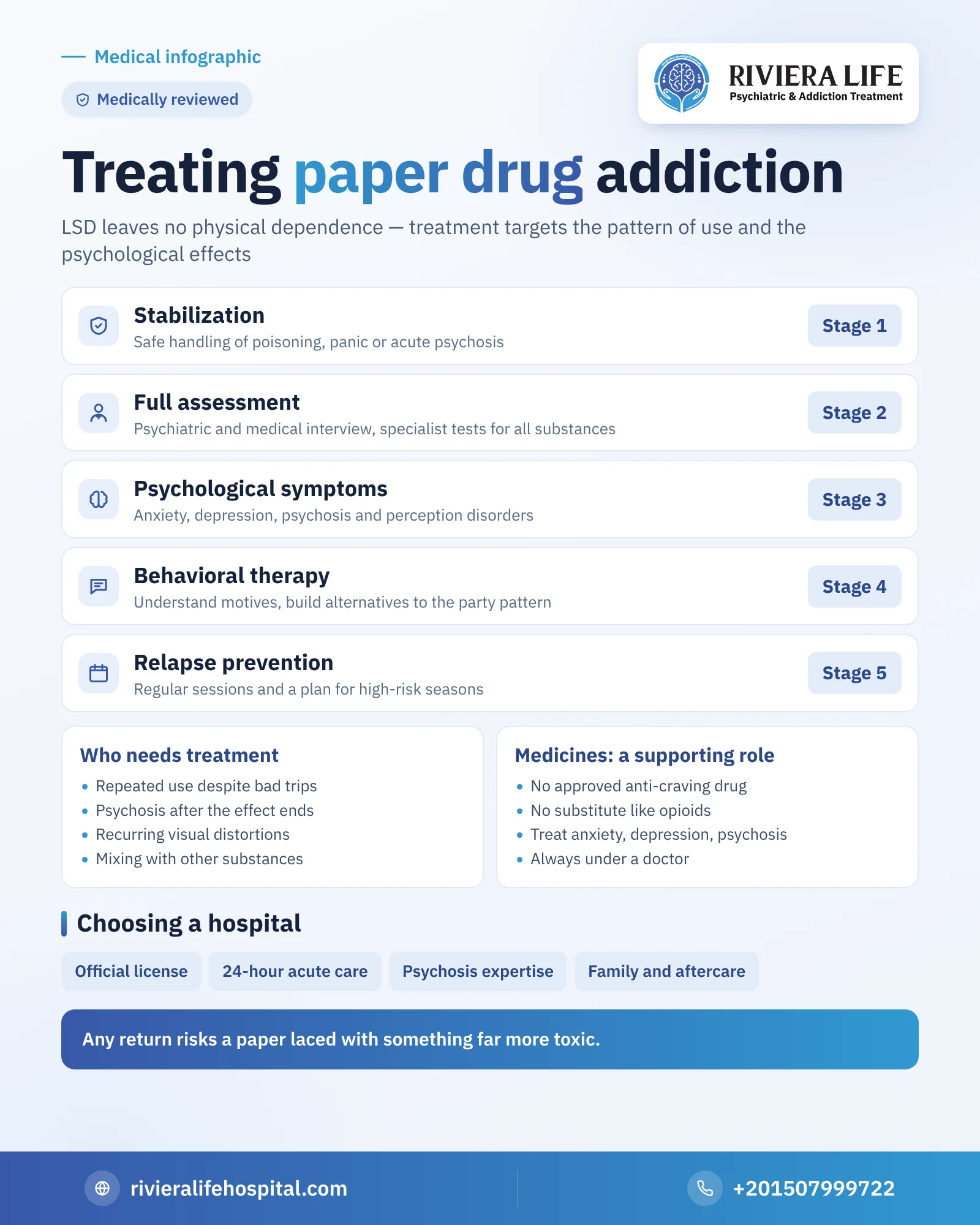
An integrated program usually goes through five stages, shortened or lengthened according to the case:
- Stabilization: handling any poisoning, terror episode or acute psychosis in a safe environment.
- Comprehensive assessment: a psychiatric and medical interview and specialist tests that reveal all the substances used.
- Treating psychological symptoms: anxiety, depression, psychosis and perception disorders.
- Behavioral therapy and rehabilitation: understanding the motives and building alternatives to the pattern of parties and use.
- Follow-up and relapse prevention: regular sessions and a clear plan for seasons and high-risk situations.
Handling the acute condition
A patient may arrive at hospital in the middle of a bad trip: intense terror, agitation, or an attempt to harm themselves. Here the first goal is safety. The patient is placed in a quiet room with little light and few stimuli, and a team member stays with them, reassuring them with simple, repeated words. The team avoids physical restraint as far as possible because it increases agitation and raises body temperature, and uses sedating medicines decided by the doctor when needed.
If the paper contains a substance from the “NBOMe” group or an unknown substance, however, the patient may need full emergency care: monitoring the heart, blood pressure and temperature, cooling the body, dealing with seizures, and checking kidney and muscle function. That is why these cases are not left at home, however calm they seem at first.
Comprehensive assessment: what is the doctor looking for?
A good assessment doesn’t only ask “how many papers?”. It looks into questions that shape the whole treatment: what other substances are used and since when, whether there are persistent psychotic or perceptual symptoms, whether there is a family history of schizophrenia or bipolar disorder, what the mood is like and the risk of self-harm, and what motives lie behind the use. A specialist test is requested when needed, because the paper drug doesn’t show in routine tests, as we explain in our article on how long the paper drug stays in the body.
Are there medicines to treat paper drug addiction?
There is no approved medicine that treats hallucinogen use disorder itself, and there is no “substitute” given in place of the paper drug as happens with opioids. But medicines play an important role in treating what accompanies it:
- Short-term sedatives for panic attacks and acute agitation, under close supervision because some can cause dependence if used for long.
- Antipsychotics when suspicion or hallucinations persist.
- Antidepressants or anti-anxiety medicines if a mood disorder is confirmed.
- Selected medicines for persistent perception disorder, bearing in mind that the evidence for each of them is still limited.
Choosing the medicine and its dose is an individual medical decision, and the patient or family shouldn’t try any psychiatric medicine without supervision.
Psychological and behavioral therapy
This is the heart of paper drug treatment. Among the most useful approaches:
- Cognitive behavioral therapy: through it the patient discovers the thoughts and circumstances that push them toward the paper drug, and practises alternative behaviors they can actually apply.
- Motivational interviewing: especially useful with young people who see the experience as “useful” or “spiritual” and don’t see a problem in it.
- Grounding techniques and managing anxiety: these help those who suffer a sense of unreality or flashback episodes.
- Treating multiple-substance use: because hashish and alcohol often accompany the paper drug, and giving them up is part of recovery.
Treating the psychotic and perceptual effects
A patient who developed psychosis after the paper drug needs longer follow-up than others, because some of these cases reveal a predisposition to a chronic psychiatric disorder. The doctor follows the symptoms after stopping for weeks and months before judging their nature. Persistent perception disorder is treated first by explaining the condition to the patient to ease their fear, then by avoiding known triggers such as hashish and late nights, with medication when needed. Reassurance here isn’t a courtesy but part of the treatment. The details of these effects are in our article on paper drug withdrawal symptoms.
Inpatient or outpatient? And how long does it take?
Most cases of repeated use without complications are treated with a regular outpatient program. A stay suits those with psychosis or suicidal thoughts, those who mix in substances whose withdrawal needs supervision such as alcohol and sedatives, or those who have failed to stop despite outpatient follow-up. A stay may range from a few days to get through the crisis to a few weeks, while outpatient follow-up usually continues for several months. What counts isn’t the number of days, but treatment not being interrupted between one stage and the next.
Relapse prevention
Relapse with the paper drug is tied to occasions more than ordinary days: a party, a trip with friends, or the summer holiday. So a good plan includes identifying these seasons in advance, agreeing clear alternatives for them, staying away from the circle that supplies the papers, and avoiding hashish and alcohol, which weaken resolve. It is important for the patient to know that any return carries the risk of a paper laced with a substance more toxic than anything they have tried.
The family’s role in treatment
The family needs to understand that the absence of physical addiction doesn’t mean the matter is simple, and that firmness doesn’t conflict with support. In family sessions, parents learn how to talk without accusing, how to set limits on late nights and pocket money, and how to notice psychological symptoms early. Knowing the causes of paper drug addiction also helps them understand what their son is looking for in these experiences.
The right hospital for paper drug addiction treatment: how to choose
The right hospital for paper drug addiction treatment is one that offers what a hallucinogen patient specifically needs: the capacity to handle poisoning and agitation, psychiatric expertise in psychosis and perception disorders, and a behavioral program suited to young people. Ask before you decide:
- Does the facility hold an official license, and is treatment there led by consultants in psychiatry and addiction?
- Can it handle an acute case around the clock, including poisoning with unknown substances such as NBOMe?
- Does it assess psychosis and family predisposition to psychiatric disorders, and follow symptoms after stopping?
- Does it have experience treating persistent perception disorder and flashbacks?
- Does it treat multiple-substance use, especially hashish, alcohol and ecstasy?
- Does it involve the family and set a follow-up plan covering party and holiday seasons?
And don’t trust a place that guarantees you recovery at a set percentage or claims to end paper drug addiction within days.
How Riviera Life meets these standards
Applying these criteria to Riviera Life, here is how it meets them:
- Official licensing: a hospital licensed by the Ministry of Health.
- A record of recovery: thousands of cases have recovered from addiction over fourteen years of continuous work.
- A consultant team: consultant-level psychiatrists and addiction specialists who assess psychotic symptoms and perception disorders, and handle use of more than one substance.
- Round-the-clock supervision: 24-hour medical monitoring that allows agitation and bad trips to be handled safely.
- Behavioral therapy suited to young people: programs that address the motives for use and the party pattern instead of relying on prohibition alone.
- Support for parents: dedicated family sessions that teach them how to support the patient and how to catch any psychological symptom at its start.
- Aftercare: follow-up after discharge that covers high-risk seasons.
- Complete confidentiality: full protection of the patient’s and family’s privacy.
There is no fee for the first consultation, and +201507999722 takes your call at any hour; you can also come to our center in Sheikh Zayed City, Giza.
More from our paper drug guide
- The paper drug: the complete guide
- Paper drug withdrawal symptoms
- Paper drug addiction symptoms
- Causes of paper drug addiction
- Hallucinogen addiction treatment: calming a bad trip, treating psychosis and psychotherapy
Questions many people ask
LSD usually doesn't need detox because it doesn't cause physical dependence. But the patient may need medical supervision if they mix it with alcohol or sedatives, or if psychosis or poisoning appears.
There is no approved medicine for this purpose. Medicines are used to treat what accompanies use, such as anxiety, depression or psychosis, while recovery relies mainly on behavioral therapy and follow-up.
It varies by case; outpatient follow-up usually lasts several months, and cases with psychosis or multiple-substance use may need a stay ranging from days to a few weeks.
Many cases improve with early treatment and complete stopping, but some reveal a predisposition to a psychiatric disorder that needs long follow-up. Early assessment clearly improves outcomes.
Look for official licensing, consultants in psychiatry and addiction, 24-hour capacity to handle acute poisoning and agitation, experience with psychosis and persistent perception disorder, treatment of multiple-substance use, a family program and aftercare. Riviera Life in Sheikh Zayed meets these criteria, and the first consultation is free.