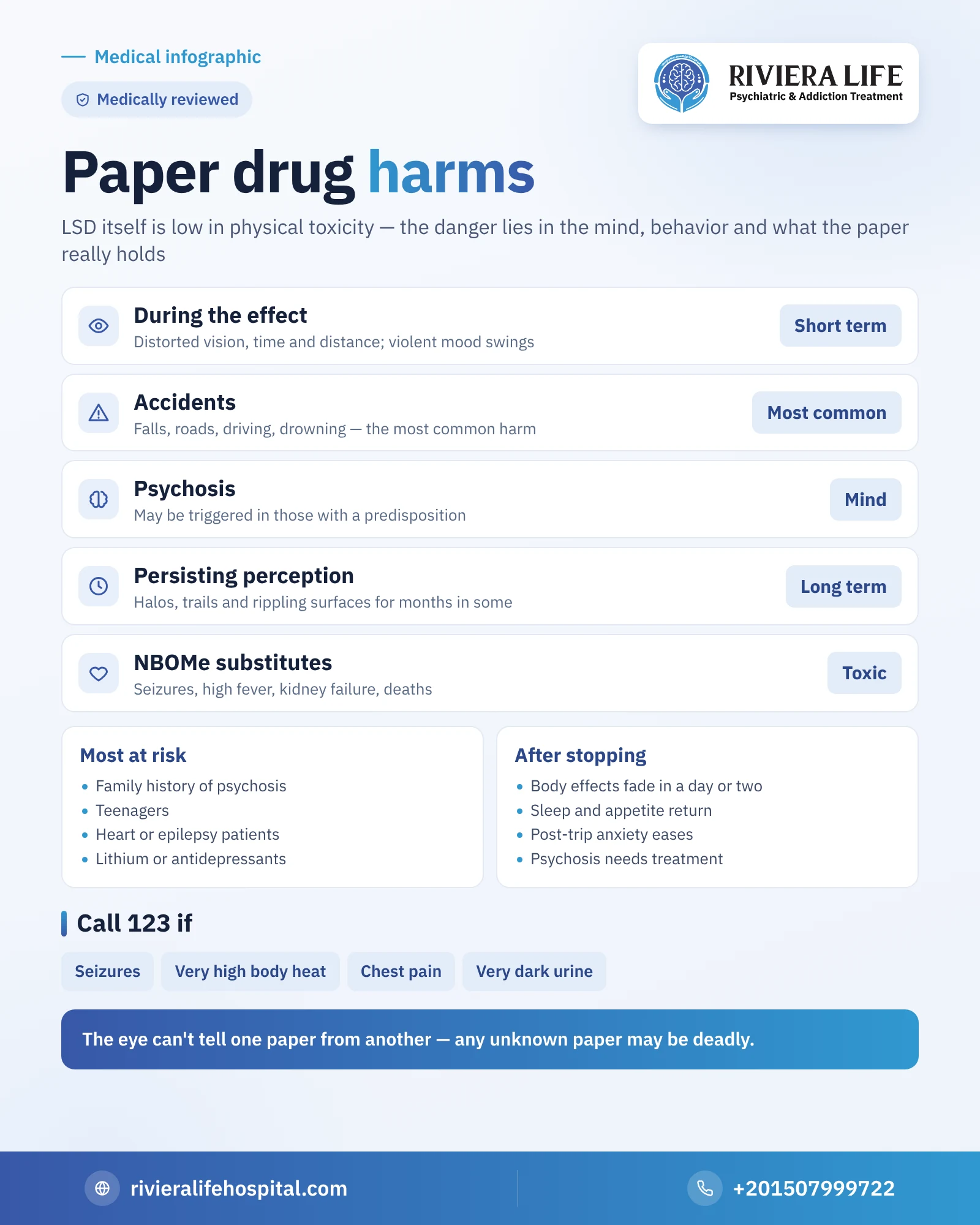
The harms of the paper drug don’t resemble the harms of usual drugs. LSD itself is low in toxicity to the body’s organs, but its greatest danger lies in the mind and behavior: a bad trip that may end in an accident, psychosis that appears in someone with a predisposition, or visual distortions that persist after stopping.
The second problem is that many papers in circulation don’t contain LSD at all, but synthetic hallucinogens such as “NBOMe” that are linked to seizures, severely high body temperature, kidney failure and deaths after a single paper. This article sets out the short-term and long-term harms, organ by organ and aspect by aspect, who is most at risk, and what improves after stopping.
Why do the harms of the paper drug differ from others?
Most drugs harm the body gradually with repetition. But the paper drug’s most serious harm may come the first time, because the source of danger isn’t the accumulation of the substance but what happens during the long hours of effect, and what the paper actually carries. The sources of harm can be summarized in three:
- Disturbed perception and judgment of reality for hours, with the risky behavior that follows.
- Stirring up latent psychiatric disorders or triggering persisting perceptual effects.
- The physical toxicity of substitute substances sold as “paper”.
Our paper drug guide explains what the substance is and how it is presented; here the focus is on harm alone.
Short-term harms during the effect
On the body
- Dilated pupils, a faster pulse and slight rises in blood pressure and temperature.
- Sweating, tremor, nausea and loss of appetite.
- Insomnia that may last the whole night and beyond.
On perception and feelings
- Distortion of vision, sounds and the sense of time and distance.
- Violent swings between euphoria and fear within minutes.
- The bad trip: terror, severe suspicion, or a feeling of dying or going mad that may last hours.
Accidents and risky behavior: the most common harm
Most serious injuries linked to LSD don’t come from poisoning, but from something the person does while not seeing reality as it is: falling from a balcony because he thought he could fly or wanted to escape something chasing him, running onto a highway, driving a car, or drowning. The person may harm himself or others in an episode of terror or suspicion. That is why being alone, or in a high place or near water or a road, is a factor that multiplies the danger more than the amount itself.
Psychological harms: psychosis, anxiety and depression
The paper drug may reveal or hasten a psychotic disorder in someone with a predisposition to it, such as a family history of schizophrenia or bipolar disorder. In these cases symptoms don’t end when the effect ends; suspicion, hearing voices or strange thoughts continue for days and weeks, and specialist psychiatric treatment is needed. And even without psychosis, repeated bad trips may leave chronic anxiety, panic attacks and a feeling that the world or the self is unreal, and depression may follow.
Persisting perception disorder and flashbacks
In a proportion of users, which can’t be predicted in advance, some visual distortions persist after the substance has left the body: halos around objects, trails behind moving bodies, rippling in still surfaces, and difficulty seeing at night. They may be mild and passing, or may last months and cause considerable distress and anxiety. Our article on paper drug withdrawal symptoms details this condition and what happens after stopping.
Substitute substances: when the paper really is toxic
The “NBOMe” group is known to be much more potent than LSD, and to affect the heart and blood vessels more severely. In European and American monitoring reports it has been linked to harms not usually known for LSD:
- Repeated seizures that are hard to stop.
- Severely high body temperature.
- A dangerously fast heartbeat and a sharp rise in blood pressure.
- Muscle breakdown that may lead to acute kidney failure.
- Violent agitation, with deaths recorded after a small amount.
Added to this, some of what is sold as “paper” on the market is soaked with substances from the synthetic cannabinoid family, which have different harms on the heart, kidneys and brain explained in our article on the harms of spice addiction.
Harms of mixing with other substances
The paper drug is rarely used alone at parties, and mixing changes the picture of danger completely. Alcohol and hashish may increase confusion and make a bad trip more severe. Stimulants such as ecstasy raise temperature and blood pressure beyond what the paper itself raises. Case reports point to seizures in people taking lithium who then use LSD. As for medicines and substances that raise serotonin, including some antidepressants and tramadol, they may increase the chance of serotonin syndrome, especially with substitute substances.
Harms to daily life
Repeated use brings with it a pattern of late nights and parties that consumes study and work. The person needs a day or two to recover his sleep and concentration after each time, so absences and lateness pile up. Over time his interest in his old friends and family may change, and the chance of legal problems increases because the substance is criminalized in Egypt. Our page on paper drug addiction symptoms covers the signs the family sees from outside.
Can the paper drug kill?
Death from direct poisoning with pure LSD is very rare. But deaths linked to the paper drug do happen, in two ways: accidents and risky behavior during the effect, and poisoning with substitute substances the user doesn’t know he is taking. And because the eye can’t tell one paper from another, the right judgment is that any paper of unknown content may be deadly.
Call an ambulance on 123 immediately if you see
After using an unknown paper, as it may contain a substance far more toxic than LSD.
- Seizures or loss of consciousness
- Severe body heat with heavy sweating, or completely hot, dry skin
- Chest pain or a very fast heartbeat
- Violent agitation or attempts to jump or self-harm
- Very little urine, or very dark urine after use
Who is most at risk of harm?
- Those with a personal or family history of psychosis or bipolar disorder.
- Teenagers, because the brain is still developing and risk judgment is weaker.
- Heart, blood pressure and epilepsy patients.
- Those taking psychiatric medicines such as lithium or antidepressants.
- Those who use alone or in an unsafe place, or mix with other substances.
Do the harms of the paper drug go away after stopping?
Most physical effects go away within a day or two, and sleep and appetite return after a few days. The anxiety that follows a bad experience usually improves with time and support. But persistent psychosis and chronic perception disorder need specialist assessment and treatment, and may improve gradually, though not always completely. That is why stopping early and getting an assessment after any unusual psychological effect are the best protection.
How can Riviera Life help you?
Riviera Life’s psychiatry consultants carefully assess the effects of hallucinogens: are they leftovers from an experience that will pass, or the beginning of a disorder that needs treatment? This is done in complete confidentiality, with a plan that includes the family, as our article on paper drug addiction treatment explains.
Read also
- The paper drug: the complete guide
- Causes of paper drug addiction
- How long the paper drug stays in the body
- Paper drug withdrawal symptoms
- Hallucinogenic pills: types of hallucinogens, their effects, bad trips and the risk of psychosis
Questions many people ask
LSD doesn't cause clear damage to brain tissue as some other substances do, but it may trigger psychosis or a persisting perception disorder in some people, and substitute substances may cause seizures and oxygen deprivation that harm the brain.
Yes, it can be, because the most serious harms such as accidents and poisoning with substitute substances may happen the first time, and the contents of a paper can't be known by eye.
Its danger is of a different kind; it is less linked to daily use, but its long hours of effect and the possibility of containing highly toxic substances make a single incident more dangerous.
For most people they disappear within hours or days, but in a small proportion they persist for months in what is known as persisting perception disorder, which needs a psychiatric assessment.
Those with a personal or family history of psychosis, teenagers, heart and epilepsy patients, those taking lithium or antidepressants, and those who use alone or mix it with other substances.