Many people call us asking: what are the withdrawal symptoms of paper, how many days do they last, and what medicines ease them? The honest answer may surprise them: LSD, the original substance in paper, doesn’t cause any notable physical withdrawal symptoms — no tremor, bone pain or vomiting like after stopping opioids or alcohol. But that doesn’t mean stopping always passes without a trace.
Some users go through days of exhaustion, anxiety and disturbed sleep, and a few may be left with visual distortions, “flashbacks” or psychotic symptoms for weeks and sometimes longer. And if strong physical symptoms appear after stopping, their source is usually another substance the person was mixing with paper. This article explains what to expect after the last paper, and what calls for a doctor.
Does paper really have withdrawal symptoms?
In the strict medical sense, no. The American diagnostic manual of mental disorders, which lists the withdrawal symptoms for each class of substance, sets out no withdrawal syndrome for hallucinogens of this type, because research hasn’t recorded a consistent pattern of physical symptoms on stopping. What is recorded instead are two different things: a temporary comedown after the experience itself, and psychological and perceptual effects that may persist in some people. The difference between the two matters, because the first usually passes on its own, while the second may need treatment.
Why doesn’t LSD cause physical withdrawal?
Substances that cause strong withdrawal, such as heroin, alcohol and sedatives, make the body readjust its systems to work with them present every day, so if they suddenly disappear the balance is upset. LSD, by contrast, produces very rapid tolerance: if a paper is repeated the next day its effect is clearly weaker, and after a few consecutive days it almost disappears. This tolerance pushes the user to space out their use, so the body never becomes used to the substance being constantly present. And the tolerance itself fades within days of stopping. The substance also doesn’t activate the reward system with the force and speed of stimulants and opioids, which is why the compulsive urge to repeat it is weaker.
All of this applies to LSD. The synthetic substances that may be sold as paper, such as the NBOMe group, have limited data on repeated use, and we can’t say with confidence what stopping them looks like.
What happens in the first days after the last paper?
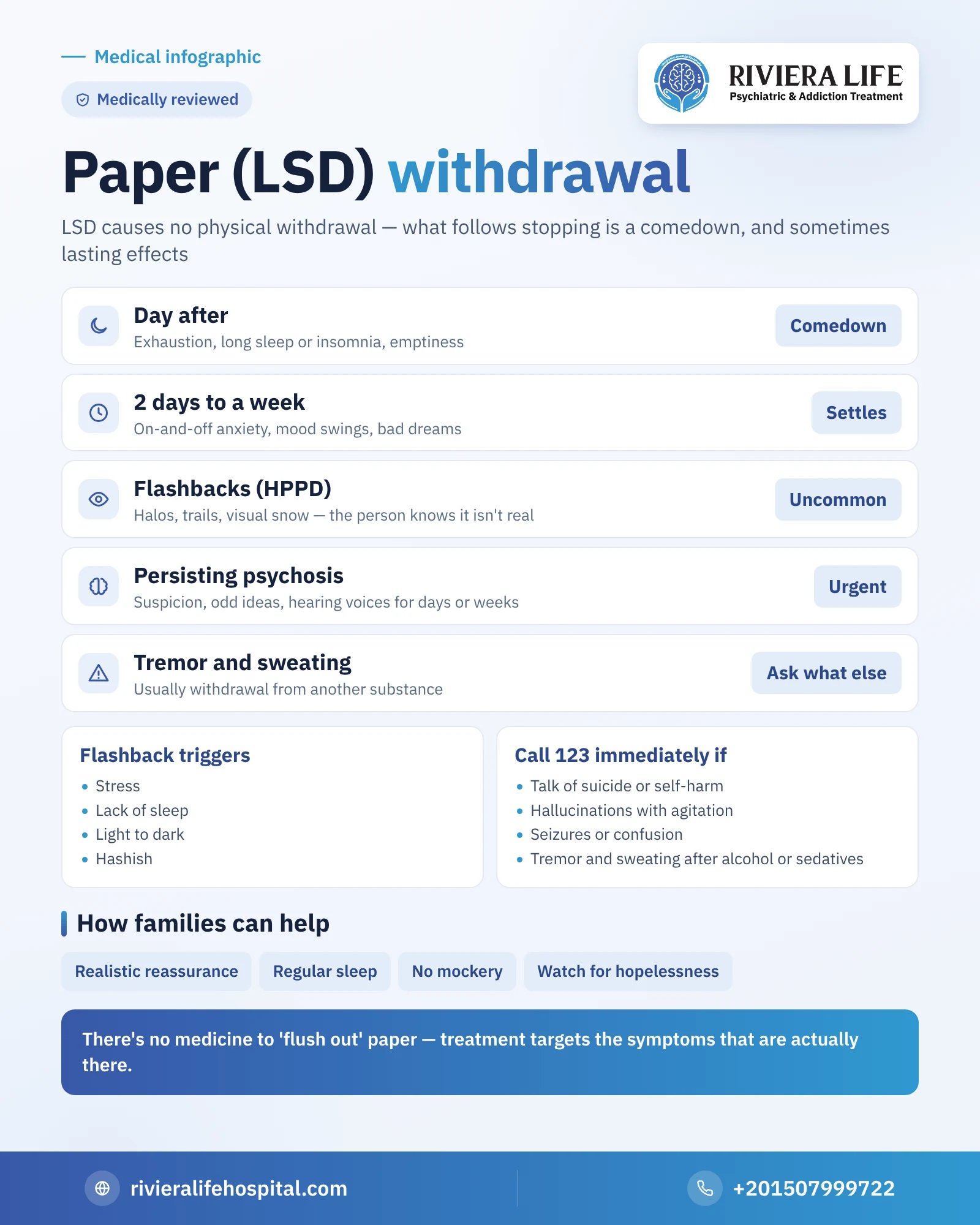
The following picture is approximate, and varies with the number of times used, what was mixed with the paper, and the person’s mental state before use:
| Period | What may happen |
|---|---|
| The day after the experience | Severe exhaustion, long sleep or insomnia, difficulty concentrating, and a feeling of emptiness or sadness |
| From two days to about a week | On-and-off anxiety, mood swings, and disturbing dreams in some people |
| The following weeks | Symptoms settle in most people, while perceptual or psychotic effects persist in a few who need follow-up |
This comedown isn’t withdrawal in the medical sense, but a natural effect of a long sleepless night and an exhausting mental experience, and in some ways it resembles what happens after staying up very late, only more intensely.
Psychological effects after stopping
Some people who used paper many times, or had a bad experience, describe after stopping:
- Persistent anxiety or sudden panic attacks, especially in crowded places.
- Low mood and a loss of enthusiasm for ordinary things.
- A feeling of being detached from oneself, or that the world seems like a dream.
- Difficulty sleeping and concentrating.
- A fear of “going mad” that feeds the anxiety itself.
These symptoms don’t mean the person has suffered permanent damage, but they deserve assessment if they last more than two weeks or disrupt daily life. The effects that may actually remain are covered in the short- and long-term risks of paper.
Flashbacks and hallucinogen persisting perception disorder
What is it?
Doctors recognize a condition called hallucinogen persisting perception disorder. In it, some of the visual distortions the person experienced while under the influence return, even though they haven’t taken anything: halos around lights, trails following moving objects, colors that seem more intense, dots or “snow” in the field of vision, and sometimes rippling in still surfaces. The difference between it and psychosis is that the person knows what they are seeing isn’t real.
How long does it last?
In some people the condition is short, widely spaced episodes that disappear within weeks or months, and in a few others it persists for longer. Its course can’t be known in advance, and there are no precise figures on how many people develop it, but it is agreed to be uncommon.
What triggers it?
Patients usually report that episodes increase with stress, lack of sleep, moving from a bright place to a dark one, and using hashish. That is why avoiding hashish and late nights is an essential part of the plan for dealing with it.
Psychosis after stopping
In a few cases, psychotic symptoms don’t end when the effect does, and suspicion, strange ideas or auditory hallucinations continue for days or weeks. This mostly happens in those with a prior predisposition, such as a family history of schizophrenia or bipolar disorder, and the substance may be what revealed this predisposition early. This condition isn’t treated by waiting, but by an urgent psychiatric assessment and appropriate medication.
Is there an urgent craving to go back?
The compulsive chemical craving known to someone addicted to heroin or shabu is rare with paper. What draws a person back is something else: friends, parties and music, the feeling that ordinary life is dull after an experience that seemed “deep” to them, and curiosity to repeat what they missed last time. These psychological and social motives are real, and deserve to be treated just as seriously, because they are what brings the person back to papers that next time may carry a more dangerous substance. The details of these motives are in our article on the causes of paper addiction.
When the withdrawal is from another substance
Paper is rarely the only substance. So if tremor, heavy sweating, body aches or seizures appear after stopping, they are most likely withdrawal from alcohol, sedatives, tramadol or pregabalin that were used to soften the “comedown” after paper. Withdrawal from alcohol and sedatives in particular can be dangerous, and needs medical supervision that isn’t available at home. That is why assessment always begins with the question: what else were they using?
When do you need a doctor immediately?
Call an ambulance on 123 immediately if you see
Or go to the nearest emergency department, and don't leave the person alone.
- Talk of suicide or self-harm
- Hallucinations or severe suspicion with agitation or aggression
- Seizures, confusion or loss of consciousness
- Severe tremor, sweating and a racing heart after stopping alcohol or sedatives
How are the after-effects of stopping managed medically?
There is no medicine to “flush” paper out of the body, and none is needed. The doctor focuses on the symptoms that are present: treating anxiety and insomnia, monitoring mood, treating psychosis if present, and dealing with hallucinogen persisting perception disorder with a plan that combines psychological support and avoiding triggers, along with medicines the doctor chooses according to the case, since the evidence for each of them is still limited. The details of the full treatment program are in our article on paper addiction treatment.
How can the family support during this period?
The most important thing the family offers is realistic reassurance. Tell your son that what he sees or feels is medically recognized, and that most of it improves with time and treatment, because the fear of going mad feeds anxiety and makes symptoms worse. Help him keep regular sleep, avoid mocking his visual complaints, and watch for any talk of hopelessness. And if you are still unsure what he took, see our article on paper addiction symptoms and our page on paper (LSD) for a clearer picture.
More from our paper (LSD) guide
- Paper (LSD): the complete guide
- Paper addiction symptoms
- Paper addiction treatment
- How long paper stays in your system
Questions many people ask
There is no known physical withdrawal syndrome for LSD. The exhaustion and anxiety after the experience usually settle within days to a week, while perceptual effects may last longer in a few people and need follow-up.
Usually not physically dangerous, but they are distressing and can cause severe anxiety. If they recur or affect study, driving or sleep, they should be seen by a psychiatrist.
These symptoms don't usually come from LSD; most likely they are withdrawal from another substance such as alcohol, sedatives or tramadol. Some of these cases need urgent medical supervision.
Yes. Many patients improve with time, psychological support and avoiding triggers such as hashish and late nights, and the doctor may use medicines depending on the case.
Stopping paper alone doesn't usually need detox, but an inpatient stay may be necessary with psychosis, suicidal thoughts, or mixing with substances whose withdrawal is dangerous.