Your son came home at dawn with his eyes unusually wide, unable to sleep, staring at the ceiling as if he could see something you can’t. Many families describe this scene before they know the name “paper”. The symptoms of paper addiction and use differ from most well-known drugs: they appear as clear episodes lasting long hours and then disappearing, not as daily drowsiness or constant overactivity.
That is why it is easy for a family to put them down to exhaustion or staying up late, while the most important sign sometimes only appears days after the experience: strange suspicion, complaints of blurred vision, or a feeling that the world is “not real”. In this article we set out what you can see with your own eyes, and when use turns into a disorder that needs treatment.
Signs that appear during the effect
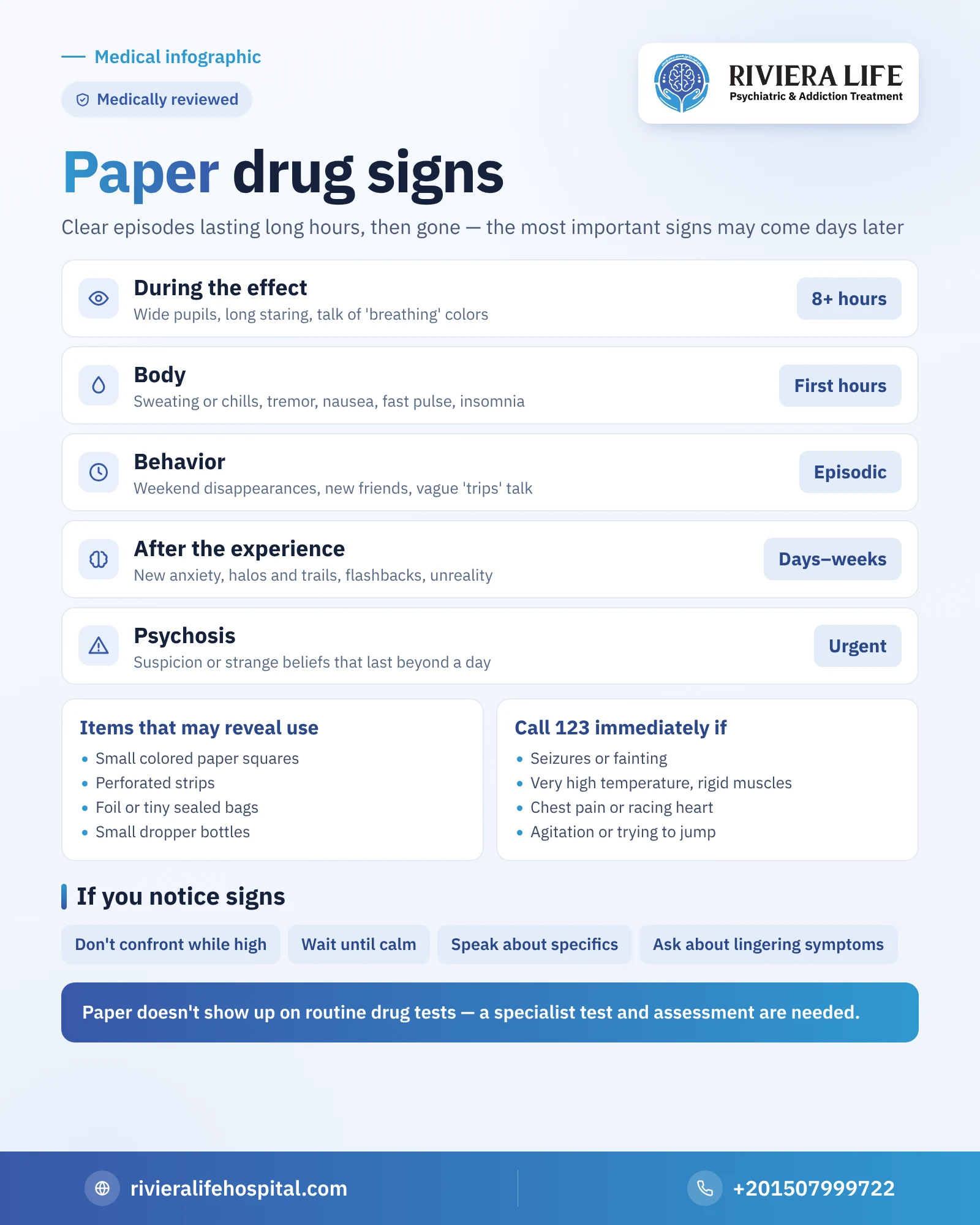
The effect of a tab begins about half an hour to an hour after it is placed on the tongue, and peaks after roughly two to four hours. During this period you may notice:
- Clearly dilated pupils, even in strong light.
- Long staring at something ordinary, such as the pattern of a carpet, the light of a lamp or their own hands.
- Talk of colors that “breathe”, walls that move or music they can “see”.
- Sudden laughter for no reason that turns within minutes into fear or crying.
- Difficulty following a conversation, and strange questions about the time, their identity or the meaning of things.
- A feeling that time has stopped, so they ask how long has passed and repeat the question.
Many users avoid their families during exactly these hours, staying at a friend’s or outside until the effect ends, so parents may only see the end of the night and what follows.
Physical signs in the first hours
Paper doesn’t change physical appearance much compared with opioids or stimulants, but the body gives signals that can be noticed: sweating despite cold weather or chills despite warmth, a slight tremor in the hands, nausea or complete loss of appetite for a day, a fast pulse, and insomnia lasting the whole night even after the hallucinations pass. The next day the person looks exhausted and absent-minded, and may sleep for long hours.
Behavioral signs with repeated use
Repeated paper use is rarely daily, because the body builds tolerance quickly, making a second tab the next day weak in effect. So behavioral signs come as a repeated pattern rather than a constant state:
- Regular disappearances at weekends or on party nights, with a refusal to explain where they were.
- New friends the family doesn’t know, and repeated talk of “experiences” and “trips” in vague language.
- A sudden interest in content about “expanding consciousness”, energy or symbols, and music and art linked to psychedelic culture.
- Unexplained requests for money, or selling personal belongings.
- Study or work slipping in the days after nights out.
Items and objects that may reveal use
The clearest physical evidence is the paper itself: small squares the size of a fingernail, with colorful, cartoon or geometric designs, and sometimes a strip of several squares separated by perforated lines. They are usually kept in aluminum foil or a small sealed bag inside a wallet, a phone case or between the pages of a book. Instead, you may find a small dropper bottle of clear liquid, or thin pieces that look like gelatin. The look of a tab doesn’t indicate the substance on it, which we explain on our paper drug page.
Psychological signs that appear after the experience
This is the part families usually miss, because it comes days or weeks after the last tab, and no one links it to it:
- New anxiety or panic attacks that weren’t there before.
- Complaints of seeing halos around lights, trails following moving objects, or dots moving in the field of vision.
- Sudden returns of fragments of the experience without using, which young people call “flashbacks”.
- A feeling that the world isn’t real, or that the person is watching themselves from outside.
- Thoughts of suspicion and mistrust, or strange beliefs about special messages or extraordinary abilities.
These effects and how long they are expected to last are explained in detail in our article on paper drug withdrawal symptoms.
Is there such a thing as paper addiction?
LSD doesn’t usually cause physical dependence or the daily compulsive craving that heroin or shabu cause. But psychiatry recognizes a diagnosis called hallucinogen use disorder, which is considered when a harmful pattern repeats over months, such as:
- Continuing to use despite previous bad experiences or clear psychological symptoms.
- Using larger amounts or more tabs than intended.
- Failed attempts to stop or cut down.
- Study, work or relationships slipping because of use or recovering from it.
- Using in dangerous situations such as driving or high places.
Paper is often part of multiple substance use that includes hashish, alcohol or ecstasy, and then the whole picture changes and the need for a specialist assessment grows.
How do you tell the signs of paper from other substances?
| Sign | Paper | Other substances |
|---|---|---|
| Pupils | Clearly dilated | Very narrow with opioids; also dilated with stimulants and ecstasy |
| Length of the episode | Eight hours or more | Usually two to four hours with hashish |
| Movement and energy | Moves little, absorbed in what they see | Energy and fast speech with stimulants |
| Hallucinations | Mainly visual and complex | Less distinct with hashish; may be auditory with shabu |
| Frequency | Intermittent because of rapid tolerance | Usually daily with opioids and tramadol |
The table is for guidance only: a definite diagnosis needs a medical assessment and specialist testing, because paper doesn’t show up in routine tests, as we explain in our article on how long the paper drug stays in your system.
When do the symptoms get mixed up with a mental illness?
A young man who talks about voices, conspiracies or hidden messages after a party may be under a delayed effect of the substance, or he may be at the start of a psychotic episode set off by the substance in someone already predisposed. The key difference is time: the direct effects ease gradually within about a day, while symptoms that remain after that or get worse need a psychiatrist immediately, especially if there is a family history of schizophrenia or bipolar disorder. You will find the other psychological and physical complications in our article on the long-term harmful effects of the paper drug.
Signs in teenagers and university students
A teenager tends to hide the experience more than adults do, but is less able to hide its effects. Watch for a sudden drop in grades after holidays, withdrawal from old friends, repeated insomnia on Thursday and Friday nights, or enthusiastic talk about “an experience that changed how I see life”. The curiosity of this stage and its motives are explained in our article on the causes of paper drug addiction.
What should you do if you notice these signs?
Don’t confront him while he is under the influence: a confrontation in those hours can turn the experience into an episode of terror. Wait until he has calmed down and rested, then talk about specific observations rather than general accusations. Ask him about any psychological symptoms that remained after the last time — they are often what will persuade him to accept seeing a doctor. You can read about treatment options in our article on paper drug addiction treatment.
Danger signs that can’t wait
Call an ambulance immediately on 123 if you see
Some tabs contain highly toxic synthetic substances, and the first minutes matter.
- Seizures or loss of consciousness
- A very high temperature with heavy sweating or rigid muscles
- A very fast heartbeat or chest pain
- Agitation, violence or an attempt to jump from a high place
- Talk of self-harm, or persistent frightening hallucinations
More from our paper drug guide
- The paper drug: the complete guide
- Paper drug withdrawal symptoms
- Paper drug addiction treatment
- The causes of paper drug addiction
Questions many people ask
Strikingly dilated pupils even in light, with insomnia, sweating and a fast pulse during the hours of the effect. But other substances share these signs, so they aren't enough on their own to judge.
Rarely, because the body builds tolerance quickly, weakening the effect of a tab repeated on consecutive days. So use usually appears as intermittent episodes linked to parties and weekends.
The direct effects ease within about a day, while suspicion and hallucinations that continue after that or get worse need an urgent psychiatric assessment, especially with a family history of psychotic disorders.
Small colored paper squares with pictures, kept in aluminum foil or a small bag, and sometimes a small dropper bottle. Don't try it; keep it to show the doctor.
Yes. In some users, visual distortions or fragments of the experience can return weeks or more later — a medically recognized condition that needs psychiatric follow-up if it recurs or is distressing.