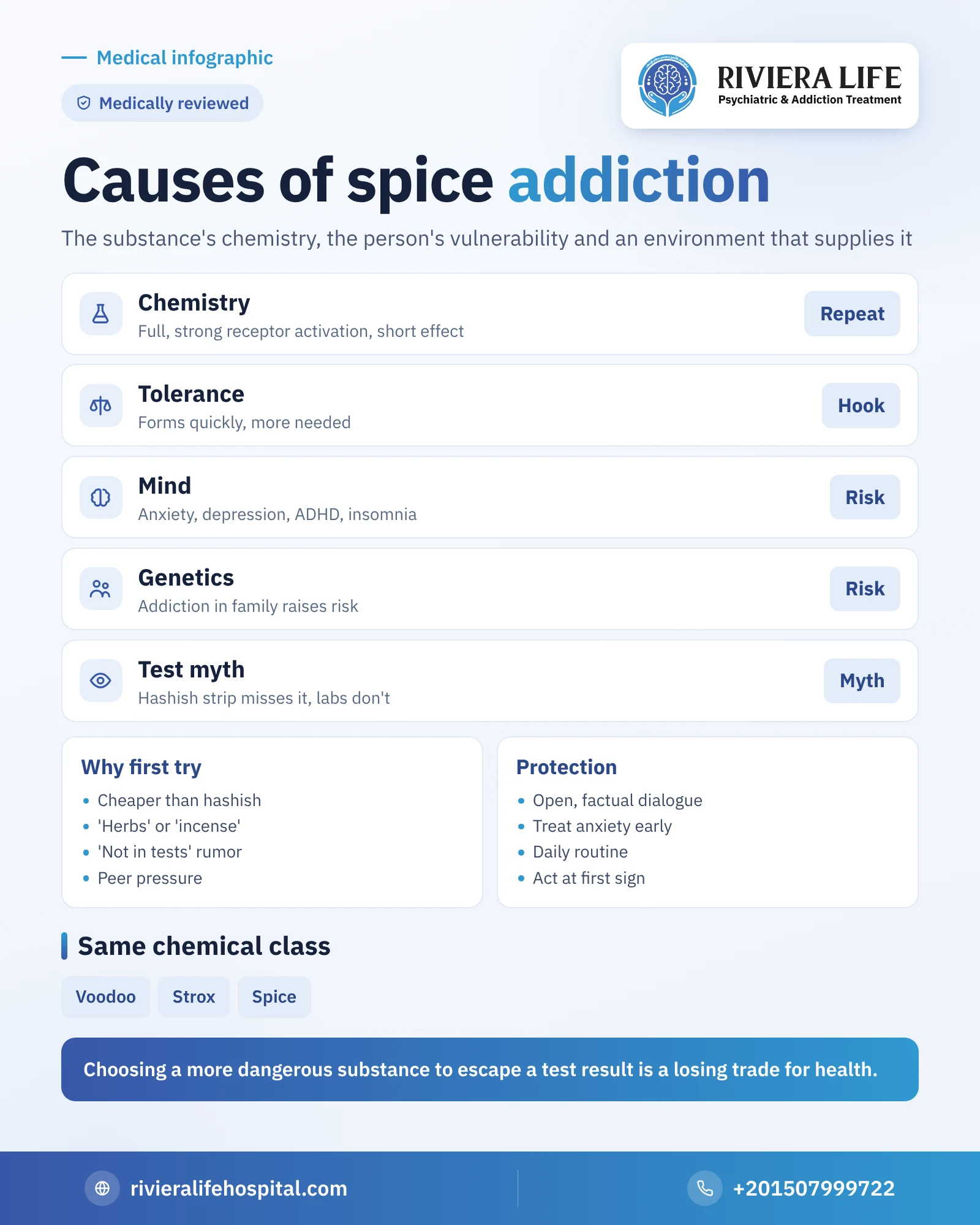
No one starts with the intention of becoming addicted to spice. The story often begins with a cigarette offered by a friend as “cheaper hashish” or “herbs that don’t show up in tests”, then it is repeated because the effect is fast and short and leaves a desire for more. The causes of spice addiction are a mixture of three things: the characteristics of the substance itself that push towards repetition, the person’s psychological and genetic circumstances, and the environment that supplies the substance and makes it look attractive. In this article we take each side apart, and explain who is most at risk and what protects against it.
Why do young people try spice for the first time?
The initial motives for trying differ from the motives for continuing. At the start, a limited number of reasons recur in patients’ accounts:
- The low price compared with hashish, and the ease of obtaining small amounts.
- The belief that it is “herbs” or “incense” that is less harmful, because of the packaging and brand names.
- The widespread rumor that it doesn’t show up in tests, an incomplete rumor as we will explain.
- Curiosity and peer pressure, especially in adolescence and university.
- Seeking a quick escape from distress, boredom or insomnia.
These reasons explain the first step, but they don’t explain why some people find themselves smoking every hour after weeks.
How does the substance itself push towards repetition?
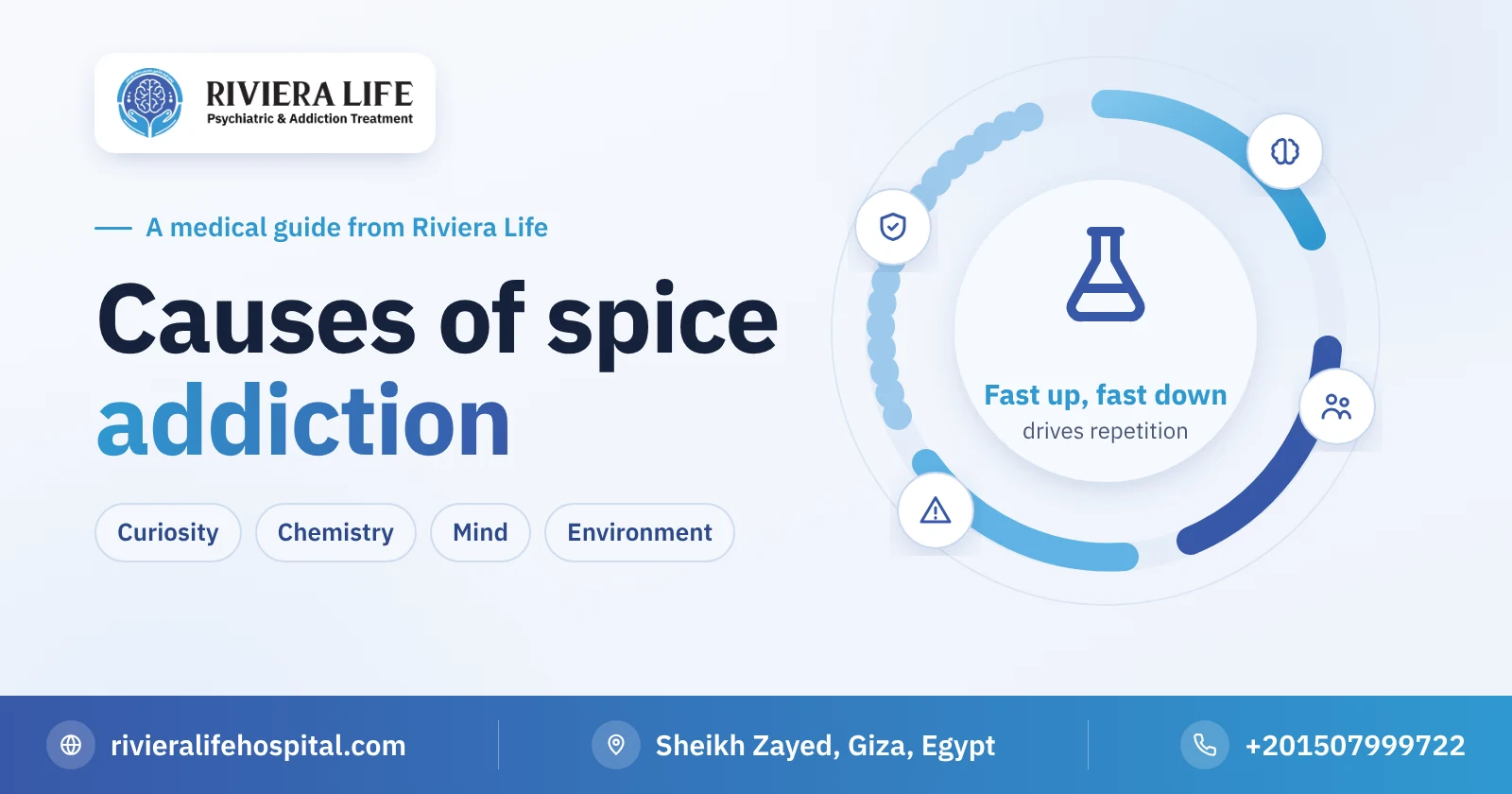
A large part of the reason lies in the chemistry of spice. Its compounds activate the cannabinoid receptors in the brain fully and strongly, reach the brain within minutes, then their effect recedes relatively quickly. This rapid pattern, a sharp rise then a quick fall, is precisely the pattern that entrenches repetition in the reward system. And with each fall, distress and tension appear that push to a new cigarette.
Added to this, tolerance forms quickly; receptors exposed to full and repeated activation lose sensitivity, and the person needs a larger amount or more closely spaced smoking to get the same effect. In a British study that asked users who had tried both hashish and spice, the great majority said that spice withdrawal was worse, and that its effect was faster and shorter. To explain this chemistry in detail you can refer to the spice page.
Psychological factors
Many of those who become attached to spice use it, consciously or unconsciously, to soothe untreated psychological pain. The most prominent things we see in assessment:
- Chronic anxiety and panic attacks, where smoking gives momentary relief that later turns into more severe anxiety.
- Depression and loss of pleasure, so spice becomes the only thing that “moves” the mood.
- Attention deficit hyperactivity disorder, which is generally linked to impulsivity and thrill-seeking.
- Insomnia, as some start smoking to sleep and then can’t sleep without it.
- Trauma and harsh experiences in childhood or adolescence.
The relationship here is mutual: the psychological disorder increases the likelihood of use, and use worsens the disorder. That is why a treatment that ignores either side doesn’t succeed.
Genetics and biological predisposition
Addiction research in general indicates that genes explain a considerable part of a person’s susceptibility to addiction, estimated in many studies at roughly half, though the proportion differs by substance. There is no “spice gene”, but addiction in a parent or close relatives raises the risk. Age also plays an important role; the brain continues to mature until roughly the mid-twenties, and someone who starts using in adolescence is more vulnerable to dependence and to longer effects on attention and memory.
The social and family environment
The surroundings largely determine whether the first experience will remain the last:
- Friends who use regularly and consider spice a normal part of an evening out.
- Absence of suitable family supervision, or conversely harsh supervision that pushes towards stubbornness and concealment.
- Ongoing family disputes, separation or loss of a parent.
- Unemployment, long idle time and the absence of a daily goal.
- Easy access to the substance in the neighborhood or through intermediaries on social media.
The “doesn’t show up in testing” myth
This idea is among the strongest reasons for its spread worldwide, and spice has been linked from its beginning to groups subject to periodic testing. The truth is that the common hashish strip doesn’t detect it, because its compounds are different in structure, but specialized laboratories have tests that detect many of them. More importantly, relying on this idea means that the person chose a more dangerous substance to escape a test result, which is a losing trade for health. You will find what tests actually detect in the article on how long spice stays in the body.
Moving from hashish to spice
Many spice users come from a background of hashish or bango use. The matter begins for a circumstantial reason, such as a rise in the price of hashish or its scarcity, or a desire for a “stronger” effect after tolerance to hashish has formed. But the move isn’t to a stronger version of the same thing, but to a substance different in its risks. Someone who uses both together benefits from reading the hashish page to understand the difference. And in Egypt specifically, some move between local blends carrying names such as voodoo and strox, which are from the same chemical class.
Why does it spread in closed and marginalized settings?
International reports, especially in Europe, point to the wide spread of synthetic cannabinoids in prisons and among those living on the streets or in harsh social conditions. The reasons are similar: the substance’s cheapness, the ease of hiding it even in the form of soaked paper, and its ability to “switch off” the feeling of boredom, cold or despair for hours. This international picture reminds us that addiction can’t be separated from circumstances, and that social pressure, idleness and hopelessness are direct fuel for it.
Who is most at risk of spice addiction?
| Risk factor | Why does it raise the likelihood? |
|---|---|
| Starting in adolescence | A brain that hasn’t fully matured and is more sensitive to quick reward |
| A history of regular hashish use | Prior tolerance and a search for a stronger effect |
| Untreated anxiety or depression | Using the substance as a means of self-soothing |
| Addiction in the family | Genetic predisposition and an environment tolerant of use |
| Idleness and unemployment | Long time without daily structure |
| Previous trauma | Psychological pain looking for a quick anesthetic |
The presence of one or more factors doesn’t mean addiction is inevitable, and their absence doesn’t guarantee safety. They are indicators that help the family and doctor estimate the level of caution.
When does occasional use turn into addiction?
The turning point is usually not a specific day, but a gradual accumulation: the number of cigarettes increases, the time between them shortens, and smoking becomes a condition for sleeping, eating or leaving the house. Then irritability, sweating and insomnia appear when it is delayed, which is the beginning of physical dependence. At this stage willpower alone is usually not enough, and the signs become clear to those around, as the article on spice addiction symptoms explains.
What protects against falling into spice?
- Open dialogue within the family that talks about drugs with information, not with scare tactics.
- Real knowledge that spice is an unknown chemical substance and not “herbs”.
- Early treatment of anxiety, depression and insomnia instead of leaving them for the young person to treat in their own way.
- A daily routine with study or work, exercise and regular sleep.
- Quick intervention at the first sign of use, before it turns into dependence.
Understanding the cause is part of treatment
Knowing why the person started and why they continued isn’t a theoretical luxury, but a cornerstone of the treatment plan. At Riviera Life the assessment begins by looking for psychological and social motives and accompanying disorders, because treating them is what protects against going back after stopping. You will find the stages of this plan in the article on spice addiction treatment.
More from the spice guide
- Spice: the comprehensive guide
- Spice addiction symptoms
- The harms of spice addiction
- Spice addiction treatment
Questions many people ask
Because its compounds activate cannabinoid receptors fully and strongly with a fast, short effect, so smoking is repeated and tolerance forms quickly, and most users describe its withdrawal as more severe.
There is no predisposition specific to spice, but genetics explains a considerable part of susceptibility to addiction in general, so addiction in the family raises the risk without making it inevitable.
This often happens, as some use it to calm down or sleep, then use increases anxiety and depression themselves. That is why both conditions must be treated together.
It doesn't usually show on the hashish strip, but specialized laboratories detect many of its compounds with dedicated tests, so the rumor is incomplete and misleading.
Through calm, information-based dialogue, treating anxiety and insomnia early, organizing his day, knowing his friends without spying, and intervening quickly at the first sign of use.