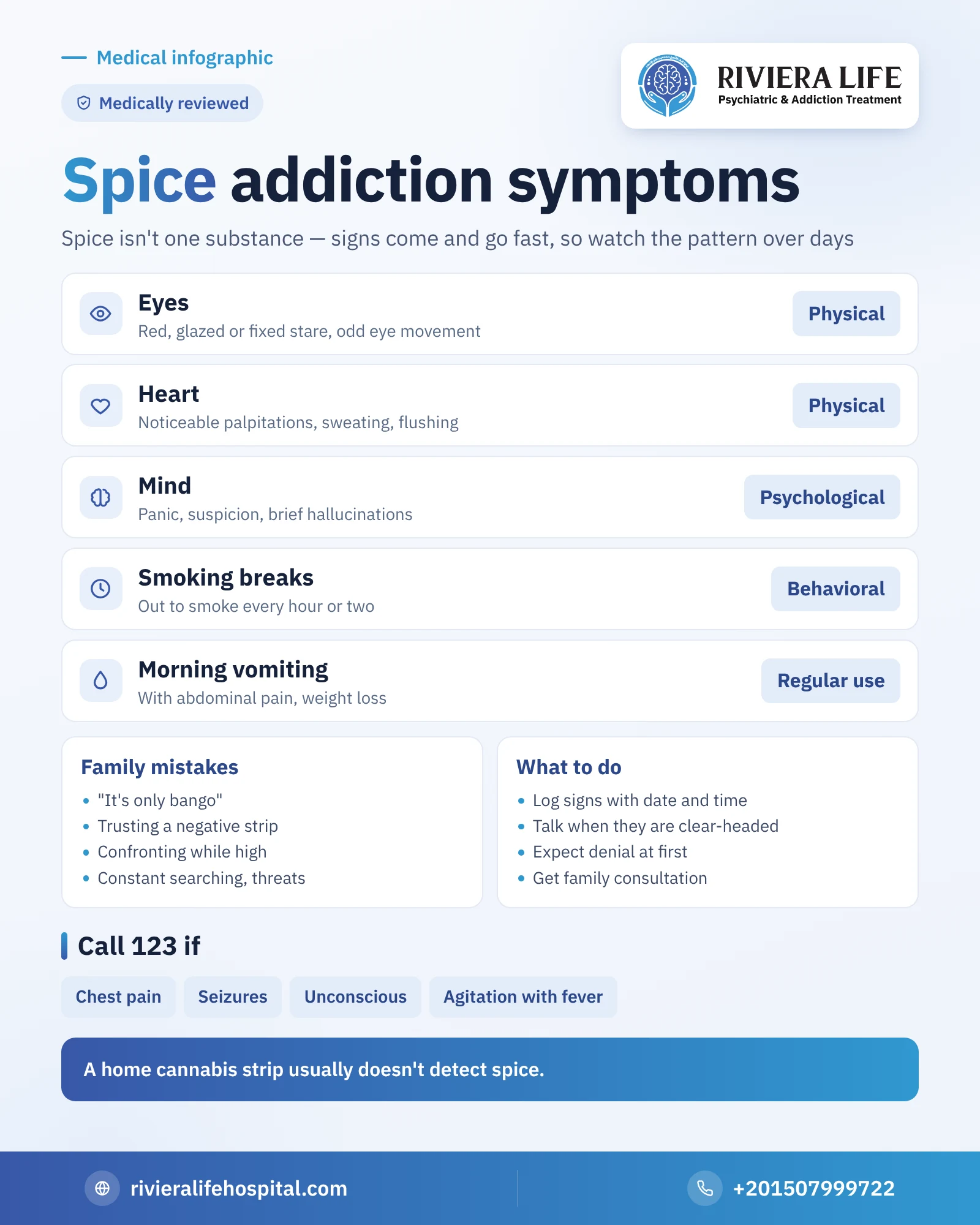
Spice addiction symptoms differ from the calm picture people associate with cannabis. Instead of laughter and laziness, the family may see sudden bouts of agitation, glazed eyes, repeated morning vomiting, and a young man who leaves his room several times an hour to smoke. This article gathers the physical, psychological and behavioral signs that can be noticed at home, explains how to tell them apart from the signs of cannabis, when they point to addiction in the medical sense, and the next step if they come together in front of you.
Why do spice symptoms seem confusing?
The first problem is that spice isn’t a single substance. The bag your son smokes today may contain a compound different from last week’s bag, and each compound has its own character of effect. So you may see the same person calm and half-asleep one day, and tense and aggressive another day. The second problem is that the effect is relatively short, starting within minutes and usually fading within a few hours, so the signs appear and disappear quickly before you can be sure of them. That is why the family needs to watch the pattern over days, not a single moment.
Physical signs during the effect
These signs usually appear in the minutes or hours following smoking:
- Red eyes with a glazed or fixed stare, and sometimes involuntary eye movement.
- Noticeable palpitations, sweating, and sudden pallor or flushing of the face.
- Heavy or stammering speech, and difficulty coordinating movement as if the person were “stiff”.
- Nausea and vomiting, and sometimes severe lethargy reaching something like a brief faint.
- Tremor in the hands or unusual muscle movements.
Some of these signs, such as seizures, chest pain or loss of consciousness, go beyond the limits of “the effect” into poisoning, and need immediate emergency care. You will find these danger signs detailed on the spice page.
Psychological signs that catch attention
The psychological side is what distinguishes spice more than anything else. With many of its compounds there appear:
- Acute anxiety or panic attacks in which the person describes a feeling that they will die or lose their mind.
- Unjustified suspicion of family or friends, and the feeling that someone is watching them or plotting against them.
- Brief auditory or visual hallucinations, or incoherent speech.
- A rapid swing from laughter to anger, and irritability out of proportion to the situation.
- Detachment from their surroundings, as if they don’t hear whoever is speaking to them.
In some users these symptoms continue for days after the last smoke, and may develop into a psychotic episode that needs a psychiatrist’s intervention. Any talk of harming oneself or others must be dealt with seriously and immediately.
Behavioral signs at home
Over time, passing signs turn into a pattern of life that can be observed:
- Repeatedly going out to the balcony, the roof or the bathroom to smoke, sometimes every hour or two.
- A strange herbal or incense smell that doesn’t resemble the familiar smell of cannabis.
- Small colored bags printed with brand names or drawings, rolling papers, or e-cigarettes with unknown liquids.
- Disturbed sleep: either long late nights or heavy sleep at odd times.
- A clear decline in study or work, and absence without a convincing explanation.
- Insistently asking for money, or sums of money and small items disappearing.
- A changed circle of friends and intense concern for the phone’s privacy.
Signs that appear with repeated use
When use becomes daily, deeper signs appear indicating that the body has begun to adapt to the substance. The most prominent are repeated morning vomiting attacks with abdominal pain, loss of appetite and weight loss, and weak concentration and memory noticed by teachers or work colleagues. There is also sharp irritability, insomnia and sweating if the person is late for their usual smoking time, which then calm suddenly after they smoke. This rapid return to calm after smoking is one of the clearest indicators of dependence, and the details of what happens on stopping are in our article on spice withdrawal symptoms.
How do you tell spice signs from cannabis signs?
The signs alone can’t settle it, but there are general differences that help with a first reading:
| Sign | Cannabis, usually | Spice, usually |
|---|---|---|
| Mood | Relaxation, laughter and laziness | Sharp swings between lethargy, panic and agitation |
| Heart | Mild racing | Clear palpitations and sometimes chest pain |
| Stomach | Increased appetite | Nausea and repeated vomiting in many cases |
| Smoking frequency | A limited number of times a day | Many times, because the effect is short |
| Home test | Shows on a cannabis strip | Usually doesn’t show on a cannabis strip |
This last difference explains the confusion of many families: clear signs and a negative strip. Here our article on how long spice stays in the body helps, as it explains the tests that actually detect it.
When does use become addiction?
Doctors rely on specific criteria to diagnose a substance use disorder, and mere experimentation isn’t enough. The most important include: loss of control over amount and frequency, failed attempts to cut down, spending a long time obtaining the substance or recovering from its effect, craving, neglecting study, work or relationships, continuing despite clear health or psychological problems, then tolerance and withdrawal symptoms. Two or three criteria within a year point to a mild disorder, and the classification rises as the number increases. The diagnosis itself is the specialist doctor’s job after a full interview, not the family’s.
Signs that warn of serious complications
There are symptoms that don’t count among the ordinary signs of addiction, but indicate that the body has begun to be harmed. They include reduced urine or a change in its color with flank pain, which may indicate kidney injury, repeated attacks of palpitations even without smoking, and any seizure or fainting. Also vomiting that recurs for days and eases with hot showers, a pattern doctors link to cannabis and its derivatives. These conditions need an urgent medical examination, and you will find them explained in our article on the harms of spice addiction.
Mistakes families make on noticing the signs
- Feeling reassured because “it’s just bango”, when the substance may be far more dangerous.
- Relying on a negative home test strip and treating it as proof of innocence.
- Confronting the person while under the influence, when they are in a state of suspicion or agitation that may turn into violence.
- Constant searching and threats, which push towards hiding more than towards treatment.
- Postponing asking for help until “complete certainty”, while complications may come before that.
Signs a teacher or employer notices
Sometimes the first to ring the bell is someone from outside the home: a teacher who notices sleeping in class and a sudden drop in grades, or a manager who sees repeated lateness, irritability with colleagues and unusual mistakes. These observations deserve to be taken seriously, because they reveal the effect of use on daily performance even when the person is good at hiding it at home.
What do you do if the signs come together?
Start by writing down what you see with the date and time, as these notes are very useful to the doctor later. Wait for a moment when the person is clear-headed, and talk about your concern for them and about specific changes you have noticed, without judgments or labels. Don’t expect a confession from the first conversation; denial is an expected part of the picture. Then seek specialist consultation for the family even if they refuse at first, as the family’s way of dealing with it greatly affects their acceptance of treatment later. To understand why your son in particular fell into this substance, our article on the causes of spice addiction will help you.
The role of medical assessment at Riviera Life
The consultants in psychiatry and addiction treatment at Riviera Life carry out a confidential assessment that includes an interview, examination and specialized tests, and determine whether the symptoms are passing use or dependence that needs a treatment plan, and whether they are accompanied by a psychological problem that needs separate care. The first consultation is free.
More from our spice guide
- Spice: the complete guide
- Spice addiction treatment
- Spice withdrawal symptoms
- The causes of spice addiction
Questions many people ask
There is no single decisive sign, but many families first notice sharp mood swings with frequent trips out to smoke and a strange herbal smell. What counts is several signs together, lasting days.
Yes, red eyes are common with both, but spice is more marked by palpitations, vomiting and attacks of panic or agitation, which are less common with cannabis.
Because a home strip for cannabis usually doesn't detect spice compounds. Detecting them needs specialized tests in equipped laboratories.
Not necessarily; many pass as the substance wears off, but if they last for days or recur, they call for urgent assessment by a psychiatrist to rule out a psychotic episode.
With chest pain, seizures, loss of consciousness, severe agitation with hallucinations or a high temperature. Call an ambulance on 123 without waiting.