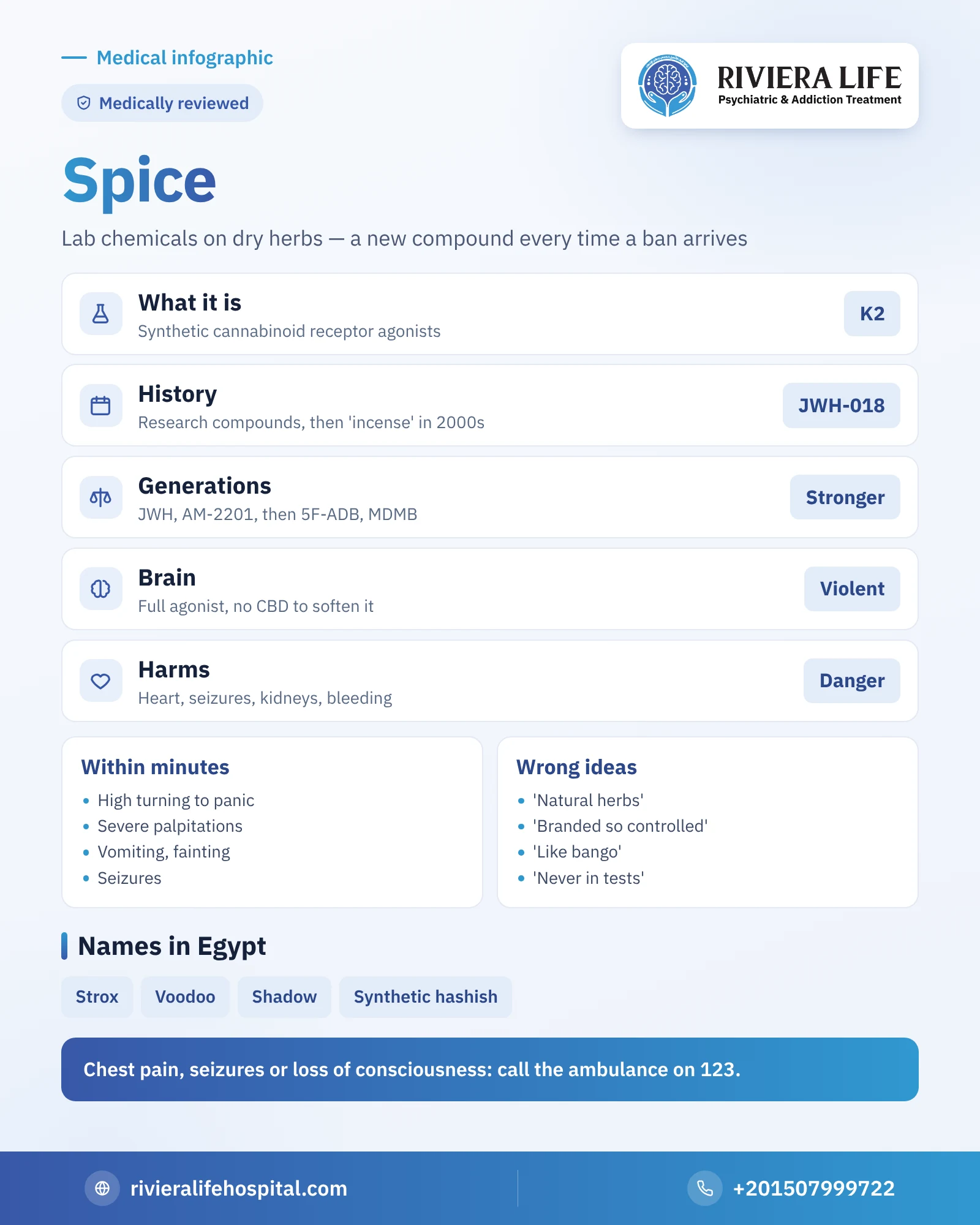
Spice isn’t synthetic hashish as its common name suggests, but chemicals synthesized in laboratories and sprayed on dry herbs to look like a natural plant. It is known globally by the names “spice” and “K2”, and spread in Egypt under local names, the best known being strox, voodoo and shadow.
Its real danger is that the compound in the bag changes from one batch to another, and that some of these compounds have an effect on the brain dozens of times stronger than the active substance in hashish, or more. On this page we explain what spice is scientifically, how it appeared, what it does to the body, and why poison centers treat it as an emergency, then connect you to every detailed article about it.
What is spice?
Spice falls under a class doctors call “synthetic cannabinoid receptor agonists”, that is, compounds made chemically to attach to the same receptors targeted by tetrahydrocannabinol (THC) in the cannabis plant. But they aren’t extracted from the plant, and often don’t resemble its active substance in structure. The chemical powder is dissolved in a solvent and then sprayed on worthless dried plant leaves, or added to e-cigarette liquids, or soaked into paper, so it reaches the user in a form that suggests it is a “herbal blend”.
Because the substance is sprayed on the leaves unevenly, one part of the bag may carry a tiny amount and another part a doubled amount. This is what makes the same experience mild one time and violent the next, without the user knowing why.
From the laboratory to the street: the story of K2 and spice
The story began in research laboratories that had nothing to do with drugs. In the 1980s and 1990s, researchers at universities and pharmaceutical companies made compounds that mimic cannabis to study receptors in the brain and test the possibility of pain relief, the best known being a series that carried the initials of the American chemist John Huffman, such as the compound JWH-018. The methods for preparing them were published in scientific research, and they were never released as medicines.
In the middle of the first decade of the millennium, small colored bags carrying the name “spice” appeared in Europe, sold as incense or room fresheners “not for human consumption”. In late 2008 laboratories in Germany and Austria revealed that these blends contained synthetic compounds from that research series. Shortly afterwards the same products spread in the United States under the name K2 and many trade names, then reached most regions of the world including the Arab region.
Names of spice circulating in Egypt
The word “spice” itself is rarely used on the Egyptian street; what circulates are local trade names for blends from the same chemical class. The best known is strox, then voodoo and shadow, and each has a separate page on our site dealing with its nature in the Egyptian market. Some young people also call it “synthetic hashish” or “chemical bango”. These names don’t guarantee a particular content; a bag carrying one name may contain a different compound from month to month, and may be mixed with completely different substances.
Generations of compounds: why does the content keep changing?
Whenever a country bans a particular compound, manufacturers make a slight modification to its molecule to produce a new compound whose name isn’t yet in the laws. In this way what could be called “generations” succeeded one another:
- The first generation: early research compounds such as JWH-018 and CP-47,497, which were found in the first spice products.
- The next generation: compounds to which fluorine atoms or new chemical rings were added to increase their strength, such as AM-2201 and XLR-11.
- The newest generations: compounds from the “indazole carboxamide” family such as 5F-ADB and MDMB-4en-PINACA, which are among the strongest and most linked to cases of severe poisoning and death.
European drug monitoring bodies track hundreds of compounds in this class, and new ones are discovered almost every year. This means that knowing the name of the product doesn’t tell you the substance in it, or its strength.
What does spice do in the brain and body?
The brain contains a natural network called the “endocannabinoid system”, which helps regulate mood, memory, appetite, sleep and the sensation of pain. THC in hashish activates the receptors of this network partially, like someone turning a volume knob to the middle. Most spice compounds, however, are “full agonists” that turn the knob to the maximum, and bind to the receptor much more strongly. The scientific profile of the European drugs agency states that some of them bind to the first cannabinoid receptor more than a hundred times as strongly as THC.
Added to this, natural hashish contains other substances such as cannabidiol that may soften part of its effect, and these are completely absent in spice. The result is effects that are more violent, faster and shorter:
- A high or quick relaxation that may turn within minutes into panic, suspicion or hallucinations.
- Severe palpitations and raised blood pressure, and sometimes chest pain.
- Nausea and vomiting, and heavy drowsiness or temporary loss of consciousness.
- Seizures in some users, even among those with no history of epilepsy.
- Aggressive or incomprehensible behavior, and difficulty speaking and moving.
Because the effect ends relatively quickly, many repeat smoking many times a day, so tolerance and dependence form faster than they expect.
Does spice have any medical use?
No. The compounds circulating under the name spice have not been approved as medicines anywhere in the world, and haven’t gone through safety trials in humans. This differs from a limited number of synthetic cannabis medicines that some countries dispense on prescription for specific conditions such as chemotherapy nausea, as those are medicines of known composition and dose subject to strict control, and have no connection to the sprayed blends sold on the street.
Why is spice among the most dangerous modern drugs?
Looking at poison center data is enough to understand the picture. In the United States, poison centers recorded in the first five months of 2015 a more than twofold rise in calls related to synthetic compounds compared with the same period of the previous year, and the most prominent things recorded were agitation, a racing heart, drowsiness, vomiting and confusion, with documented deaths. American health bodies also recorded specific unforgettable waves:
- 2012: cases of acute kidney failure in healthy young people linked to a single compound that had recently appeared in the blends.
- 2018: a wave of serious bleeding in the state of Illinois due to blends contaminated with an anticoagulant used in rat poison.
- Mass poisonings in various cities that affected dozens of people in a single day due to one very strong batch.
These incidents sum up the problem: an unknown substance, at an unknown dose, that may carry unknown impurities. You will find the full details of what it leaves on the heart, kidneys and brain in the article on the harms of spice addiction.
Spice within the cannabis family
Many put spice and hashish in one box, and this is a misleading simplification. Hashish and marijuana are products of the same cannabis plant, their active substance is known and their effect rises relatively slowly. Spice shares only the receptor it targets with them, and differs from them in strength, speed and complications. Cases of seizures, kidney failure and acute psychosis after a single time are very rare with hashish, but repeatedly documented with spice. To learn the full picture of the plant and its derivatives you can refer to the hashish page.
Spice and the law in Egypt
The health authorities in Egypt have listed a number of synthetic cannabinoid compounds in the schedules of narcotic substances, and the law treats their possession, use and trafficking as it treats prohibited drugs, with penalties increasing with trafficking. The door remains open for those who seek treatment themselves, as the law distinguishes between a user who comes forward for treatment voluntarily and someone who is caught. To ask about a particular case it is preferable to ask a specialized lawyer, and the Fund for Drug Control and Treatment of Addiction provides a free hotline on 16023.
The spice guide: each aspect in a separate article
We have dedicated to each question about spice an article that answers it alone in detail:
- Spice addiction symptoms: the physical, psychological and behavioral signs the family sees at home, and how to tell them from the signs of hashish.
- Causes of spice addiction: why young people try it, and why use quickly turns into daily repetition.
- The harms of spice addiction: its effect on the heart, kidneys, brain, mental health and life.
- Spice withdrawal symptoms: the timeline of what comes after stopping, and when it needs a doctor.
- How long spice stays in the body: why it doesn’t show on the hashish strip, and what urine, blood and hair tests detect.
- Spice and sex: its effect on desire, erection, fertility and the relationship.
- Spice addiction treatment: the stages of treatment, supporting medicines, psychotherapy and choosing a hospital.
Wrong ideas about spice
The idea: spice is natural herbs, so it is lighter than hashish. The reality is that the herbs are just a carrier for the substance, and the active component is pure chemical and often stronger in effect.
The idea: as long as it is sold in bags printed with trade names, it is a controlled product. The reality is that attractive packaging doesn’t mean any control; the concentration differs between one bag and another and even between the two ends of the same bag.
The idea: it doesn’t cause addiction because it is “like bango”. The reality is that repeated use causes tolerance and dependence, and most of those who have tried to stop describe withdrawal symptoms more severe than hashish withdrawal.
The idea: it never shows up in tests. The reality is that it doesn’t show on the strip dedicated to hashish, but specialized laboratories have tests that detect many of its compounds.
Where does the family start?
If you notice a sudden change in your son’s behavior, such as bouts of agitation, unjustified suspicion or repeated vomiting in the morning, together with a strange herbal smell or small colored bags, don’t wait until you are completely sure. Record what you see with the date and time, and choose a calm moment to talk away from threats and accusation. Remember that a negative result from a home test strip doesn’t clear anyone of spice, as most strips don’t detect it. And the most important step is to ask for a specialized consultation to assess the case, as the family itself needs guidance at this stage.
When is spice poisoning an emergency?
Call the ambulance on 123 immediately if any of these appear
Poisoning by synthetic compounds may deteriorate within minutes, and there is no home antidote for it.
- Chest pain or severe palpitations that don’t settle
- Seizures or an epileptic fit
- Loss of consciousness or no response to calling
- Severe agitation or hallucinations with aggression
- A very high temperature and heavy sweating
- Vomiting that doesn’t stop or very little urine
Until the ambulance arrives, remove any sharp objects from around the person and reduce the light and noise around them, and if they lose consciousness while breathing, put them on their side. Don’t give them a sleeping pill or any other substance on the pretext of calming them, and keep the bag or its remains if found, as it may help the doctors.
When should you ask for help?
Any repeated use of spice deserves an early medical assessment, even before clear signs of dependence appear, because its complications may come the first time or the tenth time without warning. At Riviera Life the consultants in psychiatry and addiction treatment assess the case in complete confidentiality, and determine whether it needs residence or outpatient follow-up, involving the family from the first day.
Medical sources and referencesThe information in this article is based on reliable scientific sources
1NIDA — Synthetic cannabinoids (K2/Spice) DrugFactsnida.nih.gov2EUDA — Synthetic cannabinoids and spice products drug profileeuda.europa.eu3CDC — Synthetic cannabinoids: an overview for healthcare providerscdc.gov4CDC MMWR — Rise in adverse health effects associated with synthetic cannabinoids in the United States, 2015cdc.gov5StatPearls — Cannabis and synthetic cannabinoid toxicityncbi.nlm.nih.gov