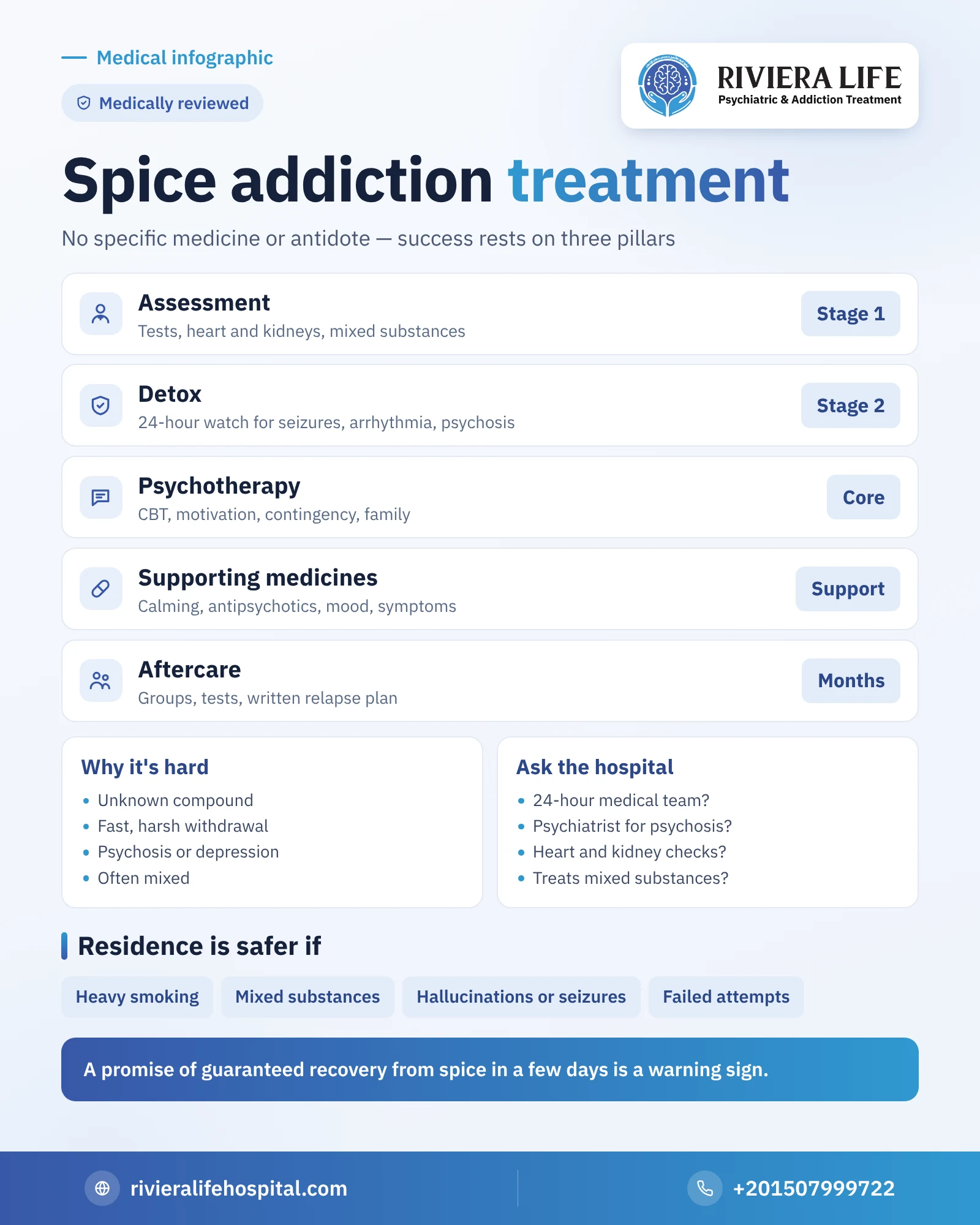
Spice addiction treatment is possible, but it differs from the treatment of many drugs in one essential point: there is so far no medicine approved specifically for it, and no antidote for its poisoning. That is why successful treatment rests on three pillars: safe detox in which symptoms are managed one by one under medical supervision, psychological and behavioral therapy that addresses the causes and motives of use, and long follow-up that prevents relapse. Added to this is special attention to what spice may have left behind of psychosis, depression or damage to the heart and kidneys. This article explains the stages in detail, the supporting medicines, the duration of treatment, and how to choose the right hospital.
Why is spice among the hardest drugs to treat?
Several difficulties come together in spice that don’t easily come together in others. The substance itself is unknown; neither the patient nor the doctor knows exactly which compound was used or its strength. Withdrawal starts quickly and carries psychological and physical symptoms more severe than hash withdrawal. Also, a considerable proportion of patients arrive with psychotic symptoms, depression or suicidal thoughts that need specialized psychiatric care. And many mix spice with other substances such as tramadol, pregabalin and alcohol, so treatment becomes treatment for more than one addiction at the same time. That is why many doctors describe it as among the most dangerous synthetic drugs, and the spice page explains the reasons for that scientifically.
Stages of spice addiction treatment
- Comprehensive assessment: a medical and psychological interview, a physical examination, and specialized tests, with heart and kidney checks when needed, and assessment of mixed substances and accompanying disorders.
- Detox and managing withdrawal: getting through the hardest days safely under round-the-clock supervision.
- Psychological and behavioral therapy: understanding motives and building alternative skills for dealing with pressures and craving.
- Treating co-occurring disorders: psychosis, depression, anxiety, insomnia and hyperactivity.
- Rehabilitation and aftercare: a gradual return to daily life with follow-up, support groups and a written relapse prevention plan.
Detox: how is spice withdrawal managed?
Withdrawal symptoms begin within hours to a day, and usually intensify in the first five days, and their timeline details are in the article on spice withdrawal symptoms. During this period the medical team monitors pulse, blood pressure, temperature and fluids, watches for any sign of seizure, rhythm disturbance or psychosis, and assesses mood daily to detect suicidal thoughts. The goal isn’t just “cleaning the body”, but for the patient to come out of this stage stable and ready for the next step.
Medicines used in spice addiction treatment
Since there is no approved specific medicine for synthetic cannabinoid addiction, the doctor chooses medicines that treat each patient’s specific symptoms, for a calculated period:
Calming and sleep medicines
Used in the first days to ease acute anxiety and insomnia and prevent seizures in those suffering severe agitation, for a short period and under close supervision, because some of them may cause dependence if used without control.
Antipsychotics
When hallucinations, severe suspicion or disordered behavior appear. Some patients need them for days only, and others need longer follow-up if use revealed a latent psychotic disorder.
Depression and anxiety medicines
If depression or anxiety continues after withdrawal ends, which is common, regular treatment for them is started, because leaving them is among the most important reasons for returning to smoking.
Medicines for physical symptoms
To treat nausea, vomiting and headache, with fluid replacement, and follow-up of kidney function in those who have shown signs of its injury.
Research is being conducted on medicines that may reduce craving for cannabis in general, but none of them has so far been approved as a standard treatment for spice. Any medicine is given within an individual plan the doctor decides, and shouldn’t be used without supervision.
Psychological and behavioral therapy
Here lies the largest part of the actual treatment. Among the evidence-supported methods in treating cannabis and cannabinoid use disorders:
- Cognitive behavioral therapy: the patient learns to recognize the situations and thoughts that precede craving, and trains in practical alternatives.
- Motivational interviewing: builds an internal motive for change, and especially suits young people who enter treatment under family pressure.
- Contingency management: tangible rewards linked to commitment and test results, which has proven useful in improving continuation.
- Family therapy: turns the family from a party in the conflict into a partner in recovery.
Duration of spice addiction treatment
There is no single duration for everyone. Managing withdrawal usually takes from one to two weeks, the intensive treatment program after it may extend weeks to a few months, and outpatient follow-up continues for months. The principles of addiction treatment stress that staying in treatment long enough, usually estimated at at least three months, is clearly linked to better results. What matters is that there is no gap between one stage and another, because the weeks following discharge from residence are among the highest periods of relapse risk.
Residence or outpatient follow-up?
Residence is preferred for those who smoke heavily, mix several substances, have shown seizures, hallucinations or suicidal thoughts, whose previous attempts failed, or who live in an environment where getting the substance is easy. Outpatient follow-up suits milder cases or the stage after residence. Often the ideal path combines both.
Preventing relapse after treatment
Relapse prevention includes keeping away from places and friends linked to use, organizing sleep, which remains fragile for weeks after stopping, continuing treatment of anxiety and depression, periodic tests as a tool of reassurance rather than punishment, and having a written plan for what the patient does when craving is strong. To understand the motives that must be treated for this plan to hold, see the article on the causes of spice addiction. And relapse, if it happens, means reviewing the plan, not abandoning it.
The family’s role in the treatment journey
In the program the family learns how to support without covering up or funding use, how to set clear limits without estrangement, and how to recognize the early signs of relapse explained in the article on spice addiction symptoms. Family sessions aren’t a formal addition, but part of the treatment itself.
The right hospital for spice addiction treatment: how to choose
The right hospital for spice addiction treatment is one that offers what a synthetic cannabinoid patient specifically needs: medical supervision that deals with unpredictable withdrawal, strong psychiatry for psychosis and depression, and follow-up of what may have affected the heart and kidneys. Before you decide ask:
- Is there a medical staff throughout night and day able to control the seizures and heart rhythm disturbances that may accompany spice withdrawal?
- Does a psychiatry consultant assess and treat psychotic symptoms, depression and suicidal thoughts?
- Are heart and kidney tests done when needed, not settling for detox?
- Does the program treat substances mixed with spice such as tramadol, pregabalin and alcohol in the same plan?
- Does it rely on proven psychological and behavioral therapy, or on isolation and residence alone?
- Is there follow-up after discharge and a program for the family?
And if a place promises to cure you of spice at a guaranteed rate or in a few days, consider that a warning sign.
How Riviera Life meets these standards in spice addiction treatment
Here is how these criteria are met at Riviera Life:
- Official license: a hospital licensed by the Ministry of Health.
- A long journey with recovery: work in addiction treatment extending fourteen years, and thousands of patients who have recovered.
- Specialists in complex cases: the psychiatry and addiction consultants in the team treat the psychosis, depression and anxiety that accompany synthetic cannabinoids.
- Constant medical presence: follow-up around the twenty-four hours in the hardest days of spice withdrawal.
- An individual plan: treatment that suits the pattern of spice use, the substances mixed with it and the state of the heart and kidneys.
- A family program: sessions that help the family support, set limits and deal with relapse.
- Aftercare: extended follow-up after discharge to prevent returning.
- Complete confidentiality: full privacy for the data of the patient and their family.
Your first consultation about spice costs you nothing, and you can call night or day on +201507999722; the hospital is located in Sheikh Zayed, in Giza Governorate.
More from the spice guide
- Spice: the complete guide
- Spice withdrawal symptoms
- The harms of spice addiction
- How long spice stays in the body
Questions many people ask
There is so far no medicine approved specifically for synthetic cannabinoid addiction. Treatment relies on medicines that treat symptoms under supervision, with psychological and behavioral therapy and long follow-up.
Managing withdrawal usually takes one to two weeks, the intensive program weeks to months, and follow-up months. Continuing for at least three months is linked to better results.
Some mild cases may be followed as outpatients under medical supervision, but residence is safer for those who smoke heavily, mix substances or have shown hallucinations or seizures.
In most cases it improves with stopping and treatment within days to weeks, but some patients need longer psychiatric follow-up if use revealed a latent disorder.
Choose one licensed by the Ministry of Health with consultants in psychiatry and addiction treatment, round-the-clock medical supervision, a family program and aftercare. Riviera Life in Sheikh Zayed, Giza, meets these criteria with fourteen years of experience.