How long spice stays in the body isn’t a single number, because “spice” itself isn’t a single substance. But as an approximate rule: the breakdown products of its compounds usually appear in urine for one to three days after occasional use, may extend to a week or more with heavy daily use, and their traces remain in hair for about three months. The point that surprises most families is that spice usually doesn’t appear on the usual hash test strip, and needs a specialized test. Here we explain why, what each sample detects, and the limits of these tests.
Why doesn’t spice show up in a hash test?
The common hash strip is designed to recognize a specific breakdown product of THC, in a way resembling a key and a lock. Spice compounds act on the same cannabinoid receptors in the brain, but their chemical structure is completely different most of the time, so this strip doesn’t recognize them. That is why a family may have clear signs of use in front of them, and then the strip result comes back negative. This result doesn’t mean spice is absent; it means the tool used wasn’t designed to detect it. Medical references confirm that routine tests in emergency departments don’t detect these compounds either.
What happens to spice inside the body?
After smoking, the lungs absorb the substance quickly, so it reaches the blood and brain within minutes. Then the liver begins breaking it down into multiple products, most of which leave with the urine. Because these compounds dissolve in fat, part of them is stored in fatty tissue and leaks out slowly in someone who uses heavily, which explains the long detection period in chronic users. The original substance itself rarely remains in urine, so specialized tests look for the breakdown products, not the original compound.
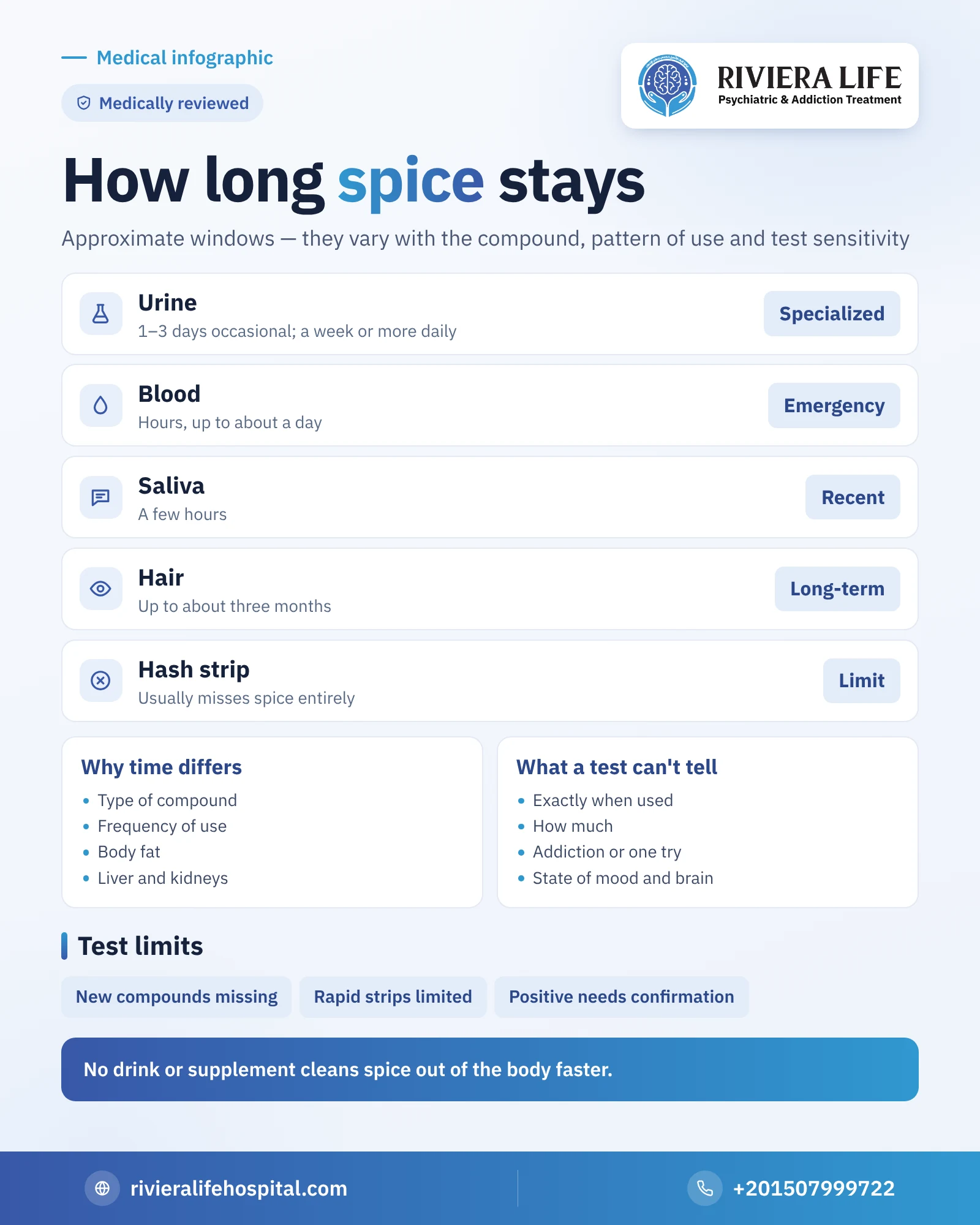
How long spice shows in each type of test
The following periods are approximate, and differ according to the compound, the pattern of use and the test’s sensitivity:
| Sample | Approximate window | Notes |
|---|---|---|
| Urine | One to three days after occasional use, and may extend to a week or more with daily use | The most used, and needs a specialized test, not the hash strip |
| Blood | Hours, and may reach about a day | Used in emergencies and investigations more than in follow-up |
| Saliva | Usually a few hours | Detects very recent use, and is less widespread |
| Hair | Up to about three months | Doesn’t detect the last few days |
Urine test
It relies on looking for the breakdown products of particular compounds. The labs that offer it have specific lists of compounds; for example, some reference tests abroad look for the products of recent compounds such as MDMB-4en-PINACA and 5F-MDMB-PINACA using liquid chromatography coupled with mass spectrometry.
Blood test
It picks up the original substance or its products in the first hours, so its greatest value is in assessing a case of acute poisoning or loss of consciousness, not in detecting past use.
Hair test
Substances are deposited in hair as it grows, so the part close to the scalp roughly reflects the last few months. Its usefulness is in drawing a picture of the pattern of use over the long term, not in knowing what happened yesterday.
Why does the time differ from person to person?
- Type of compound: each compound has a different breakdown speed and different products.
- Frequency of use: someone who smokes several times a day is completely different from someone who tried it once.
- Body fat: fat-soluble compounds stay longer in some people.
- The state of the liver and kidneys: if their function weakens, spice leaves the body more slowly.
- The amount of substance in the mix: irregular spraying makes the real amount unknown.
- The test’s sensitivity and the list of compounds it looks for.
The limits of tests: a race against new compounds
Here lies the biggest challenge. Every specialized test looks for a specific list of known compounds, while manufacturers constantly release new compounds to get around the laws. So a test may come back negative because the compound the person used hasn’t been added to the list yet. Reference labs update their lists periodically, but they usually remain a step behind the market. This fact makes judging use from the test alone insufficient, and makes a comprehensive medical assessment necessary.
Screening and confirmatory tests
There are rapid strips for some spice compounds, but they cover a limited number and may give inaccurate results. A positive result from any rapid test needs confirmation in a lab equipped with precise instruments that identify the compound by name. Conversely, a negative result doesn’t rule out use if the behavioral and physical signs are clear. You will find these signs detailed in the article on spice addiction symptoms.
What if the hash strip comes back positive?
A positive hash strip result usually means the person really did use hash or bango, and doesn’t mean they didn’t use spice. Many use the two alternately, and some mixes in circulation may combine cannabis herbs with sprayed synthetic compounds. So the result of a single strip, positive or negative, isn’t enough to know the real substance. For how long hash itself shows in the body, see the article on how long hash stays in the body.
Tests in emergencies
When someone arrives at the emergency department with seizures, agitation or severe palpitations after smoking, doctors don’t wait for the result of a specialized test that may take days. Treatment starts immediately based on the symptoms and vital signs, with blood tests, kidney and muscle function and a heart tracing. Here it helps a lot for the family to tell the medical team what they know about the substance, and to bring the packet or its remains if found.
What doesn’t the test tell you?
Even a confirmed positive test doesn’t determine exactly when the person smoked, how much they smoked, or whether they are addicted or tried it once. And it measures nothing about the state of the brain and mood. The test may turn negative after days while the urgent craving, insomnia and irritability continue for weeks, the stage explained in the article on spice withdrawal symptoms. Also, the substance leaving the body doesn’t mean its effects on the heart and kidneys have gone, if they happened, as in the article on the harms of spice addiction.
Can the body be “cleansed” of spice quickly?
Recipes, drinks and supplements claiming to clear spice from the body in days spread online. There is no scientific evidence for any of them, and some may harm the kidneys or upset the body’s salts, especially in someone whose kidneys may already have been affected by the substance. The body clears spice products through the liver and kidneys at its natural pace, and time alone is the decisive factor. More importantly, being preoccupied with the test result distracts from the real question: how does the person stop using and stay stopped?
Advice for the family before requesting a test
If you suspect your son is using spice, don’t rely on a home hash strip and then feel reassured by its negative result. It is better for the test to be part of a medical assessment that determines the appropriate test and the lab capable of it, and reads the result in the context of symptoms and history. And use the test as a tool to reach treatment, not as a means of proving a “crime” or of punishment, because the second approach often ends in hiding and estrangement.
The role of tests in the treatment journey
Within a treatment program, regular tests help follow commitment and detect relapse early, and give the patient evidence that gradually rebuilds their family’s trust. At Riviera Life the results are read within the full assessment carried out by consultants in psychiatry and addiction treatment, and aren’t used alone to judge the patient. You will find the full stages of the plan in the article on spice addiction treatment, and the general picture of the substance on the spice page.
More from the spice guide
- Spice: the complete guide
- Spice addiction symptoms
- Spice withdrawal symptoms
- Spice addiction treatment
- Spice vs hash: a substance from the lab and a substance from the plant
Questions many people ask
It usually doesn't show on the hash strip or routine test, because its structure differs from the active substance in hash. Detecting it needs a specialized test that looks for the metabolites of its compounds.
Roughly one to three days after occasional use, and the period may extend to a week or more with heavy daily use, depending on the compound and the test's sensitivity.
Yes, specialized labs can detect many of its compounds in hair for up to about three months, but it doesn't detect very recent use.
The compound used may be new and not on the test's list, or enough time may have passed since the last use. That is why judgment isn't made from the test alone without a medical assessment.
No. Craving, insomnia and irritability may continue for weeks after the test turns negative, and recovery needs treatment and follow-up, not just waiting.