The harms of spice addiction don’t wait years to appear as happens with many drugs. Some of the most dangerous, such as heart rhythm disturbance, seizures and acute kidney failure, may strike a healthy young man after a few times of smoking. On top of that come harms that accumulate with continuation in the brain, mental health, stomach and daily life. This article presents what poison center reports and medical studies document about the effect of spice organ by organ, and explains what can improve after stopping, and when the case is an emergency.
Why are the harms of spice more severe than those of hash?
The basic reason is that spice compounds activate cannabis receptors fully, while the active substance of hash activates them partially. Some of these compounds continue to act even after the body breaks them down, because their breakdown products are themselves active. Added to this is that cannabis receptors exist in the heart, vessels, kidneys and digestive system and not in the brain alone, so the effect extends to the whole body. And with no control over content, the packet may carry impurities that have nothing to do with cannabis at all.
What do poison center data say?
Poison centers are the first to receive calls when things go wrong, so they offer a realistic picture of acute harms. In the United States these centers recorded in the first five months of 2015 more than three thousand five hundred calls related to synthetic cannabinoids, an increase of more than double over the previous year. The most frequently reported were agitation, then racing heartbeat, drowsiness, vomiting and confusion. A considerable proportion of cases were life-threatening, with documented deaths. These numbers don’t measure all harms, but they reveal that emergencies aren’t a remote possibility.
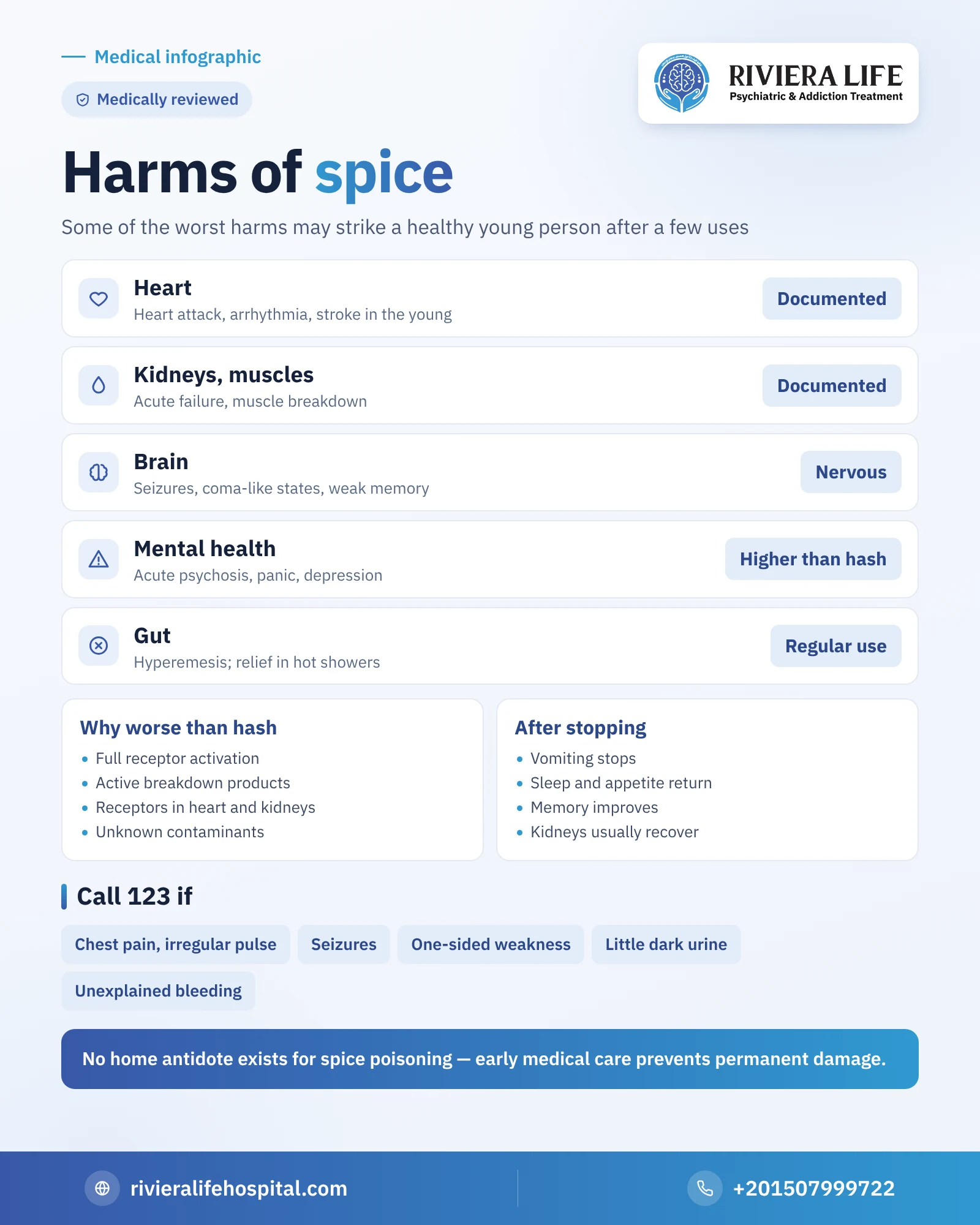
Harms of spice on the heart and blood vessels
The heart is among the most affected organs. Spice may raise the pulse and blood pressure sharply, and medical reports have documented cases of heart muscle infarction and serious rhythm disturbance in young people in their twenties with no medical history. Cases of stroke have also been recorded due to constriction of vessels or the formation of clots. The risk increases in those who mix spice with stimulants or suffer from high blood pressure or an undiscovered congenital heart defect.
Harms of spice on the kidneys and muscles
In 2012 the US Centers for Disease Control documented sixteen cases of acute kidney failure in several states in healthy young people, many of them linked to a new compound that appeared in the mixtures at the time. Some needed dialysis, and the kidneys recovered in this series, but doctors warned of possible long-term effects. Among the documented harms is also muscle breakdown, when severe agitation, seizures or high temperature cause muscle fibers to break down and release substances that strain the kidneys. The warning signs here: pain in the flank or back, reduced urine or its color changing to dark, and severe muscle pains.
Harms of spice on the brain and nervous system
- Seizures: among the most dangerous things that distinguish spice from hash, and they may happen in someone with no history of epilepsy.
- Loss of consciousness or a semi-coma state for hours, especially with the newer, very strong compounds.
- Weak short-term memory and concentration and slow thinking with regular use.
- Greater effect in teenagers, because the brain is still maturing.
Harms of spice on mental health
The psychological effect may be the most exhausting face for families. Spice is linked to episodes of acute psychosis with severe suspicion, hallucinations and disorganized behavior, which may last days after stopping. Studies indicate that the risk of psychosis with it is higher than with hash, especially in those with a family predisposition to psychotic illnesses. It is also linked to panic attacks, chronic anxiety and depression, and to suicidal thoughts in some users. In a few cases use reveals a latent psychotic disorder that needs long treatment.
Harms of the digestive system: the vomiting that doesn’t stop
Doctors know a pattern called “cannabinoid hyperemesis syndrome”, appearing in regular users as repeated episodes of severe nausea, vomiting and abdominal pain, in which the patient usually notices that bathing in hot water eases it. This syndrome is documented with spice too, and may cause severe dehydration that strains the kidneys. Its decisive treatment is stopping use, as it usually improves within days to weeks.
Harms of the lungs and other methods of use
Smoking exposes the lungs to solvents, burnt herbs and combustion products, and cases of pneumonia and shortness of breath have been recorded in some users. Electronic liquids containing these compounds give a concentrated dose that is hard to control, and have been linked to cases of acute poisoning. The most dangerous is what isn’t seen: in 2018 the US state of Illinois saw a wave of serious bleeding in users of mixtures contaminated with an anticoagulant of the type used in rodent poisons, with deaths.
Harms of spice on daily life
- Declining studies or losing work because of weak concentration and repeated absence.
- Constant tension at home because of mood swings and bouts of anger.
- Debts and small thefts to cover repeated smoking throughout the day.
- Legal problems, as spice compounds are banned in Egypt.
- Social isolation and distance from old friends.
These harms overlap with private life and the marital relationship, which we discuss separately in the article on spice and sex.
Mixing with other substances: multiplying the danger
Some users combine spice with alcohol, tramadol, pregabalin or sedatives, so suppression of consciousness comes together with the risk of seizures and vomiting, a mixture that may lead to choking. Mixing it with stimulants doubles the burden on the heart. The strox page covers the common mixing patterns in the Egyptian market.
Harms in teenagers
A teenager isn’t a small-sized adult. Their brain is still building the connections responsible for attention, controlling impulsivity and decision-making, and repeatedly exposing it to a substance that activates cannabis receptors this strongly may leave a longer effect on study, memory and mood. Teenagers are also more inclined to smoke large amounts in one session with friends, which raises the likelihood of acute poisoning.
Spice and alcohol: why does combining them multiply the danger?
Some young people think alcohol “softens” the effect of spice or prolongs it. In reality each suppresses the central nervous system in its own way, so drowsiness increases and responsiveness weakens, and the person loses the ability to judge their condition at the very time they need it.
This isn’t a theoretical warning, as emergency departments receive many cases combining the two substances. Among the dangers doctors notice in this mixture:
- Loss of consciousness or coma, and difficulty waking the person.
- Repeated vomiting with dehydration, and the risk of inhaling stomach contents into the lungs.
- Pulse and blood pressure disturbance, and extra strain on the heart.
- Seizures and more severe and longer psychotic episodes.
- Road accidents, falls and violence as a result of absent sound judgment.
And if combining them stays with a person for a long period, dependence on both substances together may develop, and stopping one alone becomes insufficient. To learn about the effect of alcohol alone you can read the harms of alcohol on the body and mind, and on the path of recovery see spice addiction treatment. Anyone using the mixture who loses consciousness or whose breathing becomes broken needs the ambulance on 123 immediately.
What improves after stopping?
The good news is that many of the harms recede with abstinence and treatment: vomiting usually disappears, sleep and appetite return gradually, concentration and memory improve within weeks to months, and the kidneys regain their function in most cases of acute injury if treated early. What may remain is the effect of clots or strokes if they happened, and some psychotic cases that need long psychiatric follow-up. That is why every month that passes without treatment raises the likelihood of damage that doesn’t return. The path of safe stopping is explained in the article on spice addiction treatment, and the accompanying symptoms in the article on spice withdrawal symptoms.
When are the harms of spice an emergency?
Call an ambulance on 123 immediately if there appear
There is no home antidote for spice poisoning, and early medical intervention prevents permanent complications.
- Chest pain or severe irregular palpitations
- Seizures or loss of consciousness
- Sudden weakness on one side of the body, or faltering speech
- Severe agitation or hallucinations with aggression or talk of self-harm
- Very high fever with heavy sweating and muscle stiffness
- Little or dark urine with flank pain
- Unexplained bleeding from the gums, nose or in the urine
At Riviera Life the consultants in psychiatry and addiction treatment assess what spice has left behind physically and psychologically, with heart and kidney tests when needed, before building a treatment plan that suits the case.
More from the spice guide
- Spice: the complete guide
- Spice addiction symptoms
- Causes of spice addiction
- Spice addiction treatment
- The joker drug: what it is, its harms, emergency signs and treatment
Questions many people ask
Yes, medical reports have documented cases of heart attack, stroke and rhythm disturbance in healthy young people after using spice, although they don't happen to every user.
It may cause acute kidney failure, either through the direct effect of some compounds or because of dehydration and muscle breakdown. Reduced urine and flank pain are two signs that call for immediate examination.
Most go away within hours or days after stopping, but some cases develop into persistent psychosis that needs psychiatric treatment, especially with a family predisposition.
It may be cannabinoid hyperemesis syndrome, which appears with regular use and usually improves after stopping use within days to weeks.
In most cases memory and concentration improve gradually within weeks to months of abstinence, and treatment and regular sleep speed up this improvement.