The harms of “chemical” range from an episode of agitation or psychosis that may start from the first cigarette, to heart strain and the possibility of seizures and acute kidney failure, then a decline in memory, mood and daily life with continued use. What makes these harms harder to predict is that the substance inside the bag is unknown, so a person may have an “ordinary” experience ten times and then end up in the emergency department on the eleventh. This article sets out what “chemical” does to the brain, the heart and the rest of the body, and when the situation becomes an emergency that can’t be postponed.
Why do the harms of “chemical” come as a surprise?
With known medicines, the doctor knows the relationship between amount and effect. With “chemical” this relationship is completely cut, for two reasons: the compound itself changes from one batch to another, and its distribution on the herbs is uneven. A third reason is added: many of these compounds activate cannabis receptors fully and strongly, unlike natural cannabis, so the response is more violent. This trio explains why emergency doctors see severe symptoms from an amount the patient describes as “small”.
Short-term harms within hours of use
- A rapid heartbeat and high blood pressure.
- Nausea and vomiting, and dizziness and imbalance that may cause falls and injuries.
- Acute anxiety, panic attacks and a feeling that death is near.
- Confusion, hallucinations and agitation that may lead to behavior dangerous to oneself or others.
- Deep drowsiness or loss of consciousness in some cases.
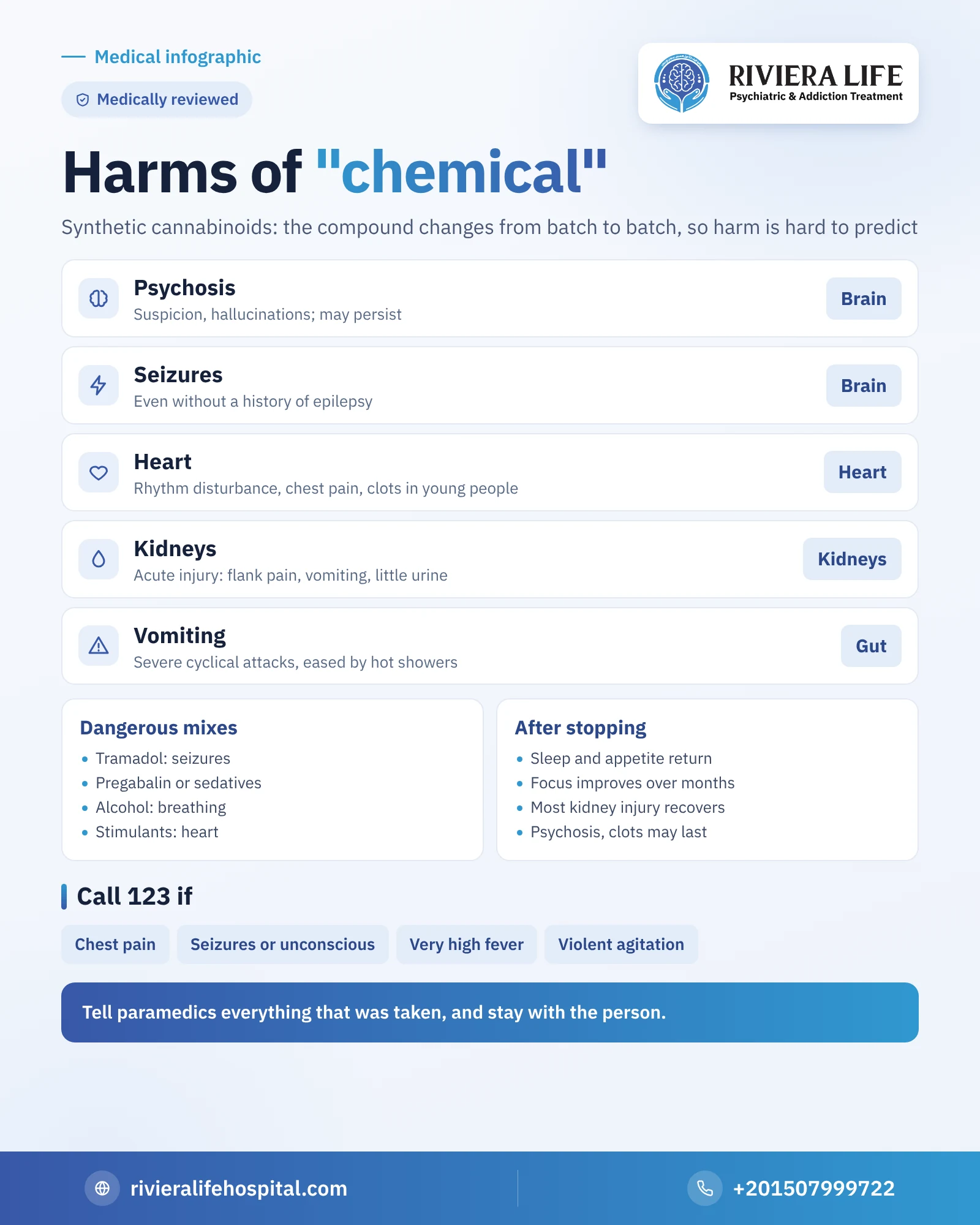
Harms of “chemical” on the brain and mental health
Psychosis
Among the most dangerous things linked to synthetic cannabinoids are psychotic episodes: suspicion and persecution, auditory and visual hallucinations, and unrealistic ideas. They may pass within hours, but in some people they continue for days or weeks, and may reveal a latent predisposition to a chronic psychotic disorder, especially in those with a family history of these disorders.
Seizures
Medical reports record seizures in users of synthetic cannabinoids even without a previous history of epilepsy, something rare with natural cannabis. A seizure may cause injuries and choking, and always needs assessment in hospital.
Memory and mood
With continued use, users complain of weak concentration and short-term memory, apathy and loss of motivation, mood swings, and chronic depression and anxiety. Much of this improves after stopping, but to varying degrees.
Thoughts of self-harm
The depression that accompanies chronic use or appears after stopping may carry thoughts of self-harm in some people, especially with the impulsiveness the substance causes. Any talk of this kind is taken seriously and calls for a psychiatric assessment the same day, not waiting for it to “calm down by itself”.
Harms of “chemical” on the heart and blood vessels
The heart is among the most affected organs. The racing and high blood pressure may develop in some cases into a heart rhythm disturbance, or reduced blood supply to the heart muscle appearing as chest pain, and cases of heart attacks and strokes have been recorded in young people after using these substances. The risk increases with undiscovered heart disease, or with mixing “chemical” with stimulants.
Harms of “chemical” on the kidneys
In medical reports, synthetic cannabinoids have been linked to acute kidney injury in healthy people, appearing as flank pain, vomiting and reduced urine. Factors such as dehydration from repeated vomiting, and muscle breakdown during severe agitation or seizures, contribute to this. The good news is that many of these cases improve with early treatment, but delay may require temporary dialysis. And because kidney injury may begin with mild symptoms the patient thinks are “ordinary tiredness” after a late night, persistent vomiting with back or flank pain after use is reason enough to check kidney function.
Repeated vomiting and the digestive system
Some regular users suffer attacks of severe, repeated vomiting with abdominal pain, recurring every few weeks, and the patient sometimes notices that a hot shower eases them temporarily. This picture is known with cannabis of all types and may be more severe with synthetic forms; it leads to dehydration and salt imbalance if untreated, and usually only stops when use stops.
Harms to the lungs, body temperature and muscles
Smoking leaves sprayed with solvents and unknown substances irritates the airways and causes coughing and shortness of breath. And if the bag contains a manufactured stimulant, the risks of severe overheating and muscle breakdown are added, conditions that may affect the kidneys and heart together and need hospital treatment.
Harms of mixing with other substances
Combining “chemical” with tramadol raises the risk of seizures, combining it with pregabalin, sedatives or alcohol may deepen loss of consciousness and depress breathing, and combining it with stimulants doubles the burden on the heart. The more substances there are, the more complex treatment becomes. You can review the harms of tramadol if it is part of the pattern of use.
The unknown substance adds another layer of risk: the doctor treating a mixed poisoning doesn’t know precisely which substance is responsible for each symptom, so treats the most dangerous symptoms first and monitors the rest. So telling them everything the patient took isn’t a minor detail; it may change their decisions in the first hours, such as the choice of calming medicines, the length of observation or the need for intensive care.
Harms of “chemical” on teenagers
A teenager’s brain is still building the circuits responsible for judgment and emotional control. Repeated exposure to strong substances at this stage is linked to a clear academic decline, more psychotic episodes, and a greater likelihood of continuing use at a later age. So early intervention with a teenager isn’t an exaggeration but real prevention. A teenager is also less able to recognize danger signs in their body, and more inclined to hide what happened for fear of punishment, so they reach the emergency department late. A clear message from parents that asking for help in danger won’t be met with punishment may save their life one day.
Social and legal harms
What the user loses isn’t limited to their health. Absence from study and work, small accumulating debts, repeated clashes at home, and the risk of legal accountability because these substances are listed in the drug schedules in Egypt. The family bears a large part of this burden, so understanding the causes of “chemical” addiction helps it cope without collapsing too.
Do the harms of “chemical” disappear after stopping?
Many harms improve with stopping and treatment: sleep and appetite return, concentration and mood improve gradually over months, and the kidneys recover in most cases of acute injury if treated early. But chronic psychosis, or complications of clots and heart attacks, may leave a permanent mark. This is what makes stopping early, with a clear plan as in our article on “chemical” addiction treatment, more important than any later treatment of complications.
When does the situation become an emergency?
Call an ambulance on 123 immediately if you see
- Chest pain, severe palpitations or shortness of breath
- Seizures or loss of consciousness
- A very high temperature with confusion or heavy sweating
- Violent agitation or psychosis in which the person loses the sense of danger
- Vomiting that won’t stop or very little urine
- Sudden weakness on one side of the body or slurred speech
Tell the paramedics everything you know about the substance and what was taken with it, don’t give the person any medicine or drink to wake them, and stay with them until the ambulance arrives.
More from our “chemical” guide
- “Chemical”: the complete guide
- “Chemical” addiction symptoms
- How long “chemical” stays in the body
- “Chemical” addiction treatment
- Glue and inhalant addiction treatment: medical examination, psychotherapy and the family
Questions many people ask
Cases of heart attacks and strokes have been recorded in young people after using synthetic cannabinoids, and the risk increases with undiscovered heart disease or mixing with stimulants.
Yes, synthetic cannabinoids have been linked to acute kidney injury, appearing as flank pain, vomiting and reduced urine, and it usually improves if treated early.
It may cause psychotic episodes that pass in many people, but persist in some or reveal a latent psychotic disorder, especially with a family history.
Sleep, concentration and mood improve gradually over months, and most acute kidney injuries recover, but complications of clots and chronic psychosis may remain.
Regular cannabinoid use may cause severe cyclical vomiting attacks with abdominal pain, which usually only stop when use stops.