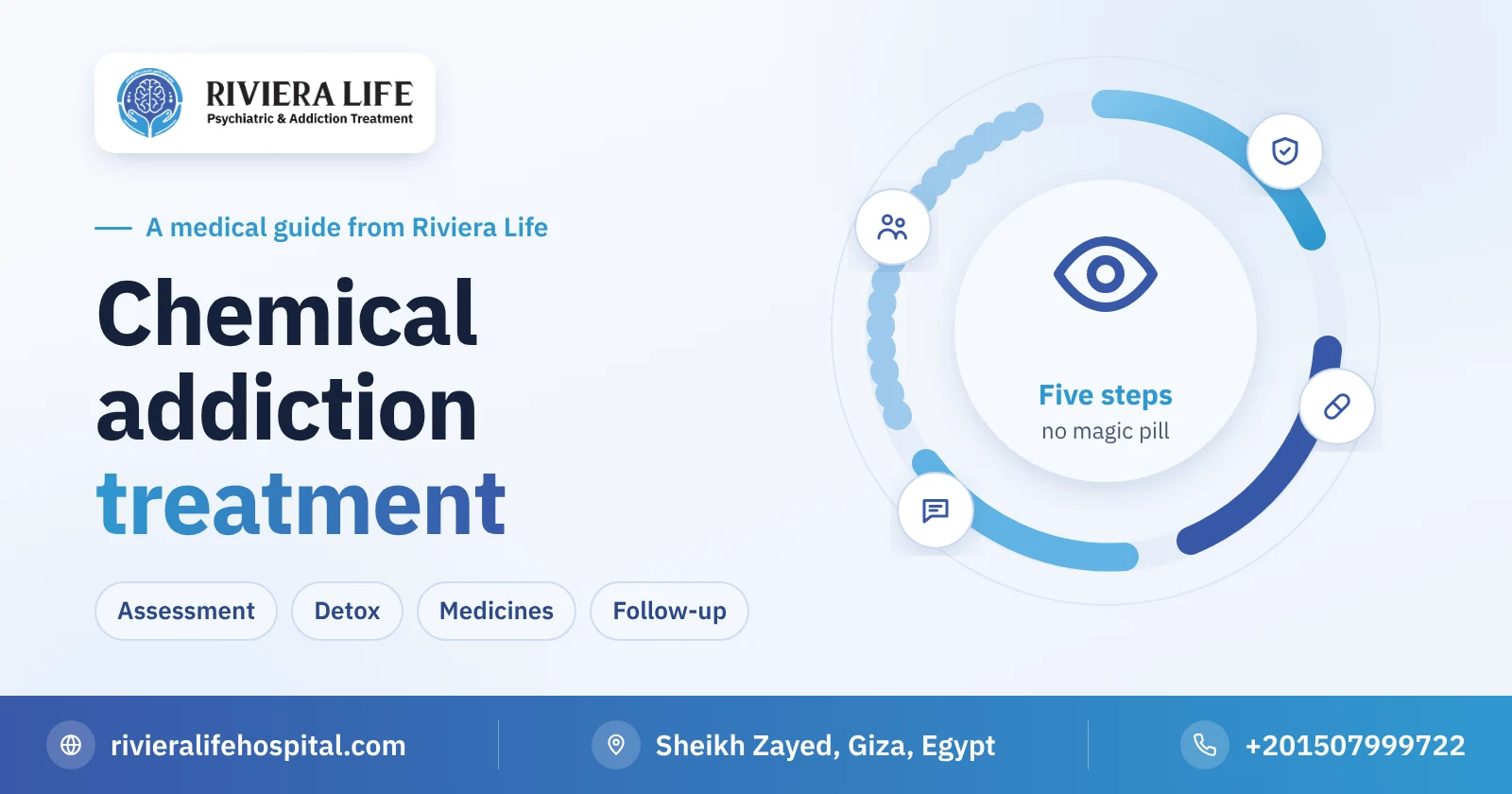
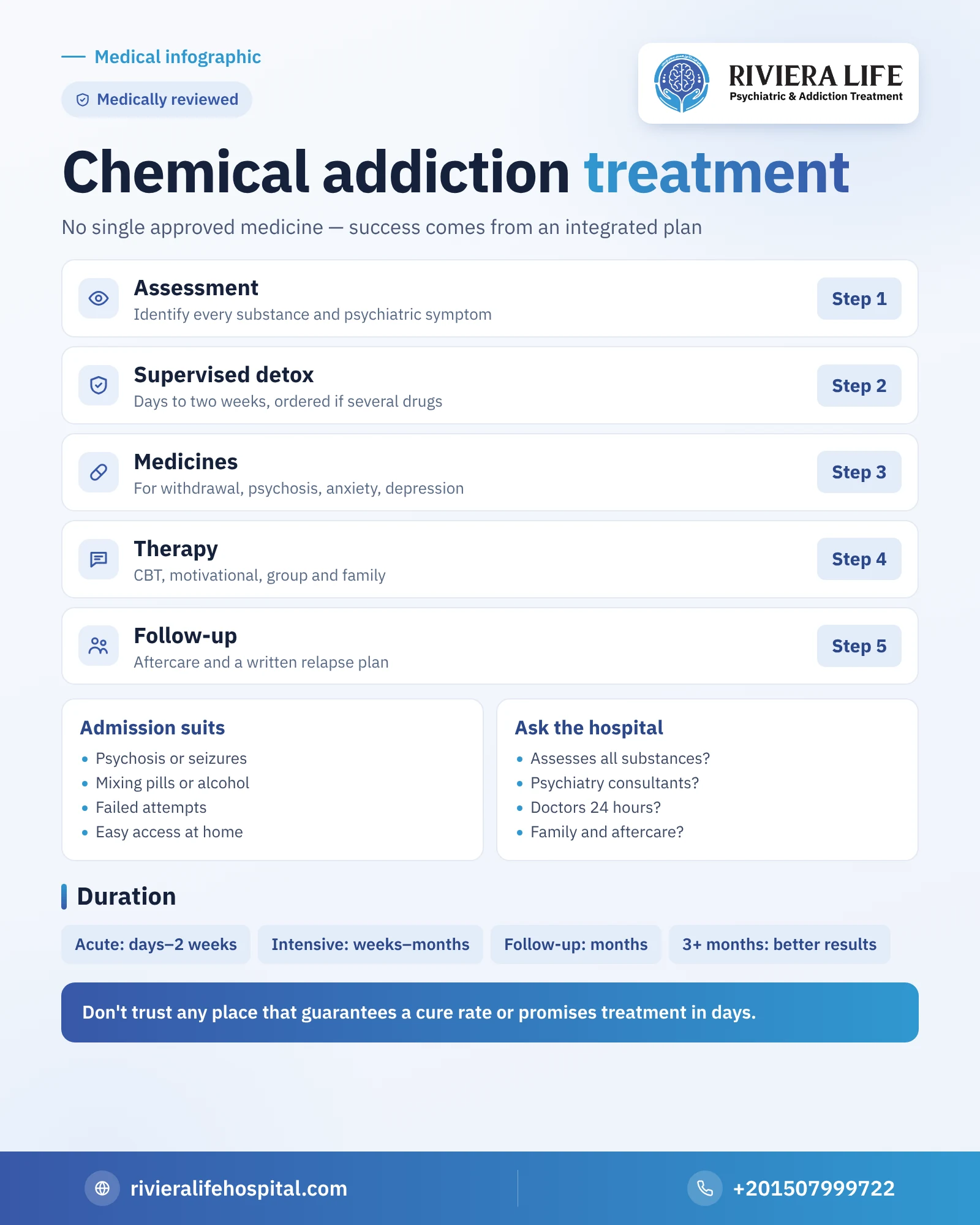
Chemical addiction treatment is possible, and it usually goes through five steps: an assessment that identifies what the patient actually used and the psychological symptoms that accompany it, then withdrawal of the substances under medical supervision, then medicines to treat the symptoms and accompanying disorders, then psychological and behavioral therapy, then extended follow-up to prevent relapse. There is no single approved medicine that treats synthetic cannabinoid addiction, so success depends on an integrated plan, not a magic pill. The intensive stage usually takes weeks, while follow-up extends for months. This article explains each step, and how to choose the right place.
What we explain here also applies to treating addiction to the drug under the other spellings used in some countries, as they are different names for the same drug.
Step one: knowing what the doctor is dealing with
In most types of addiction the doctor knows the substance from its name. With chemical, however, the name isn’t enough. That is why a good assessment begins with detailed questions: what trade name the patient bought, how many times a day they use, what pills or drinks they combine with it, and whether they have had episodes of psychosis, seizures or fainting. The doctor uses specialized laboratory tests when needed, and checks of the heart, kidneys and salts. The aim is to draw a realistic picture of the case, because the plan for someone who smokes chemical alone is completely different from the plan for someone who combines it with tramadol and pregabalin.
The stages of chemical addiction treatment
- A comprehensive medical and psychological assessment, identifying all the substances used.
- Safe withdrawal of the substances under medical supervision, in a considered order if there are several substances.
- Medication for the symptoms and accompanying psychiatric disorders.
- Psychological and behavioral therapy dealing with the causes and triggers of use.
- Follow-up, aftercare and a written relapse-prevention plan.
Supervised withdrawal of the substances
The acute stage of withdrawal usually takes days to about two weeks. During it the team follows sleep, pulse, blood pressure and fluids, and intervenes early when agitation, psychotic symptoms or a heart disturbance appear. If the patient uses other substances, their withdrawal is arranged so that symptoms don’t pile up at the same time. You will find the details and timing of the symptoms in the article on chemical withdrawal symptoms.
The medicines used in chemical addiction treatment
There is still no medicine approved specifically for treating synthetic cannabinoid addiction, as international references confirm. That is why the doctor uses medicines for specific aims:
Medicines to ease withdrawal symptoms
Medicines that help sleep and calm anxiety and nervousness, and others for nausea and headache, which the doctor chooses for a short period, monitors their effect and stops gradually.
Medicines for psychotic symptoms
If hallucinations or persecutory thoughts appear, the psychiatrist prescribes an antipsychotic at a suitable dose and for a period determined by how the case develops. Some patients need it for days, and some longer if an underlying psychotic disorder turns out to be present.
Treating accompanying disorders
Depression, anxiety and attention deficit hyperactivity disorder need targeted treatment, because leaving them untreated is among the strongest causes of returning.
All these decisions are individual medical ones, and none of them should be tried at home without supervision. If the patient also uses an opioid such as tramadol, they may need a medication plan specific to it, as the article on tramadol addiction treatment explains.
Psychological and behavioral therapy
- Cognitive behavioral therapy: in it the patient learns to recognize the situations and thoughts that lead them to smoke, and to build practical alternatives.
- Motivational interviewing: strengthens the patient’s inner wish to change, and is particularly useful with hesitant young people.
- Contingency management: tangible rewards for commitment and for negative tests, which has proven useful with different types of addiction.
- Group therapy: breaks the patient’s feeling that they are alone, and teaches them from others’ experiences.
- Family therapy: rearranges relationships inside the home so they become a support for recovery.
How long does chemical addiction treatment take?
Acute withdrawal takes days to two weeks, the intensive program may extend from several weeks to a few months depending on the case, and outpatient follow-up usually continues for months afterwards. International principles of addiction treatment indicate that staying in treatment for a sufficient period, often estimated at at least three months, is linked to better results. Beware of any program that promises to finish the matter in days.
Inpatient or outpatient treatment?
Inpatient admission is most suitable for someone who has had an episode of psychosis or seizures, combines chemical with pills or alcohol, whose previous attempts have failed, or who lives in an environment where the substance is easy to reach. Outpatient treatment suits milder cases or the stage after admission. The ideal path is often to start with admission and then move gradually to follow-up.
The decision also takes into account the patient’s age and the circumstances of their study or work. A teenager, for example, needs a program in which the parents take a strong part and which cares about their return to study, while an employee needs a plan that protects their privacy and allows them a gradual return to work without losing what they have built.
The family’s role in treatment
The family needs to understand that chemical isn’t “a phase that will pass”, and to learn how to set clear limits without cutting off, and how to act if they notice a slip. That is why the family takes part in sessions dedicated to them within the program. Understanding the causes of chemical addiction helps them deal with the roots of the problem, not just its appearances.
Preventing relapse after treatment
The first months after discharge are the most sensitive. What protects the patient in them: keeping follow-up appointments and prescribed medicines, staying away from friends and places linked to use, a daily routine with regular sleep, activity and work or study, and a written plan for what to do when the urge comes. Most importantly, the patient should know that a new packet may contain a stronger substance than they are used to, and that their body has lost part of its tolerance, so a slip becomes more dangerous than the old use.
The right hospital for chemical addiction treatment: how to choose
The right hospital for chemical addiction treatment is the one that offers what this patient specifically needs: the ability to deal with a substance of unknown composition, strong psychiatry for psychosis and anxiety, and experience with cases where chemical is mixed with other substances. Ask before you decide:
- Does treatment start with an assessment that asks about all the substances used, not chemical alone?
- Is the case handled by consultant psychiatrists able to follow psychotic symptoms?
- Are there doctors on duty all day to control agitation, seizures or heart disturbance?
- Does the place have a clear plan for withdrawing accompanying substances in a safe order?
- Does the program include the family and provide aftercare after discharge?
- Does it respect the confidentiality of the patient and their family’s data?
And don’t trust any place that guarantees a cure rate or promises treatment within days.
How Riviera Life meets these standards
These criteria are what Riviera Life provides, and their details are as follows:
- Official accreditation: the hospital holds a Ministry of Health license in psychiatry and addiction treatment.
- Long experience: fourteen years in which we have treated addiction, and thousands of patients have recovered at the hands of our team.
- An assessment that starts from the unknown: consultants in psychiatry and addiction treatment identify everything the patient used before setting the plan.
- Round-the-clock care: 24-hour medical supervision during withdrawal to intervene as soon as any complication appears.
- Treating multiple substances: ordered plans for those who combine chemical with tramadol, pregabalin or others.
- Complete confidentiality: the privacy of the patient and their family is protected at every stage.
- Family and care after discharge: meetings for the family, and follow-up after admission that reduces the chances of returning to chemical.
The first consultation with us is free, and our number +201507999722 is available to you at any time; the hospital is located in Sheikh Zayed, Giza. If you want to know more about the substance itself, see the page on the drug chemical.
More from the chemical guide
- Chemical: the complete guide
- Chemical withdrawal symptoms
- The harms of chemical
- How long chemical stays in the body
- Glue and inhalant addiction treatment: medical examination, psychological therapy and the family
Questions many people ask
There is no medicine approved specifically for this yet, but medicines are used to treat withdrawal symptoms, psychosis, anxiety and depression within an integrated plan.
Acute withdrawal takes days to two weeks, the intensive program weeks to months, then outpatient follow-up for months. Staying at least three months is linked to better results.
It is preferable with episodes of psychosis or seizures, mixing with other substances, or failed previous attempts. Milder cases may be treated as outpatients after assessment.
Yes, many recover with organized treatment and follow-up. Relapse is possible, but it means adjusting the plan, not that it failed.
Look for an assessment of every substance used, consultant psychiatrists for psychosis, round-the-clock doctors, a safe plan for other substances, a family program and aftercare. Riviera Life in Sheikh Zayed, licensed by the Ministry of Health with fourteen years of experience, meets these criteria.