“Chemical” isn’t the name of a single drug, but a street word used in Egypt and some Gulf countries for a whole group of lab-made substances, the best known being herbal mixes sprayed with chemicals such as strox, voodoo, shadow and spice. The real problem starts here: whoever buys “chemical” doesn’t know which compound is in the bag, its concentration, or what has been added to it.
Some write it “kemikal”, “kamkal” or “kemekl”, especially in the Gulf, and in every case what is meant is the same group of synthetic substances we explain here.
This very vagueness is what makes poisoning with it sudden, and makes the emergency doctor’s task harder. This page explains what the word actually means, and why it matters for the family to understand that it is a general name, then leads you to a separate article for each aspect: symptoms, withdrawal, testing, harms, causes and treatment.
What is “chemical”?
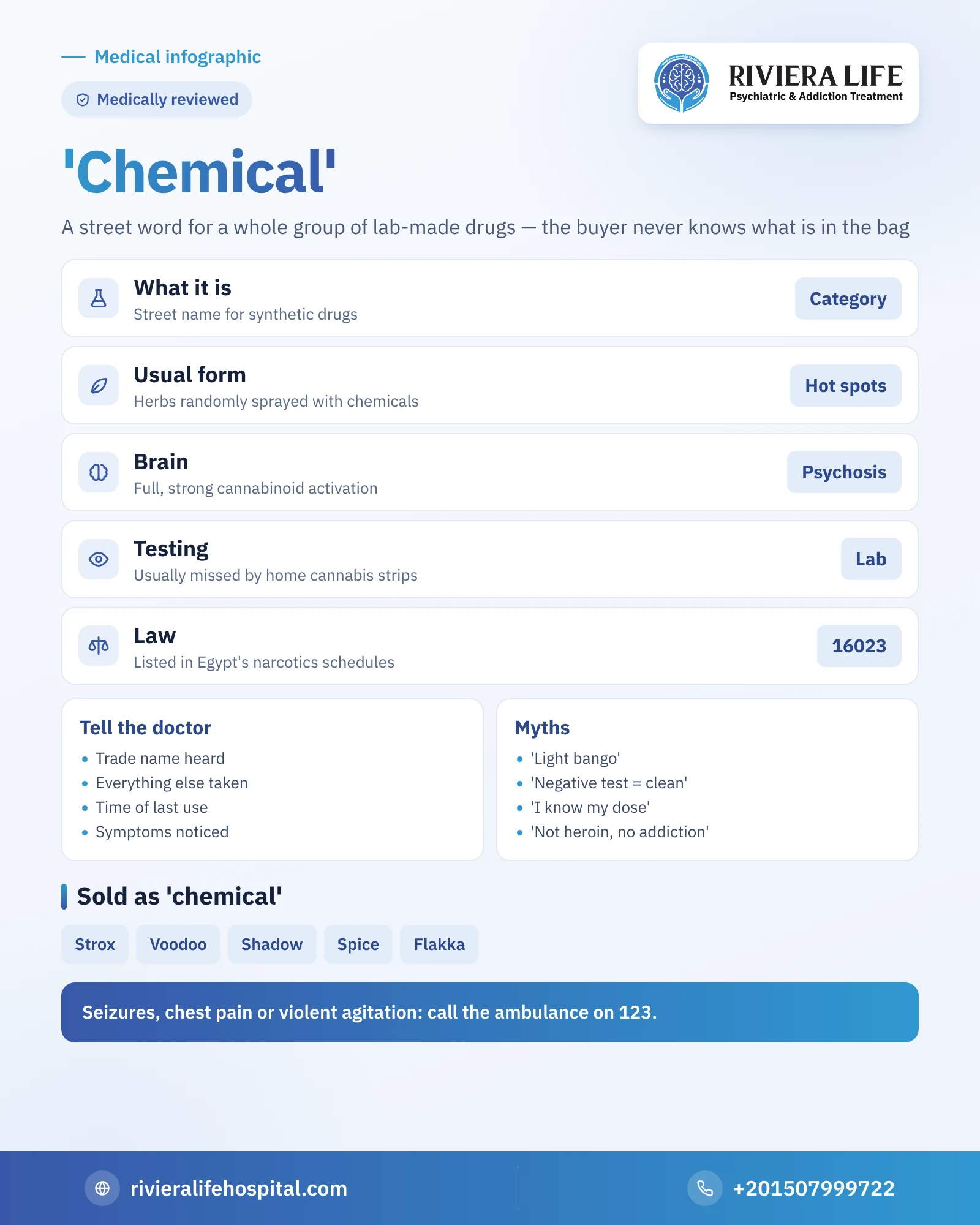
In street language the word “chemical” means any drug that is made chemically and doesn’t come from a natural plant, as opposed to hashish and bango, which users consider “natural”. The most common use of the word concerns dry plant leaves that have no value in themselves, sprayed with a synthetic substance then rolled and smoked. The entire effect comes from the sprayed substance, while the herb is merely a means of carrying it.
The sprayed substance in most cases belongs to a group doctors call “synthetic cannabinoid receptor agonists” (Synthetic Cannabinoids), compounds designed to mimic the effect of the active substance in cannabis, but which bind to the same receptors much more strongly. In other cases the same name is used loosely to describe synthetic stimulants from the cathinone family such as flakka, or mixes whose components even their seller doesn’t know precisely. That is why it is right to say that “chemical” is a “category” set by the market, not a substance defined by science.
Why does it matter that the name is general and not a specific substance?
When a family tells the doctor “our son smokes chemical”, it gives useful but incomplete information. The word tells the doctor that the substance is most likely synthetic and powerful in effect, but doesn’t tell them whether it is synthetic cannabinoids that cause agitation and seizures, a stimulant that raises the temperature and strains the heart, or a mix of the two. This changes the way follow-up is done in the emergency room, the type of test required, and what is expected during withdrawal.
That is why we advise families of three things: to tell the doctor the trade name they have heard if there is one (strox, voodoo, shadow, spice), to mention everything the person takes with it in pills or alcohol, and to bring the packet or part of it if that is possible without putting anyone at risk, not to test it at home, but so the medical team knows what it is dealing with.
Names of “chemical” circulating in Egypt
Trade names change quickly, and a single name often carries different compositions from one batch to another. The most heard under the umbrella of “chemical”:
- Strox: the best-known sprayed mix in Egypt and the most widespread among young people.
- Voodoo: another trade name for a sprayed herb, marketed as stronger or “different”.
- Shadow: a mix from the same family, whose content changes according to the source.
- Spice: the oldest international name for these mixes, from which the idea spread.
- Flakka: a synthetic stimulant from a different family, sometimes included under the word “chemical” because it is also “lab-made”.
New trade names appear every so often, some of them just different packaging for the same substance, and some a completely new composition under an old name. That is why no name can be relied on to know the actual substance.
Forms of “chemical” and ways of using it
The most common form is chopped dry herbs resembling bango or tea leaves, sold in small bags, sometimes with added colors or scents. It is rolled into cigarettes or mixed with tobacco. Liquids used in e-cigarettes also appear, as do white or crystalline powders in the case of synthetic stimulants, and paper sheets soaked in the substance. Smoking remains the best-known route, and it is also the fastest to reach the brain.
The most dangerous thing about the manufacturing method is that the spraying is done by hand and at random. One leaf in the bag may contain double the concentration of its neighbor, so the person takes “the usual cigarette” and gets a dose they didn’t expect. This explains repeated stories of young people who smoked the same amount they were used to and then ended up in the emergency room.
What does “chemical” do in the brain and body?
Natural cannabis activates the cannabinoid receptors in the brain partially. Many synthetic cannabinoids, however, activate these receptors fully and with far greater strength, without containing the other substances present in the plant that may soften some of its effects. The result is a more violent and less predictable effect:
- Dizziness, detachment from the surroundings and slowed speech and movement, sometimes followed by sudden agitation.
- Acute anxiety, panic attacks and a feeling of danger or persecution.
- Hallucinations and strange thoughts that may reach outright psychosis continuing after the substance has worn off.
- A racing heartbeat and raised blood pressure, and chest pain in some cases.
- Nausea and repeated vomiting, and seizures in severe cases.
And if the substance is a synthetic stimulant, a different picture is added: excessive wakefulness, heavy sweating, a rise in temperature and aggressive behavior. Mixing the two types in one bag isn’t rare, so the risks come together.
Does “chemical” have any medical use?
No. There is no approved medical use for the compounds sold under the name “chemical”. It is true that some of them were originally developed in research labs to study the body’s cannabinoid system, but they haven’t been approved as a treatment for any disease, and haven’t been tested on humans the way medicines are tested. This alone means that no one knows the “safe” dose of them, because it simply doesn’t exist.
Why is “chemical” dangerous?
The danger of “chemical” comes from vagueness more than from a particular substance:
- Unknown composition: the compound changes from batch to batch, and what the person tried last month isn’t what they are smoking today.
- Uneven concentration: random spraying creates “hot spots” that may cause poisoning from a single cigarette.
- Greater strength than natural cannabis: full binding to the receptors explains the severity of the agitation, psychosis and seizures.
- Tests that don’t detect it: the usual bango test strip usually doesn’t pick it up, so discovery of the problem is delayed.
- Common mixing: many users combine it with tramadol, pregabalin or alcohol, so the risks multiply.
- A low price: its cheapness puts it within reach of teenagers, who are the most affected, with a brain that is still developing.
“Chemical” within the family of synthetic drugs
Most of what is sold as “chemical” belongs to what international bodies call “new psychoactive substances”, substances designed to mimic known drugs with a slight modification to their chemical structure. The two largest groups in it are synthetic cannabinoids, which include strox, voodoo, shadow and spice, and synthetic cathinones, including flakka. The first is closer in idea to bango but much more violent, and the second is closer to stimulants. Each trade name can be looked up on its own page if the family knows the substance precisely.
“Chemical” and the law in Egypt
In recent years the Egyptian authorities have listed a number of synthetic cannabinoids and other synthetic substances in the narcotics schedules, so possessing, circulating and using them is treated as dealing with drugs and is subject to the penalties of the anti-narcotics law. At the same time, the law allows a user who comes forward on their own seeking treatment to be treated without a criminal case being brought against them. This matters to families who hesitate out of fear of the consequences. For specific legal inquiries it is preferable to consult a lawyer, and the Fund for Drug Control and Treatment of Addiction also provides a free, confidential hotline on 16023.
The “chemical” guide: each aspect in a separate article
Every common question about “chemical” has its own article explaining it at length; choose the ones that concern your situation:
- Chemical addiction symptoms: what the family sees in behavior, body and mood, and when use becomes addiction.
- Chemical withdrawal symptoms: what happens after the last cigarette, the timeline of symptoms, and when a doctor is needed.
- How long chemical stays in the body: why the usual test comes back negative, and which test actually detects it.
- The harms of chemical: what it does to the brain, heart and kidneys, and when the case becomes an emergency.
- Causes of chemical addiction: why young people start with it, and why use is repeated despite bad experiences.
- Chemical addiction treatment: the steps of treatment, supporting medicines, duration and follow-up, and how to choose a hospital.
Common myths about “chemical”
The myth: “chemical” is a light type of bango. The truth is that the similar look is deceptive, as the sprayed substance may be far stronger than natural cannabis, and its complications such as seizures and acute kidney failure aren’t usually linked to bango.
The myth: as long as the test is negative, there is no use. The truth is that the common test is designed to detect the natural cannabis substance, and usually doesn’t recognize synthetic compounds.
The myth: someone who has tried a type and knows its effect can control the dose. The truth is that the changing composition and concentration make every bag a new experiment, even if it carries the same name.
The myth: there is no addiction to “chemical” because it isn’t heroin. The truth is that regular use causes tolerance, dependence and clear withdrawal symptoms, and the patient may need medical supervision to stop.
Where does the family start?
If you find a bag of strange-smelling herbs, or notice unexplained episodes of spacing out or agitation, don’t wait for the result of a home test strip to be sure. Write down what you have seen and its dates, and talk with the person when they are fully conscious in a tone of worry, not accusation. Don’t try to identify the type of substance yourself, try it or sniff it closely. And ask for a specialized consultation even before the person agrees, as the family having a clear plan changes the whole conversation. And if you want a picture of the early signs, see the article on chemical addiction symptoms.
Signs of “chemical” poisoning
Call the ambulance on 123 immediately if any of these appear
Poisoning with 'chemical' may develop within minutes, and because the substance is unknown its course can't be predicted.
- Seizures, loss of consciousness or difficulty bringing them round
- Chest pain or severe irregular palpitations
- A very high temperature with heavy sweating or hot dry skin
- Violent agitation or hallucinations in which they lose their sense of place and danger
- Repeated vomiting that doesn’t stop, or abnormally slow breathing
Until the ambulance arrives, move sharp objects away, speak calmly, and don’t restrain them by force unless they are putting themselves or others in danger. If they lose consciousness while breathing, put them on their side. Don’t give them food, drink or any medicine. And tell the paramedics that they used “chemical”, along with any trade name you heard and any other substances, as this information saves precious time.
When should you ask for help?
It is enough for use to be repeated, or for a single episode of psychosis or severe agitation to appear, for the case to deserve a psychiatric medical assessment. At Riviera Life, the hospital licensed by the Ministry of Health with fourteen years of experience in psychiatry and addiction treatment, the consultants assess the case in complete confidentiality, and put in place a plan that deals with the unknown substance and with the psychiatric symptoms that accompany it. The first consultation is free, and you can get in touch around the clock on +201507999722.
Medical sources and referencesThe information in this article is based on reliable scientific sources
1NIDA — Synthetic cannabinoids: what they are and their risksnida.nih.gov2NIDA — Synthetic cathinones (bath salts)nida.nih.gov3EUDA — Scientific profile of synthetic cannabinoidseuda.europa.eu4StatPearls — Natural and synthetic cannabinoid toxicityncbi.nlm.nih.gov5MedlinePlus — Drug use and addictionmedlineplus.gov